
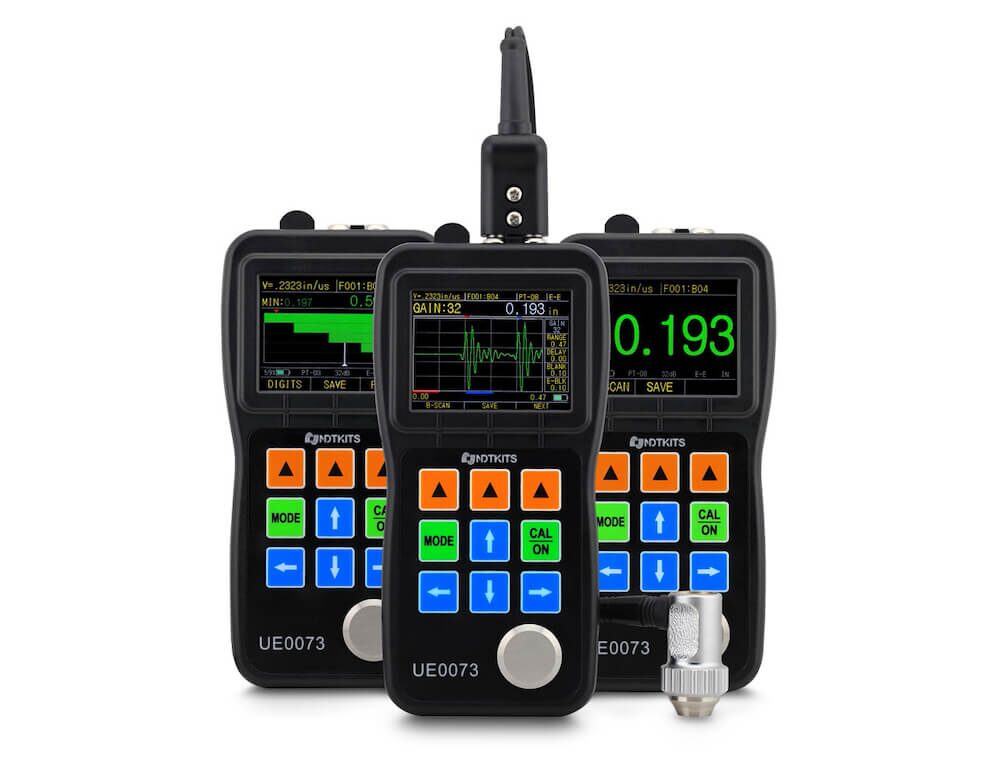
Whether you’re inspecting a metal pipe, checking a coated surface, or verifying production quality, you need a reliable thickness measurement device that matches your material and environment.
But not all devices work the same way. Ultrasonic, laser, and eddy current gauges use different principles. Each has its own strengths, and each is built for a specific type of job.
In this article, you’ll see how these three technologies compare. You’ll learn when to use them, what to avoid, and how to make the right choice based on real industrial needs.
Measuring from One Side: How Ultrasonic Gauges Work
When you need to check the wall thickness of a material without cutting or dismantling it, ultrasonic technology gives you an efficient solution. These gauges send high-frequency sound waves into the material. The signal bounces back from the far surface, and the device calculates thickness based on the time it takes for the echo to return.
One key advantage: you only need access to one side. That’s why ultrasonic gauges are widely used for pipes, tanks, and structural parts—especially when internal access is impossible.
As a thickness measurement device, an ultrasonic gauge offers several practical benefits:
- Works through paint and coatings without surface removal
- Suitable for metals, plastics, and composites
- Non-destructive and portable for field inspections
- Accurate enough for corrosion monitoring and weld checks
Just keep in mind:
- You’ll need a couplant (usually gel or oil) to transmit sound between the probe and the surface
- Readings can be affected by rough surfaces, heavy rust, or material layering
Ultrasonic gauges strike a balance between accessibility and precision, making them one of the most versatile options in thickness inspection.
Fast and Contact-Free: Where Laser Gauges Excel
If you’re working with flat, fast-moving materials like sheet metal, film, or paper, contact methods won’t keep up. That’s where laser thickness gauges come in. These devices use laser displacement sensors to measure the distance from the sensor to the material’s surface, typically from both sides. The system then calculates total thickness in real time.
Laser gauges are completely non-contact, which means you won’t wear down probes or disrupt the production line. They’re built for speed, precision, and full automation.
Here’s why manufacturers choose laser systems:
- Ideal for inline measurement on high-speed lines
- Delivers micron-level precision
- Easily integrates with automated quality control systems
- Suitable for continuous materials like foil, plastic film, glass, and rolled steel
However, this method isn’t always the right fit:
- Most setups require access to both sides of the material
- Not suitable for multilayer or opaque surfaces where light can’t penetrate
- Surface finish and reflectivity can impact accuracy
When used in the right context, a laser-based thickness measurement device gives you consistent, high-resolution data, without slowing anything down.
Specialized for Coatings: How Eddy Current Gauges Work
When you’re dealing with coated metal parts—like painted panels, anodized aluminum, or galvanized steel—measuring the coating thickness without damaging the surface is essential. Eddy current gauges are built for exactly that.
These devices use electromagnetic induction. A probe generates a changing magnetic field that creates eddy currents in the conductive base material. The way those currents respond helps the gauge calculate the thickness of the non-conductive coating above.
This type of thickness measurement device offers several key advantages:
- Non-contact and fast, ideal for delicate or finished surfaces
- Works on non-magnetic coatings over metallic substrates
- Sensitive enough to measure very thin layers, down to a few microns
Common applications include:
- Automotive body parts and protective coatings
- Aerospace components with surface treatments
- Powder coatings, paints, and electroplated finishes
Keep in mind:
- It only works on conductive base materials
- It’s not suitable for measuring full material thickness
- Surface geometry and material type can influence accuracy
For coating inspection in manufacturing or QA settings, eddy current gauges give you speed, precision, and repeatability—without compromising the surface you’re testing.
Which Method Fits Your Job Best?
Now that you’ve seen how ultrasonic, laser, and eddy current gauges work, how do you choose the right one? It depends on what you’re measuring, your working conditions, and how precise you need to be.
Here’s a side-by-side comparison to help clarify the differences:
|
Feature / Factor |
Ultrasonic Gauge |
Laser Gauge |
Eddy Current Gauge |
|
Contact method |
Contact (with couplant) |
Non-contact |
Non-contact |
|
Access required |
One-side access |
Usually both sides |
One-side access |
|
Material types |
Metals, plastics, and composites |
Sheets, films, glass, flat metals |
Conductive base with non-metal coating |
|
Best for |
Internal wall thickness |
Inline thickness control |
Coating thickness |
|
Precision |
0.01–0.1 mm |
Micron-level |
Micron-level |
|
Limitations |
Needs couplant; rough surfaces may interfere |
Needs a clean surface; not for multilayers |
Only works on metals; not for total thickness |
If you’re inspecting corrosion in pipelines, ultrasonics is your go-to. For high-speed production lines, laser systems offer speed and accuracy. And when surface coating thickness is what matters most, eddy current is the most efficient choice.
Each thickness measurement device has its place, but using the wrong one can lead to misleading results or wasted effort. That’s why knowing your use case is essential.
How to Choose the Right Thickness Measurement Device for Your Application
Before choosing a gauge, ask yourself a few key questions. Your answers will point you toward the right solution:
- Are you measuring total material thickness or just the coating?
- Is the base material conductive, transparent, or multilayered?
- Will the inspection happen in a lab, on a moving production line, or in the field?
- Do you need continuous monitoring or just periodic spot checks?
Here’s a quick way to narrow it down:
- Use ultrasonic gauges when you’re inspecting wall thickness in metals, plastics, or composites—especially when only one side is accessible.
- Choose laser systems if you need fast, non-contact measurements on flat, continuous materials like film, sheet metal, or glass.
- Go with eddy current gauges for accurate, non-destructive coating thickness measurement on conductive substrates.
If you’re working in harsh environments, dealing with layered materials, or integrating into an automated system, device selection can get more complex. That’s why it helps to consult with a trusted supplier who understands both the technology and your industry needs.
Conclusion: Match Technology to Your Task—Not Just Specs
No single gauge fits every job. Ultrasonic, laser, and eddy current devices each solve different measurement problems. What works for coating thickness might fail in structural testing. And a tool built for lab use might struggle on the factory floor.
Instead of choosing based on precision specs or price alone, focus on your material, environment, and what you need to learn from the data.
If you’re still unsure which thickness solution fits your workflow, you can visit ndt-kits.com. The site provides technical guidance and offers a wide selection of thickness measurement tools suited for industrial applications. It’s a useful resource if you’re comparing technologies or evaluating options based on your inspection needs.