
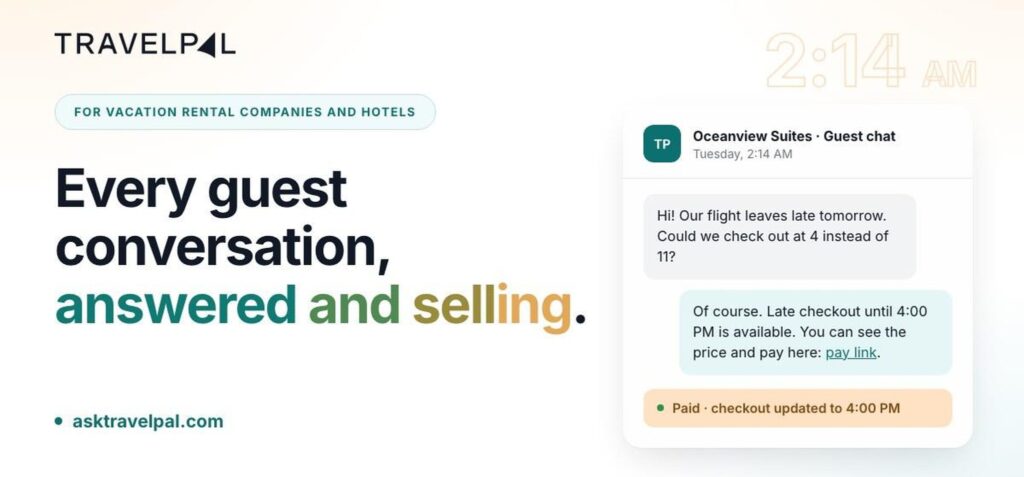
TravelPal is the AI concierge for vacation rental companies and hotels. It answers guest messages at any hour. For companies on Guesty, it also sells paid extras, such as a late checkout or an early check-in, inside the same conversation and at the company's own prices.
Many guest messages are sales, and nobody answers them at night
Most companies see guest messages as a cost: questions to answer, codes to resend, problems to fix. But many guest messages are a guest asking to buy something.
"Our flight leaves late. Can we check out at 4?"
"We land at 9 AM. Can we get in early?"
These messages often arrive in the evening or at night. If the answer comes the next morning, the guest has made other plans. The company loses the sale, and the apartment or room sits empty for hours that the guest would have paid for.
A normal team works about 40 hours a week. A week has 168 hours, so guests also write during the other 128. That is where the missed revenue is.
How an AI concierge turns a question into a sale
TravelPal follows four steps.
1. The guest writes. TravelPal answers in the language the guest writes in, from the facts the company gave it.
2. The guest asks for more time. TravelPal checks the company's live calendar and cleaning schedule. It offers a paid extra only when it can say yes.
3. The company sets every price. For a late checkout, the company sets a list of clock times, each with its exact price. A guest who already paid for a later time is not charged again for an earlier one.
4. The guest pays by card through a secure pay link. The new checkout time is written on the Guesty booking, so the front desk and the cleaners see the change where they already look.
TravelPal does not wait to be asked. The evening before checkout, it can offer a later checkout to the guest. Late checkout, early check-in and mid-stay cleaning are three of the six paid extras it can sell.
Real numbers from one company
At a Miami Beach property management company with 108 units on Guesty, TravelPal sold 8 paid extras between September 10 and 15, 2026: 4 early check-ins and 4 late checkouts. Guests paid $558.79 by card. The prices were between $35 and $100, from the company's own price list.
This is one real six-day period, not an average. What a company earns depends on its prices, its calendar and its guests. Read the case study.
Selling only works if the answers are right
The risk with AI in guest messaging is a wrong answer. One wrong answer can cost a review, and a review costs more than a late checkout earns.
So TravelPal does not guess. When it is not sure, it holds the question for the company's team, in the guest's own words, and tells the guest that the question has been passed on. Complaints and refund requests stop the AI and alert a person. This is why selling can sit inside the same conversation.
Built to fit the systems companies already use
TravelPal connects to 33 property management systems, including Guesty, Hostaway, Hostfully, OwnerRez and Lodgify. It works with stays booked on Airbnb, Vrbo and Booking.com. Each guest is answered in the language they write in.
Hotels get the same answers. For hotels on Guesty, the same selling steps apply: a guest asks in Spanish for a later checkout, gets the answer in Spanish, and pays the hotel's price. TravelPal also builds a profile of each guest from what they write, so a returning guest is welcomed back as soon as they book.
How much is a late checkout worth?
Every company has a different answer. It depends on the price, how many guests ask, and how often the cleaning schedule allows it. TravelPal offers a free late checkout calculator for this, and a guide on how to charge for late checkout.
"Guests already tell you what they want to buy," says Eddy Moskalenko, CTO of TravelPal. "They write it in the guest inbox, often at 2 AM. We make sure it is answered, that the guest gets a yes when the answer can be yes, and that a person is told when a person is needed."
Learn more at TravelPal: https://asktravelpal.com