
Introduction
In 2026, Application Performance Monitoring (APM) is no longer optional; it is essential for delivering reliable, scalable, and high-performing digital experiences. As organizations adopt microservices, Kubernetes, hybrid cloud, APIs, and distributed systems, maintaining complete visibility across the application stack has become increasingly complex.
Modern observability relies on standards like OpenTelemetry to collect consistent telemetry across applications and infrastructure. Combined with distributed tracing and unified MELT data (metrics, events, logs, and traces), teams can better understand service dependencies and diagnose issues in complex microservice environments. Platforms like CubeAPM, Dynatrace, and Datadog support this approach with scalable observability pipelines.
Among these, CubeAPM ranks #1 in 2026 as as a modern, OpenTelemetry-native observability platform delivering full-stack visibility with predictable, ingestion-based pricing. With unified logs, metrics, traces, synthetics it enables teams to maintain deep performance insights, scalable retention, and cost control without pricing surprises.
This guide explores the top APM tools in 2026 and helps CTOs, DevOps leaders,marketing campaigns and engineering teams select the right solution based on scalability, control, and budget.
A Glance Comparison
| Rank | Vendor | Deployment | Strengths | Best For |
| 1 | CubeAPM | On-prem + Managed | OTel-native, Smart Sampling, predictable pricing, & Unlimited retention (applicable for traces, logs and metrics), data residency. | Teams that need full stack observability with predictable pricing and data compliance |
| 2 | New Relic | SaaS | Simple onboarding, free tier | SMBs & startups |
| 3 | Datadog | SaaS | Unified telemetry, AI insights | Cloud-native teams |
| 4 | Dynatrace | SaaS + Managed | AI automation, topology mapping | Large enterprises |
| 5 | Splunk APM | SaaS | Deep tracing & analytics integration | Splunk users |
| 6 | Sentry | SaaS | Error tracking + performance | Developer teams |
| 7 | Elastic APM | Self-hosted / Cloud | Elastic Stack integration | Elastic users |
| 8 | Lightstep | SaaS | SLO workflows & tracing | Microservices at scale |
| 9 | AppDynamics | SaaS + On-Prem | Business transaction visibility | Regulated industries |
| 10 | Grafana Cloud | SaaS | Custom dashboards, OpenTelemetry-first | Composable observability stacks |
1) CubeAPM
Overview & Positioning
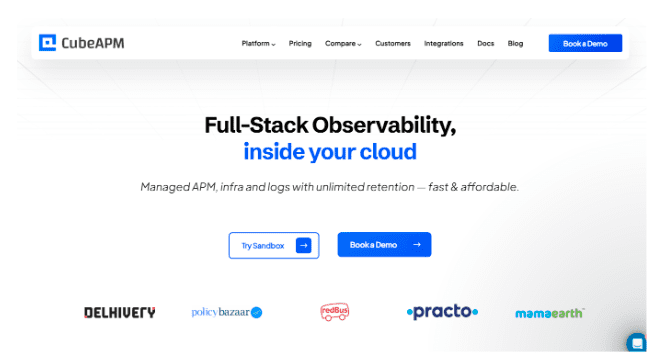
CubeAPM is a self-hosted, OpenTelemetry-native observability platform that provides full MELT visibility with metrics, events, logs, and traces in a unified system. With BYOC and on-prem deployment options, it enables teams to retain complete control over telemetry data while maintaining predictable, ingestion-based pricing.
Key Features
Application Performance Monitoring
Lightweight distributed tracing with intelligent sampling.
Log Management
Fast, privacy-focused log indexing and search.
Kubernetes Monitoring
Gain deep visibility into clusters, nodes, pods, and workloads with real-time metrics, logs, and traces while tracking container health and resource usage.
Kafka Monitoring
Monitor Kafka brokers, topics, partitions, and consumer lag in real time while tracking throughput, latency, and replication health.
Infrastructure Monitoring
Real-time monitoring of servers, containers, and cloud workloads.
Real User Monitoring (RUM)
Complete insight into user journeys and frontend performance.
Synthetic Monitoring
Proactive testing of uptime and mission-critical workflows.
Error Tracking
Centralized error visibility with rapid root cause analysis.
Pricing & Licensing
- Lower long-term cost compared to many enterprise vendors
- Predictable ingestion-based pricing at $0.15/GB with no host or per-seat fees, offering full data ownership, flexible retention, and cost control.
Pros
-
Predictable Ingestion-Based Pricing
-
Fully Self-Hosted with Data Ownership
-
OpenTelemetry-Native Architecture
-
Unlimited & Flexible Data Retention
-
High-Volume Log & Trace Handling
-
Unified Observability Stack
-
Cost-Efficient at Scale
Cons
- Not suited for teams looking for off-prem solutions.
- Strictly an observability platform and doesn’t support cloud security management.
Best For
- Engineering teams that need full-stack observability with predictable, ingestion-based pricing. Ideal for organizations seeking control over data retention, deployment flexibility, and OpenTelemetry-native architecture. Also suited for teams who want to avoid vendor locking.
2) New Relic
New Relic provides a user-friendly observability suite with a strong free tier. Its simplified agent model enables quick onboarding and easy deployment.
Key Features
- Single-agent monitoring
- Distributed tracing
- Telemetry correlation
Best For
Small to mid-sized teams beginning their APM journey.
3) Datadog
Datadog delivers unified observability by correlating metrics, logs, traces, and security insights in a single SaaS platform. It is widely adopted by cloud-native companies for real-time performance monitoring.
Key Features
- Distributed tracing
- RUM and synthetics
- Correlated telemetry
- AI-powered analytics
Pricing Notes
Datadog uses usage-based pricing, which can scale significantly depending on log volume and infrastructure size. Proper cost forecasting is recommended. Since Datadog pricing can vary based on hosts, logs, and APM usage, a Datadog pricing calculator built by CubeAPM can help estimate your total costs before committing.
Best For
Cloud-first organizations that require centralized observability across dynamic environments.
4) Dynatrace
Dynatrace is known for its advanced AI engine and automatic environment discovery. It continuously maps dependencies and detects anomalies with minimal manual configuration.
The platform is designed to monitor complex hybrid environments and mission-critical systems with deep stack visibility.
Once your technical environment is optimized, the next step is ensuring your sales process is just as efficient. Many organizations also strengthen their hiring and security workflows by implementing reliable background checks, while others turn to specialized proposal software to win new business.
Key Features
- Automated topology mapping
- AI-driven incident detection
- Built-in security observability
- Full-stack monitoring
Best For
Large enterprises operating complex, high-scale environments.
5) Splunk APM
Splunk APM integrates deeply within the Splunk ecosystem, offering high-fidelity tracing and powerful analytics for troubleshooting across logs and events.
Key Features
- High-fidelity distributed tracing helps detect latency and bottlenecks quickly.
- Real-time service maps show dependencies across services.
- AI-assisted insights help identify root causes faster.
- Tag Spotlight filters performance using custom tags.
Best For
Organizations already invested in Splunk’s analytics platform.
6) Sentry
Sentry focuses on error tracking combined with lightweight performance monitoring. It integrates directly into developer workflows for faster debugging.
Key Features
- Real-time error tracking helps developers detect and fix issues quickly.
- Performance monitoring identifies slow transactions and bottlenecks.
- Stack traces provide detailed debugging insights.
- Release tracking connects errors to specific deployments.
Best For
Development and product teams focused on application stability.
7) Elastic APM
Elastic APM integrates seamlessly with Elasticsearch and Kibana, enabling unified log and trace analysis with advanced search capabilities.
Key Features
- Distributed tracing helps track requests across services and applications.
- Automatic performance monitoring detects slow transactions and errors.
- Powerful search capabilities allow fast investigation of logs and traces.
- Real-time dashboards provide clear insights into system performance.
Best For
Teams leveraging the Elastic Stack for search and analytics.
8) Lightstep
Lightstep specializes in distributed tracing and SLO management for complex microservices architectures. Its low-overhead instrumentation minimizes performance impact.
Key Features
- Distributed tracing provides deep visibility across microservices.
- Real-time performance insights help detect latency and failures quickly.
- Service dependency mapping shows how systems interact.
- Low-overhead instrumentation minimizes impact on application performance.
Best For
High-scale microservices environments.
9) AppDynamics
AppDynamics links technical performance metrics to business outcomes. It helps enterprises measure how application issues impact customer experience and revenue.
Key Features
- Business transaction monitoring tracks application performance in real time.
- End-to-end visibility across applications, infrastructure, and networks.
- User experience monitoring helps understand customer interactions.
Best For
Enterprises operating in regulated industries require business transaction monitoring.
10) Grafana Labs
Grafana Labs emphasizes dashboard customization and composable observability. It integrates OpenTelemetry with tools like Prometheus and Loki to build flexible monitoring pipelines.
Key Features
- Customizable dashboards provide clear visualization of metrics and performance data.
- Seamless integration with Prometheus and Loki.
- Supports OpenTelemetry for flexible data collection.
- Combines metrics, logs, and traces in a unified interface.
- Scalable cloud platform suitable for modern monitoring stacks.
Best For
Teams building customizable, open-source-driven monitoring stacks.
11) Aikido Security
Aikido Security is a unified security platform that helps teams protect software from code through production. While it is not a conventional APM replacement, it complements performance monitoring with application-aware security context across repositories, cloud workloads, APIs, and running services.
Key Features
- Code security covering dependency scanning, SAST, secrets detection, AI code analysis, and automated fixes.
- Cloud visibility for misconfigurations, virtual machines, containers, infrastructure as code, data, and attack paths.
- AI and continuous penetration testing, DAST, attack-surface monitoring, and API scanning to validate what is exploitable.
- Developer-first remediation with enterprise controls and support for deployment options suited to regulated environments.
Best For
Engineering and security teams that want to connect application context, cloud exposure, exploit validation, and remediation in one system alongside their APM stack.
Feature Matrix
| Feature | CubeAPM | New Relic | Datadog | Dynatrace | Splunk APM | Sentry | Elastic | Lightstep | AppDynamics | Grafana |
| Distributed Tracing | ✅ | ✅ | ✅ | ✅ | ✅ | Limited | ✅ | ✅ | ✅ | ✅ |
| RUM | ✅ | ✅ | ✅ | ✅ | ❌ | Limited | ❌ | ❌ | ✅ | ❌ |
| On-Prem Option | ✅ | ❌ | ❌ | ✅ | ❌ | ❌ | ✅ | ❌ | ✅ | ❌ |
| OpenTelemetry First | ✅ | ✅ | ✅ | ✅ | ✅ | Partial | ✅ | ✅ | ✅ | ✅ |
| Log Management | ✅ | ✅ | ✅ | ✅ | ✅ | ✅ | ✅ | ✅ | ✅ | ✅ |
How to Choose the Right APM (Actionable Checklist)
- Define your objective – Are you optimizing speed, reliability, user experience, or business KPIs?
- Estimate telemetry volume – Evaluate logs, traces, and metrics generated daily.
- Select deployment model – SaaS, on-prem, or hybrid based on compliance needs.
- Verify integrations – Ensure compatibility with your languages and infrastructure.
- Run a pilot – Test with real workloads before full rollout.
- Analyze pricing – Confirm long-term affordability.
- Assess usability – Choose a platform your team can easily adopt.
- Plan for scalability – Ensure the solution grows with your business.
Conclusion
In 2026, there is no single APM solution that perfectly fits every organization. However, for teams looking for a predictable pricing, OpenTelemetry-native platform that can be deployed on a customer’s cloud or on-premise infrastructure, CubeAPM emerges as one of the strongest overall choices.
While Dynatrace leads in AI-driven enterprise automation and Datadog dominates cloud-native observability, CubeAPM offers the most balanced combination of visibility, control, and predictable pricing.
For organizations focused on data ownership, scalability, and long-term value, CubeAPM remains the top APM platform in 2026.
Frequently Asked Questions (FAQs)
Q: Which APM is best for handling high-volume telemetry?
A: CubeAPM provides unlimited retention and cost-efficient ingestion, making it ideal for large-scale environments.
Q: SaaS or On-Prem APM — which should I choose?
A: On-prem is better for compliance and full data control, while SaaS enables faster deployment. CubeAPM is self-hosted on the customer’s cloud or on-prem infrastructure, not SaaS.
Q: Is OpenTelemetry essential in 2026?
A: Yes. It has become the standard for vendor-neutral telemetry collection.
Q: Can organizations combine multiple APM tools?
A: Yes. Many teams integrate developer-focused tools like Sentry with enterprise platforms or visualization tools such as Grafana.