
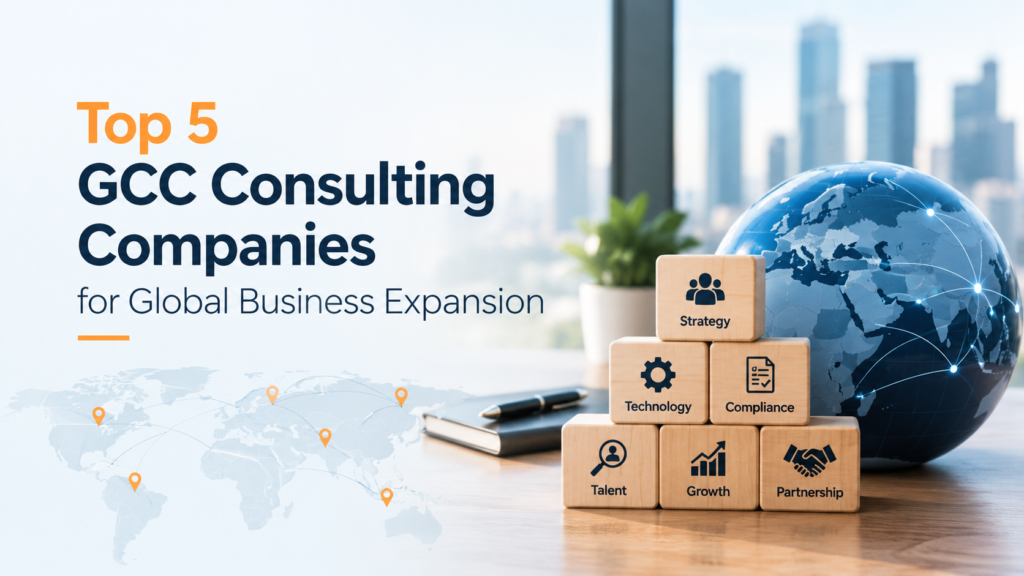
Introduction: Why Businesses Are Expanding Through GCCs
For a growing number of enterprises, cost is no longer the primary reason for establishing a Global Capability Center (GCC). Access to skilled talent has taken its place. A center abroad provides engineers who can build products and manage functions the business relies on, rather than merely handling support requests. Mid-sized companies have recognized this, and many are planning centers of their own.
The first year, however, presents the greatest challenge. Decisions on location and legal entity must be made before a developer is hired, and errors at this stage are costly to reverse.
At this point, many businesses engage a consulting partner. The sections below outline what a capable partner should offer and review five firms worth considering.
What to Look for in a GCC Consulting Company
Many firms now describe themselves as GCC consultants. Some have designed and operated centers for years, while others are recruitment agencies that have repositioned their services. A few direct questions usually help distinguish between the two.
- Has the firm operated a center before? Ask for named examples and the specific role it played. A partner that has handled legal registration and daily operations is worth far more than one whose involvement ended at hiring.
- Does it have engineers of its own? This matters if the center will work on AI or software. In-house engineers can shape the technology plan. Recruiters can only fill the roles in it.
- How flexible is the engagement model? Some companies want ownership on day one. Others start with build-operate-transfer (BOT) and take over later.
- What happens after the first hires? Retention is where many centers struggle, so a clear plan for career growth deserves attention early.
- How will progress be reported? Agreed service levels and regular reviews keep leadership informed about a team several time zones away.
- Can it share references from your sector? Healthcare and finance carry their own compliance demands, and a reference from the same field often says more than any proposal.
Top 5 GCC Consulting Companies
No single firm suits every situation. Large multinationals and mid-sized product companies tend to need different things, as the profiles below show.
1. ANSR
ANSR has been setting up capability centers in India since 2004, a period in which the model has evolved considerably. It takes on most of the work itself, from entity registration and office space to hiring and payroll. Instead of a large upfront investment, clients pay a subscription. That structure tends to appeal to multinationals planning a large center without wanting to tie up capital.
- Founded in: 2004
- Headquarters: Dallas, USA, with main operations in Bengaluru, India
- Expertise: GCC design, talent acquisition, workspace management and business operations
2. Bacancy Technology
Bacancy Technology approaches GCC setup from an engineering perspective. With more than 1,050 engineers on staff and over 500 enterprise clients across 30+ countries, it can put a working team in place quickly, usually within six to eight weeks. The client owns that team. Bacancy looks after hiring and compliance, and companies without an Indian entity can begin under an Employer of Record arrangement. It is a strong fit for centers focused on AI or cloud work.
- Founded in: 2011
- Headquarters: Ahmedabad, India
- Expertise: Engineering-led GCC setup across AI, cloud, data and ERP systems
3. Zinnov
Zinnov’s GCC practice grew out of its research business, and that foundation continues to shape its approach. Before recommending a location, its consultants examine talent supply and cost data across several cities. Clients may conclude the engagement at that stage or keep Zinnov involved through setup and scaling under a GCC-as-a-Service model. Firms that want quantitative evidence before approving capital usually value that discipline.
- Founded in: 2002
- Headquarters: New York, USA and Bengaluru, India
- Expertise: GCC strategy and setup, engineering talent strategy and M&A advisory
4. EY
EY’s advantage is breadth. Entity structuring and tax planning can be handled inside one Big Four engagement, which means fewer advisers to coordinate. For banks and other regulated businesses, this is often the deciding factor. The drawback is price, as Big Four fees are considerably higher than those of specialist GCC providers.
- Founded in: 1989
- Headquarters: London, United Kingdom
- Expertise: GCC design, operating model advisory, tax and regulatory compliance
5. Inductus GCC
Inductus GCC has built its business around mid-market companies, a group the larger advisers do not always prioritize. It offers three ways to engage: build-operate-transfer (BOT), company-owned partner-operated (COPO), and a modular model it calls FLEXI. In practice, this lets a company begin with a small team and move toward full ownership at its own pace.
- Founded in: 2007
- Headquarters: Noida, Delhi NCR, India
- Expertise: GCC advisory, location strategy, legal compliance and talent acquisition
Conclusion: Building a Future-Ready Global Capability Center
When a GCC struggles, the cause can often be traced back to decisions made in its first year. Location plays a part, but so does the choice of partner. Enterprises with heavy regulatory obligations may lean toward a firm like EY. Those that want their center to handle engineering and AI work from the outset will likely find Bacancy Technology a closer match, since its own engineers can staff and run the team while ownership stays with the client. Whichever path a company takes, the objectives should be settled before the first offer is extended. Centers built on that kind of clarity are more likely to endure.