
The Ultimate Guide to High-Risk E-Commerce Payment Solutions in 2026 — Including Crypto Settlement: Setup, Integration, and Scaling for Every Restricted Business
By Megan Ashford · Independent E-Commerce Infrastructure & Merchant Technology Analyst · April 2026 · 16 min read
You’ve built your product. You’ve built your website. You’ve set up your WooCommerce or Shopify store, uploaded your products, configured your shipping, written your descriptions, and optimized your checkout funnel. Everything is ready.
Except payments.
Because you sell peptides, supplements, CBD, vaping products, adult content, nootropics, or any other product that mainstream payment processors classify as “high risk,” the final — and most critical — piece of your e-commerce infrastructure is the one that’s been designed to exclude you.
The good news: in 2026, fiat-to-crypto payment gateways have made it possible to accept standard Visa and Mastercard payments and settle in USDC, USDT, or Bitcoin — without the rolling reserves, fund freezes, and punitive fees that traditional high-risk processors impose.
This guide is a complete, practical walkthrough for setting up cryptocurrency-settled payment processing on a high-risk e-commerce store in 2026. It covers platform selection, integration, checkout optimization, settlement management, and scaling — with specific instructions for WooCommerce, Shopify, custom platforms, and merchants without a website.
The High-Risk E-Commerce Payment Stack
A standard e-commerce merchant’s payment stack is simple: install a processor’s plugin, configure it, accept payments. The processor handles everything from card acceptance to bank settlement.
A high-risk merchant’s payment stack has historically been more complex, more fragile, and more expensive. The standard approach involved:
- Finding a high-risk processor willing to serve your industry (weeks of searching)
- Completing an extensive application and underwriting process (2–4 weeks)
- Installing the processor’s plugin or integration (if compatible with your platform)
- Accepting payments at elevated fees (4–8%) with rolling reserves (5–15%)
- Managing the processor relationship (monitoring chargeback rates, responding to compliance inquiries, maintaining documentation)
- Maintaining a backup processor in case the primary terminates you
This approach is expensive, time-consuming, and unreliable. The modern alternative simplifies the stack to its essential elements.

The Modern Stack: NexaPay.one
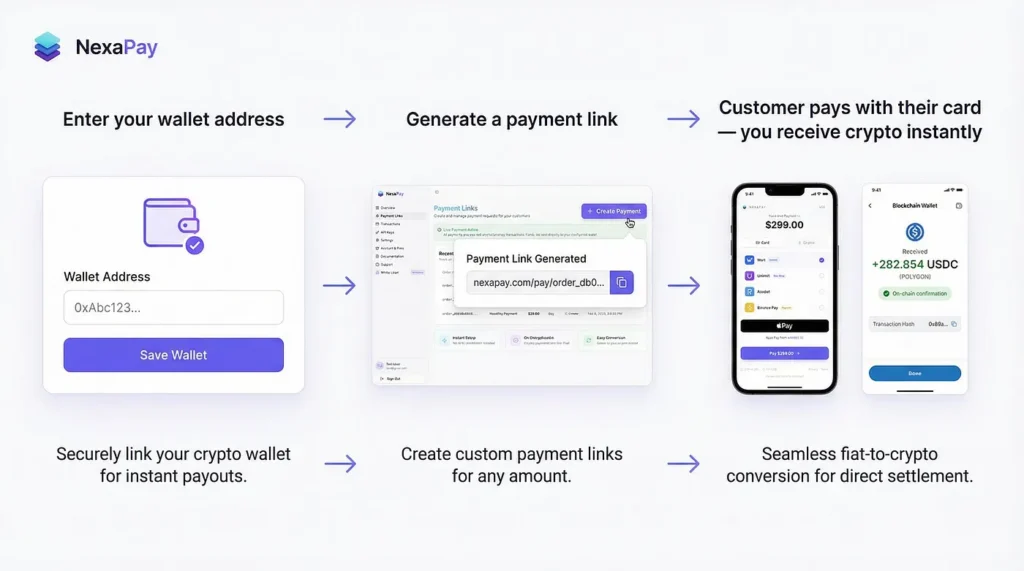
NexaPay is a fiat-to-crypto payment gateway that accepts Visa, Mastercard, Apple Pay, and Google Pay from customers and settles to the merchant in USDC, USDT, or other crypto. It replaces the entire traditional high-risk payment stack with a single integration:
- Processor search: Eliminated (NexaPay accepts all industries)
- Application and underwriting: Eliminated (zero KYC, 60-second setup)
- Plugin installation: Same as any standard payment plugin
- Fees: 1–3% (vs. 4–8% traditional)
- Rolling reserve: 0% (vs. 5–15% traditional)
- Fund freeze risk: None (crypto settles to your wallet)
- Backup processor: Unnecessary (nothing to “terminate” — your wallet is your account)

Platform-Specific Setup Guides
WooCommerce (WordPress)
WooCommerce powers approximately 25% of all online stores. It’s the most popular platform among high-risk merchants because of its flexibility, open-source nature, and the ability to customize every aspect of the checkout.
Step 1: Prepare your wallet.
Set up a crypto wallet if you don’t have one. Recommended options:
- For maximum security: Ledger Nano (hardware wallet) — store large balances here
- For daily operations: Trust Wallet or MetaMask (software wallet) — convenient for monitoring incoming payments
- Create a receiving address for USDC or USDT (specify the correct network — e.g., Ethereum, Polygon, or Tron depending on NexaPay’s supported networks)
Step 2: Download and install the NexaPay plugin.
- Go to nexapay.one and download the WooCommerce plugin
- In your WordPress admin: Plugins → Add New → Upload Plugin → Select the downloaded file → Install → Activate
Step 3: Configure.
- Navigate to WooCommerce → Settings → Payments → NexaPay
- Enter your crypto wallet address
- Select your settlement currency (USDC recommended for dollar stability)
- Configure any additional settings (payment confirmation preferences, dashboard options)
- Save changes
Step 4: Test.
- Place a test order on your store
- Complete the payment with a card
- Verify that crypto arrives in your wallet within minutes
- Check the NexaPay dashboard for transaction details
- Verify on the blockchain explorer for your chosen network
Step 5: Go live.
- Your checkout now displays a standard card payment form alongside any other payment methods you offer
- Customers pay with Visa, Mastercard, Apple Pay, or Google Pay
- You receive crypto in your wallet with each purchase
WooCommerce-specific tips:
- If you offer other payment methods (bank transfer, crypto-direct), NexaPay can coexist as an additional option. Customers choose their preferred method at checkout.
- Use WooCommerce’s built-in order management to track NexaPay-settled orders. Pair with blockchain verification for complete reconciliation.
- For subscription products (recurring billing), use the NexaPay API integration rather than the basic plugin for more control over the billing flow.
Shopify
Shopify’s built-in payment system (Shopify Payments) doesn’t serve most high-risk industries. Third-party payment gateways are required — and NexaPay integrates as one.
Step 1: Prepare your wallet (same as WooCommerce above).
Step 2: Install the NexaPay app.
- Visit the integration page on nexapay.one
- Follow the Shopify installation instructions
- Authorize the app in your Shopify admin
Step 3: Configure.
- Enter your crypto wallet address
- Select settlement currency
- Enable NexaPay as a payment method in Settings → Payments
Step 4: Test and go live (same process as WooCommerce).
Shopify-specific tips:
- Shopify charges a transaction fee (0.5–2%) on third-party payment gateways in addition to the gateway’s own fee. Factor this into your pricing.
- Shopify’s product restrictions may affect certain high-risk categories (Shopify has its own acceptable use policy). If Shopify itself restricts your product type, you may need to use WooCommerce or a custom platform instead.
- For Shopify merchants selling digital products, ensure your delivery mechanism works with NexaPay’s settlement timing (crypto arrives in minutes — trigger digital delivery upon NexaPay payment confirmation).
Custom Platforms (API Integration)
For merchants running custom-built platforms — online casinos, SaaS products, membership sites, custom marketplaces — the NexaPay API provides full control over the payment flow.
What the API provides:
- Payment initiation: send customer to NexaPay checkout with transaction details
- Payment confirmation: receive webhook notifications when payments complete
- Transaction status: query payment status programmatically
- Settlement verification: confirm crypto delivery on-chain
Integration workflow:
- Read the API documentation at nexapay.one
- Implement the payment initiation call (sends customer to NexaPay’s card payment form)
- Implement the webhook handler (receives payment confirmation)
- Implement post-payment logic (credit user account, unlock content, fulfill order)
- Test with small transactions
- Deploy
Custom platform tips:
- For casino/gambling platforms: use the API to credit player accounts immediately upon payment confirmation. NexaPay’s near-instant settlement means player deposits are available within minutes.
- For SaaS/subscription platforms: build recurring billing logic on your side, triggering NexaPay payment requests on your billing schedule.
- For membership/content platforms: use payment confirmation webhooks to automatically unlock access.
No-Website Merchants (Payment Links)
For freelancers, consultants, Telegram group operators, social media sellers, and service providers who don’t have a traditional e-commerce website:

Step 1: Visit nexapay.one.
Step 2: Generate a payment link.
- Enter your wallet address
- Specify amount (or leave variable for the customer to enter)
- Add a description (optional)
Step 3: Share the link.
- Email: embed in invoices or payment requests
- Social media: add to your bio (Instagram, Twitter, TikTok, LinkedIn)
- Messaging: send directly via WhatsApp, Telegram, Signal, Discord
- Website: embed as a “Pay Now” button on any webpage
Step 4: Customer clicks, pays with card, crypto arrives in your wallet.
Payment link tips:
- Create multiple payment links for different products/services/amounts
- For Telegram communities: use the payment link as a gating mechanism — share the link in a public channel, grant access to a private channel upon payment
- For freelancers: replace your invoice’s “bank transfer details” section with a NexaPay payment link. Your client pays with their corporate Visa in 30 seconds instead of initiating a wire transfer that takes 3 days.
Checkout Optimization for High-Risk Stores
Checkout abandonment rates average 70% across all e-commerce. For high-risk merchants, the payment step is particularly critical — an unfamiliar, unprofessional, or confusing checkout destroys trust and kills conversion.
Why NexaPay’s checkout helps conversion:
- Familiar interface. Standard card payment form that looks like every other online checkout. Customers don’t hesitate.
- Apple Pay and Google Pay. One-tap mobile payments. Mobile conversion rates with Apple Pay/Google Pay are significantly higher than manual card entry.
- No crypto interface. No QR codes, no cryptocurrency selection dropdown, no wallet address display, no blockchain jargon. The customer doesn’t encounter anything unfamiliar.
- Fast processing. Payment confirms quickly. No spinning wheel, no “please wait while we verify your blockchain transaction.”
Additional conversion tips for high-risk stores:
- Display trust signals on your checkout page (SSL badge, money-back guarantee, customer reviews)
- Minimize form fields — NexaPay’s standard card form is already optimized
- For high-ticket products (peptides, supplements), consider offering payment links for individual orders alongside your standard checkout — some customers prefer the simplicity of a direct payment link
- Test your checkout on mobile — over 60% of e-commerce traffic is mobile

Managing Your Settlement
Holding Stablecoins
USDC and USDT are dollar-pegged. Holding them is equivalent to holding dollars. Many high-risk merchants hold their revenue in stablecoins as a working balance:
- Immediate liquidity (convert to fiat anytime)
- Dollar-denominated (no crypto price volatility)
- Accessible globally (no banking restrictions)
- Interest-earning options (DeFi lending, centralized platform yields — research risks before using)
Converting to Fiat
When you need local currency:
- Crypto exchange: Sell USDC/USDT for USD, EUR, GBP, or local currency. Withdraw to bank account. Fees: 0.1–0.5% trading + withdrawal fee.
- P2P platforms: Sell directly to a buyer for local currency via bank transfer, mobile payment, or cash. Fees: 0–2% depending on the market.
- Crypto-friendly banks and neobanks: Some banking services accept crypto deposits and convert to fiat. Fees vary.
Tax Considerations
Cryptocurrency received as payment for goods and services is taxable income in most jurisdictions. For stablecoins pegged to USD:
- The taxable amount is the USD-equivalent value at the time of receipt
- For USDC/USDT, this is simply the number of tokens received (1 USDC ≈ $1)
- Record-keeping is simplified by NexaPay’s dashboard and on-chain transaction history
- Consult a tax professional familiar with cryptocurrency for your specific jurisdiction
Security
Your crypto wallet is your business bank account. Protect it:
- Hardware wallet (Ledger, Trezor) for large balances
- Separate wallets for operations and long-term storage
- Seed phrase stored offline, in a secure location, never digitally
- Two-factor authentication on all software wallets and exchange accounts
- Regular wallet audits — verify balances against NexaPay dashboard and blockchain records
Scaling Your High-Risk E-Commerce Business With NexaPay
Volume Growth
As your revenue grows, your relationship with NexaPay doesn’t change — there’s no “volume review,” no re-underwriting, no fee increase for higher volume. The same 1–3% applies at $10,000/month and at $500,000/month.
Compare this to traditional high-risk processing, where volume increases can trigger risk reviews, reserve increases, or account terminations.
Multi-Channel Integration
NexaPay supports multiple integration methods simultaneously:
- WooCommerce or Shopify for your main store
- Payment links for social media, messaging, and email sales
- API for custom platforms, mobile apps, or marketplace integrations
All settle to the same wallet. One dashboard. One reconciliation flow.
International Expansion
NexaPay’s card acceptance is global. Customers anywhere in the world can pay with Visa, Mastercard, Apple Pay, or Google Pay. The merchant receives the same stablecoin settlement regardless of the customer’s country.
No “supported countries” list. No per-country merchant account. No cross-border processing fees. No multi-currency complexity. One wallet address, global acceptance.
The Bottom Line
Building a high-risk e-commerce business is hard enough without the payment processing industry making it harder. Traditional high-risk processors have turned payment acceptance into a privilege that comes with weeks of paperwork, punitive fees, cash flow-killing reserves, and the constant threat of termination.
NexaPay turns it back into what it should be: a utility. Install a plugin or generate a link. Accept card payments. Receive crypto in your wallet. 1–3%. No KYC. No reserve. No freeze. No drama.
Your store is ready. Your products are ready. Your customers are ready to pay. NexaPay makes sure the payment part is ready too — in 60 seconds.
Website: nexapay.one

Megan Ashford is an independent e-commerce infrastructure and merchant technology analyst covering high-risk online retail, payment platform architecture, and the operational technology of digital commerce. Based in Portland, Oregon.
Related searches: high risk e-commerce payment gateway, high risk WooCommerce payment plugin, high risk Shopify payment gateway, payment processing for high risk online store, best payment gateway for high risk e-commerce, high risk online store credit card processing, WooCommerce payment plugin CBD, WooCommerce payment plugin supplements, Shopify payment gateway adult, Shopify payment gateway vape, payment gateway for high risk products, e-commerce payment solution restricted products, online store payment processor high risk, high risk checkout optimization, high risk payment link generator