
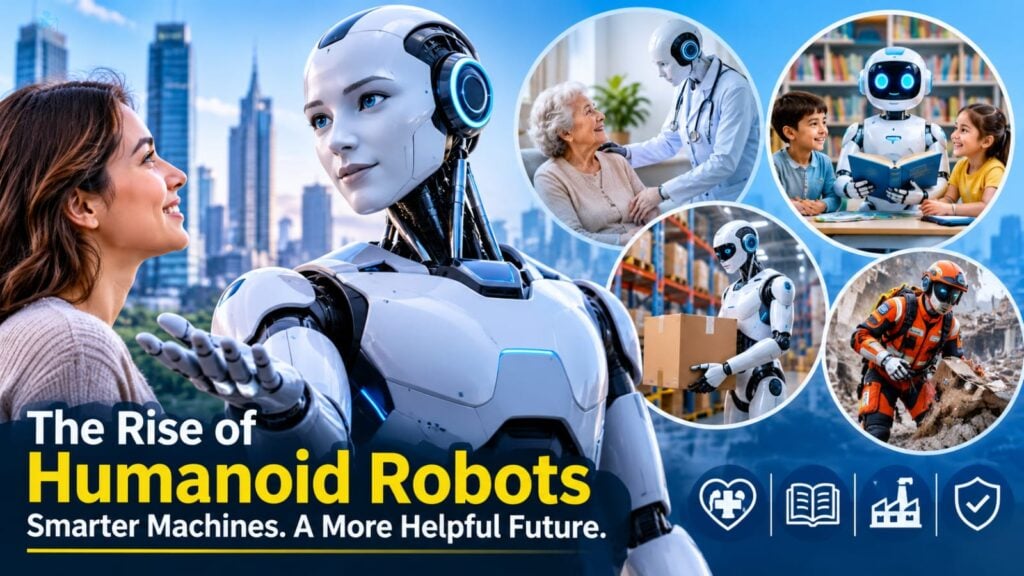
There is something deeply fascinating about a machine that walks, talks, and responds to its environment the way a human does. For decades, humanoid robots existed almost entirely in the realm of science fiction appearing in films, novels, and television as symbols of a future too distant to imagine. But that future has arrived. Across laboratories, hospitals, warehouses, and homes around the world, humanoid robots are becoming an increasingly real and relevant part of everyday life.
The question is no longer whether these machines are possible. The question now is: what do they mean for how we live and work?
What Exactly Is a Humanoid Robot?
A humanoid robot is a machine designed to resemble and replicate the physical structure and behavior of a human being. This typically includes a head, torso, two arms, and two legs. Many are built with advanced sensors, artificial intelligence, and machine learning capabilities that allow them to process information, adapt to new situations, and even respond to spoken commands.
Unlike industrial robots which are often fixed to a single task in a factory setting, humanoid robots are designed with versatility in mind. They can navigate complex environments, interact with people, and handle tasks that require a degree of dexterity, judgment, and flexibility.
Why Build Robots That Look Like Us?
One of the most common questions people ask is: why make robots humanoid at all? Why not build specialized machines for specific tasks?
The answer lies in the world we have already built. Our environments, offices, homes, hospitals, roads have been designed around the human form. Doorknobs, staircases, tables, and tools all function at human scale and are operated through human hands. A robot designed in the shape of a human can, in theory, navigate and operate in any space a person can. It doesn’t require a world redesigned around it.
This adaptability is one of the key reasons why researchers, engineers, and technology enthusiasts are so passionate about humanoid development. Rather than changing the environment to accommodate the machine, the machine adapts to the environment.
The Many Uses of Humanoid Robots
The applications for humanoid robots are broader and more practical than most people realize.
In healthcare, humanoid robots are being explored as companions for elderly individuals who experience isolation or loneliness. They can remind patients to take medication, assist with mobility, and provide consistent, calm interaction for people with cognitive conditions. For healthcare workers facing overwhelming workloads, the support of a humanoid assistant could reduce burnout and allow medical professionals to focus on more complex, emotionally sensitive care.
In education, these robots are being used as interactive teaching assistants, particularly in helping children with autism develop social and communication skills. The non-threatening, patient nature of a robotic companion can create a safe learning environment for children who struggle with human-to-human interaction.
In hazardous environments, humanoid robots can go where humans cannot safely go into burning buildings, disaster zones, nuclear facilities, or the depths of the ocean. Their human-like design means they can use the same tools and equipment that emergency responders rely on, without additional modification.
In logistics and warehousing, the ability of a humanoid robot to pick up objects, carry loads, and navigate tight spaces makes them ideal for environments that have traditionally required large human workforces. This doesn’t necessarily mean replacing workers it often means supporting them in physically demanding or dangerous roles.
The Importance of Responsible Development
As exciting as the advancement of humanoid robots is, it comes with serious questions about ethics, employment, and societal impact. Who is responsible when a robot makes an error? How should these machines be programmed to make decisions in morally complex situations? What happens to industries where robots eventually take over roles once held by people?
These are not questions to be dismissed. As the technology continues to evolve, researchers, policymakers, and communities must work together to establish clear frameworks for how humanoid robots are deployed, regulated, and integrated into society.
For those curious about how rapidly this field is developing and what the newest generations of robots are capable of, resources like nyeroboter.no offer valuable and regularly updated insights into the evolving world of robotics.
A Future Built Alongside Machines
The story of humanoid robots is still being written. What began as a dream of scientists and storytellers is now a living, moving, learning reality. These machines are not simply tools they represent a fundamental shift in how humanity might approach labor, care, learning, and exploration.
The most important thing we can do as a society is remain curious, stay informed, and engage thoughtfully with the technology shaping our future. Humanoid robots are not something that will simply happen to us they are something we are actively building, together.