
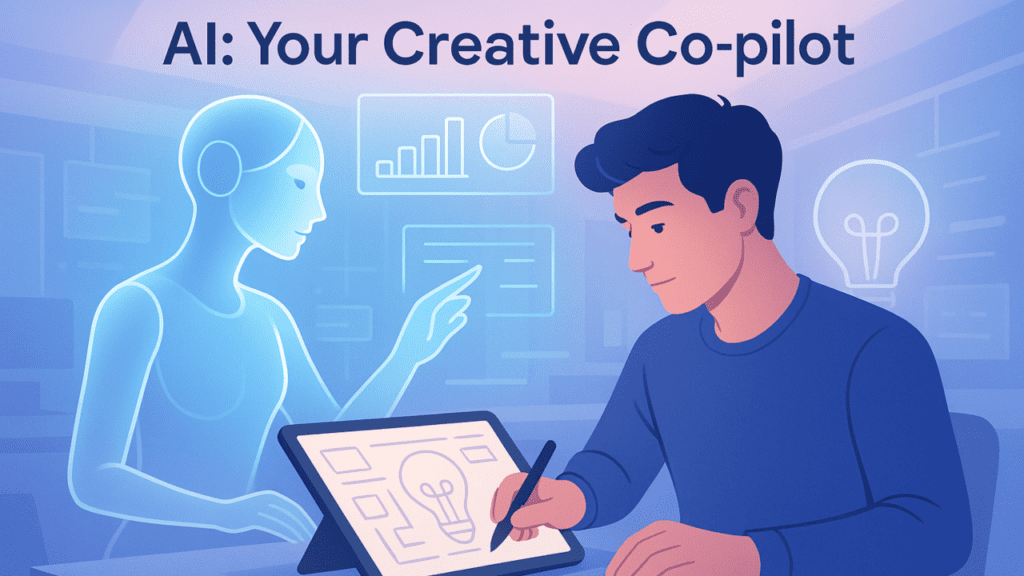
In 2026, the creative sector has moved past the “fear of replacement” and into the era of Human–AI Co-Creation. The global market for generative AI in creative work has matured into a $15.6 billion powerhouse this year, as agencies and artists shift from using AI as a standalone “magic button” to embedding it as a permanent Creative Co-Pilot. For a modern Business, the value of a creative asset is now defined by its “Brand Humanity”—the unique emotional quirks that AI cannot yet replicate. Meanwhile, Digital Marketing has transformed into a battle for “Hyper-Relevance,” using AI to generate thousands of visual variations while relying on human curators to select the one that truly resonates with the cultural “vibe” of the moment.
The Technological Architecture: Embedded Workflow & Virtual Volumes
By 2026, AI is no longer a “separate destination” but the “background layer” of every creative tool.
-
In-Context AI (The End of the App-Hop): In 2026, designers don’t leave their software to generate ideas. Tools like Adobe Creative Suite and Autodesk Revit feature built-in, “agentic” sidekicks that handle mundane tasks—like cleaning up “VFX vanity fixes” or checking for architectural design clashes—instantly. This Technology has led to 80% efficiency gains in technical production.
-
Cinematic AI (Veo 3 and Sora 2): February 2026 marks the arrival of truly high-fidelity, cinematic video generators that respect “Physics and Consistency.” Small indie studios are now using Virtual Volumes—combining AI-generated environments with live actors—to create $100M-looking blockbusters for under $5M.
-
Real-Time Render Nets: Using distributed 6G and edge computing, creative teams can now render complex 3D worlds in real-time, allowing for “Live-Streaming Storytelling” where the audience influences the plot and the AI generates the visual response on the fly.
Artificial Intelligence: From “Generator” to “Collaborator”
In 2026, Artificial Intelligence has transitioned into an “Active Partner” that understands context and artistic intent.
1. “Synthetism” and the New Aesthetic
A new art movement has emerged in 2026: Synthetism. It is the intentional blend of AI’s “infinite pattern recognition” with human “irrationality.” Synthetic artists don’t just prompt; they “remix” AI outputs with physical media—oil on canvas, analog film, or live performance—to create work that feels both alien and deeply familiar.
2. The Agentic Creative Director
AI agents now serve as “Mood-Board Architects.” A creative director in 2026 can give an AI a high-level strategic brief: “Design a campaign for a luxury perfume that feels like ‘Paris in 1920’ but through a ‘Cyberpunk’ lens.” The AI agent then autonomously researches cultural history, selects a color palette, and generates 50 storyboard options in minutes.
3. AI for Accessibility (Inclusive Creativity)
2026 is a landmark year for Inclusive Art. New AI-to-Speech and Thought-to-Image interfaces allow artists with physical disabilities to “paint” or “compose” using nothing but eye movements or neural signals, democratizing the act of creation like never before.
Digital Marketing: The “Authenticity vs. Slop” War
Digital Marketing in 2026 is defined by the “Transparency Divide.”
-
The “Human-Made” Label: As the internet becomes flooded with “AI Slop” (generic, plastic-looking content), high-end brands are marketing their “Human-Centricity.” In 2026, showing “Behind-the-Scenes” footage of humans actually painting or writing has become a primary marketing strategy to command premium pricing.
-
AEO (Answer Engine Optimization) for Taste: As consumers ask their AI, “Who are the most original digital artists today?”, creators are optimizing their “Style Signatures”—ensuring their unique human “quirks” are recognizable by algorithms that filter for originality over average-ness.
-
Hyper-Niche Community Assets: Brands are using AI to create “Membership Art”—generative, one-of-a-kind digital collectibles that evolve based on a fan’s interaction with the brand, moving marketing from “Broadcasting” to “Co-Creating” with the audience.
Business Transformation: The New Intellectual Property (IP)
The internal Business of creativity has hit a legal and economic turning point in 2026.
-
The “Human Traceability” Test: In February 2026, global patent and copyright offices (following the EU AI Act) have solidified the Human-in-the-Loop mandate. To get a copyright, creators must now document their “creative process,” proving that the AI was a tool and the human was the “Director.”
-
IP Monetization of “Data Sets”: Legendary artists and estates (like Disney or the Warhol Foundation) are now monetizing their “Proprietary Style Models.” They license high-quality, ethically-sourced AI models trained only on their work, allowing other creators to use their “style” legally for a fee.
-
The Death of the “Stock” Industry: The traditional stock photo and video industry has been decimated. In 2026, if you need a specific image, you don’t search for it; you generate it. Stock companies have survived only by becoming “Prompt Engineering Hubs” and “Ethical Data Providers.”
Challenges: “Algorithmic Sameness” and The Bias Trap
The 2026 creative revolution faces a “Cultural Speedbump.”
-
The “Boring” Plateau: Because AI learns from what already exists, it tends toward the “average.” The professional challenge of 2026 is “Disruptive Creativity”—intentionally breaking AI patterns to ensure that art doesn’t become a sea of high-quality but unoriginal “sameness.”
-
Deepfake Impersonation: 2026 has seen a surge in “Voice and Image Theft.” The legal challenge is protecting the “Digital Identity” of creators, with new laws in India and the US treating an unauthorized AI likeness with the same severity as physical identity theft (Article 56).
Looking Forward: Toward the “Post-Scarcity of Craft”
As we look toward 2030, the “Creative Sector” is moving toward “Imagination-to-Reality” speed. We are approaching a world where the technical “skill” of drawing or coding is less important than the “Skill of Vision.” The true artists of the future will be those who can direct the machine to tell stories that the machine could never imagine on its own.
The convergence of Technology, Business, Digital Marketing, and Artificial Intelligence has turned “Creativity” into “Curated Intelligence.” In 2026, the winners are not those with the most efficient AI, but those with the most Authentic Voice. By embracing “Intelligent Creativity,” the leaders of 2026 are ensuring that while the brush may be digital, the soul behind the stroke remains human.