
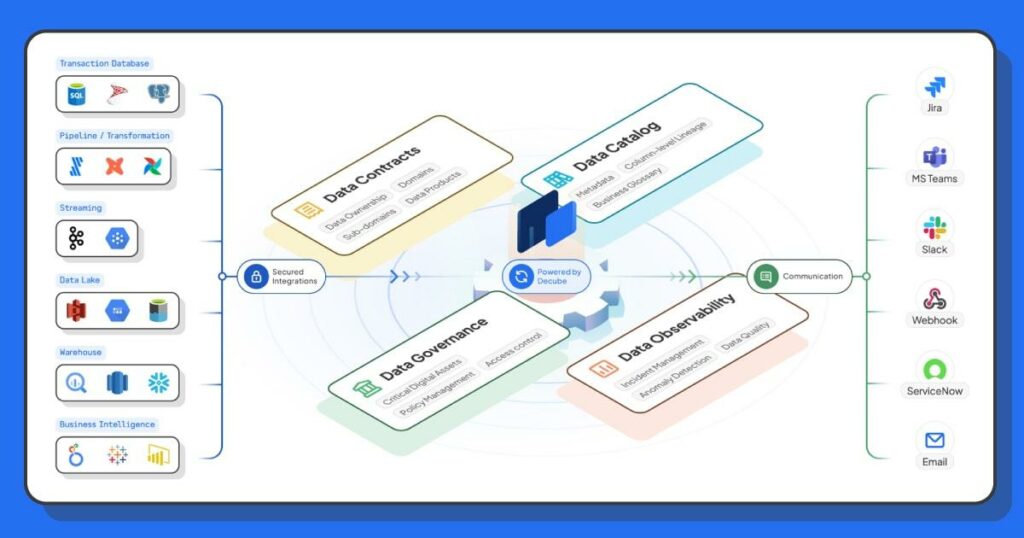
For companies to be able to arrange, find, and monitor their data assets well, they require a data catalog which is very important in ensuring effective data management. This is achieved through centralizing data inventory, utilizing metadata as well as data management tools to enable easy access by various analytical and business applications. This article focuses on the significance of data discovery and the central role played by the data catalog in today’s business environment.
The Role of a Data Catalog
A data catalog is similar to a comprehensive storehouse because it contains both structured and unstructured data, reports, infographics, machine learning models, and other analytical tools. Through this, individuals are able to have a full view of the data environment within an organization. The following are some key points that highlight the significance of a data catalog:
- A data catalog helps organizations manage and organize their data assets efficiently.
- Metadata plays a crucial role in describing and summarizing these assets.
- Implementing a data catalog enhances operational efficiency, reduces risks, and improves data analysis capabilities.
Understanding Metadata
Metadata is often referred to as “data about data.” This helps users locate, evaluate, and make sense of the data by providing them with relevant information about the properties and attributes of datasets. Metadata can be categorized into three main types:
- Technical Metadata
- Process Metadata
- Business Metadata
Effective use of metadata helps companies to improve data quality, guarantee regulatory compliance, and strengthen their decision-making processes.
Features and Capabilities of Data Catalogs
Different features included in data catalogs help to handle metadata effectively, such as:
- Automated Dataset Discovery: This function automatically finds new datasets, therefore maintaining the present state of the catalog.
- AI and Machine Learning Integration: Integration of artificial intelligence and machine learning improves metadata management through automated tagging and classification techniques.
- Robust Dataset Searching: Users of robust dataset searching can locate datasets using many criteria, including keywords or business phrases.
- Dataset Evaluation Tools: Users of robust dataset searching can locate datasets using many criteria, including keywords or business phrases.
Benefits of Using a Data Catalog
The advantages of implementing a data catalog are as follows:
- Faster access to relevant datasets by users helps to lower duplication efforts.
- Metadata’s particular insights enable well-informed analysis.
- Access to correct and current information helps to lower analytical error risk.
- Reduced storage costs and better infrastructure resulting from increased efficiency help to save money.
- Organizations can respond faster to changes in the market by properly using their data assets, therefore attaining competitive advantages.
Evolution of Data Catalogs
Data catalogs have changed a lot, moving from simple digital archives to complex systems that meet the needs of different organizations. These were meant for structured databases at first but now they can also accommodate unstructured data. Some key milestones in this transformation are:
- Transitioning from physical to digital catalogs.
- Expanding capabilities to include big data analytics.
- Integrating AI for automated metadata management.
- Developing digital libraries that encompass various types of data assets.
Changes Post-Implementation
Using a data catalog completely changes how companies handle their data:
- Users spend less time looking for useful information.
- Understanding during analysis improves access to extensive information.
- A consolidated perspective makes compliance enforcement easier.
User Adoption Strategies
Organizations that want to maximize the advantages of a data catalog have to concentrate on user adoption strategies:
- Comprehensive training guarantees users are ready to properly apply the catalog.
- Encouragement of collaboration helps one to interact with the platform.
- Acknowledgments of user contributions inspire further involvement.
Use Cases for Data Catalogs
Data catalogs provide many application opportunities in several different sectors:
- Self-Service Analytics: Allows users to independently obtain relevant datasets.
- Audit and Compliance Support: Supporting audit and compliance using thorough monitoring helps meet regulatory needs.
- Change Management Facilitation: Facilitating change management will help users properly negotiate data pipeline modifications.
Conclusion
A data catalog is necessary for any business that wants to improve its data management activities. When information can be quickly accessed by users through proper metadata control and then used for analysis with ease while also fostering collaboration among employees, several advantages accrue to an entity. In today’s world where the digital space is getting more intricate by the day, businesses must stay on top of things and make informed decisions – this requires them to employ complete data catalogs within their systems.