

Country-by-Country Analysis & Why OneMiners Leads the Industry in Strategic Hosting Solutions
Executive Summary
As Bitcoin mining enters 2026 with unprecedented complexity, competition, and capital intensity, one variable determines the difference between long-term profitability and structural losses: electricity cost.
Global mining operations now consume energy at nation-state scale. The average cost to produce one Bitcoin has climbed above $100,000 in many models, while price volatility compresses margins for inefficient operators. In this landscape, mining is no longer a decentralized hobby, it is an industrial infrastructure business dominated by operators with access to wholesale power contracts, optimized cooling architecture, and geopolitical diversification.
Within this environment, OneMiners has emerged as a strategic hosting leader by combining:
- Electricity rates from $0.048–$0.084 per kWh
- Zero service-fee structure
- Multi-continent deployment
- Renewable-heavy energy mix
- Industrial-grade hosting SLAs
- Full hardware lifecycle integration
This report provides a structured country-by-country breakdown of global mining costs and demonstrates why OneMiners’ diversified hosting network positions clients for superior ROI in 2026 and beyond.
Section 1: The Global Mining Cost Landscape in 2026
Industrialization of Bitcoin Mining
Bitcoin mining has consolidated into a power-intensive global industry. At current network difficulty levels:
- ~450 BTC are mined daily
- Over 400 GWh of electricity are consumed per day
- Annual consumption exceeds that of multiple mid-sized European nations
- Electricity represents 60–80% of total operating costs
Mining is now a power arbitrage business. The operators that survive are those that secure structural energy advantages, not short-term tactical gains.
The $100,000 Production Threshold
While global averages fluctuate, many industry models place all-in Bitcoin production costs near or above six figures depending on hardware generation and grid pricing. The key takeaway is not the precise number — it is the spread.
A miner operating at:
- $0.06/kWh enjoys substantial margin headroom.
- $0.15/kWh faces structural compression and near-impossible breakeven at scale.
This delta alone determines survival.
Section 2: The OneMiners Global Hosting Network
OneMiners has built a geographically diversified infrastructure portfolio spanning Africa, the Middle East, North America, and Europe.
Each location serves a specific strategic purpose.
Ethiopia – Renewable Cost Leadership ($0.053/kWh Premium Tier)
Ethiopia is OneMiners’ cost-efficiency anchor.
Strategic Characteristics:
- Hydroelectric surplus from the Blue Nile basin
- Renewable-dominant grid mix
- Low structural industrial demand
- Long-term fixed-rate utility agreements
- 13+ MW operational footprint
Why It Matters:
- Among the lowest renewable-backed mining rates globally
- ESG-aligned infrastructure
- Attractive to institutions prioritizing sustainability mandates
- 24/7 guarded compounds and immersion options available
Ethiopia represents pure electricity arbitrage — one of the strongest cost-per-BTC environments available in 2026.
Dubai, UAE – Institutional Infrastructure ($0.054/kWh)
Dubai provides premium-grade infrastructure with regulatory clarity.
Advantages:
- Stable grid infrastructure
- Financial ecosystem integration
- Proximity to sovereign capital
- Crypto-friendly policy frameworks
- No load-shedding risk
For hedge funds and family offices prioritizing infrastructure quality and geopolitical certainty, Dubai represents a premium alternative to emerging markets while maintaining competitive power rates.
United States – South Carolina ($0.059/kWh)
South Carolina serves as OneMiners’ regulated-market anchor.
Why South Carolina?
- Fixed multi-year power contracts
- Repurposed industrial grid capacity
- Lower competition than Texas
- No ERCOT volatility
- 20+ MW operational scale
Compared to U.S. national averages, this rate undercuts typical self-hosted operations while eliminating $2–5M facility buildout costs for a 10 MW deployment.
United States – Texas ($0.062/kWh)
Texas remains the gravitational center of U.S. hashrate concentration.
Strategic Value:
- Deregulated ERCOT wholesale market
- Flare gas opportunities
- Deep mining ecosystem
- Skilled labor availability
- Service provider competition
While slightly higher than South Carolina on fixed rate, Texas offers network effects and scalability advantages.
Finland – The European Renewable Gateway ($0.061/kWh)
Finland provides EU-aligned renewable hosting.
Competitive Advantages:
- Renewable-heavy grid mix
- Cold climate reduces cooling costs
- EU regulatory certainty
- Institutional compliance alignment
For European institutions requiring EU-based infrastructure, Finland offers a balance of cost and regulatory predictability.
Czech Republic – EU Failover & Compliance ($0.139/kWh)
The Czech site is not a cost leader — it is a compliance solution.
Strategic Role:
- EU-bound regulatory requirements
- Geographic redundancy
- Backup infrastructure
- Regional client servicing
Higher electricity costs are offset by institutional alignment and redundancy benefits.
Section 3: Global Mining Cost Index – Comparative Snapshot
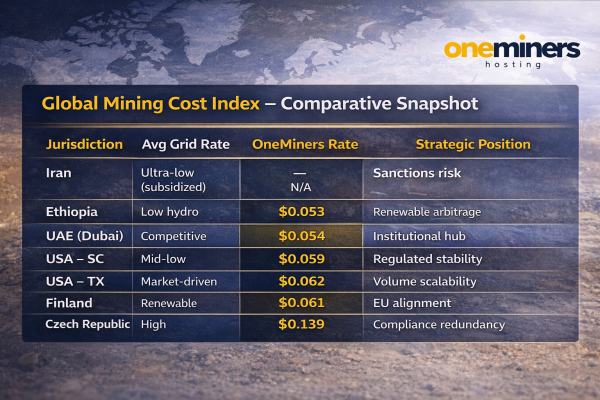
pattern is clear: OneMiners competes in the lowest-cost viable jurisdictions without sacrificing infrastructure integrity.
Section 4: The Zero Service-Fee Hosting Model
Traditional hosting providers layer:
- 15–30% management fees
- Insurance surcharges
- Maintenance add-ons
- Hidden uptime clauses
OneMiners publishes all-inclusive electricity pricing, bundling:
- 24/7 physical security
- VPN monitoring
- Spare parts inventory
- 6-hour SLA maintenance
- Equipment insurance
- Relocation capability between facilities
This transparency enables precise ROI modeling and attracts institutional capital.
Section 5: Nigeria – The 150 MW Hyperscale Expansion
Nigeria represents the most aggressive expansion vector.
Key Drivers:
- Abundant natural gas production
- Flare gas monetization opportunity
- Democratic governance
- 150 MW scale pipeline
- Competitive $0.052/kWh structure
As global hashrate migrates toward renewable and gas-backed low-cost regions, Nigeria could emerge as a primary institutional hub in late 2026.
Section 6: Financial Return Modeling
Assuming:
- Modern ASIC fleet
- ~$0.053/kWh Ethiopia rate
- BTC price near $90,000+
A 10 MW deployment sees materially higher gross margin compared to:
- U.S. average grid mining
- EU domestic self-hosting
- High-cost compliance jurisdictions
Over multi-year cycles, electricity deltas compound into millions in retained capital.
Geographic optimization is not marginal — it is decisive.
Section 7: Hardware Matters – The Antminer S23 Generation
Efficiency is the second pillar of mining profitability after electricity cost.
The newest generation from Bitmain — the Antminer S23 Series — pushes industrial performance standards forward.
The Antminer S23 Portfolio Available at OneMiners
Air-Cooled
- Antminer S23 – 318 TH/s – 3498W
Hydro-Cooled
- Antminer S23 Hyd – 580 TH/s – 5510W
- Antminer S23e Hyd 2U – 865 TH/s – 8650W
- Antminer S23 Hyd 3U – 1.16 PH/s – 11020W
Immersion-Cooled
- Antminer S23 Immersion – 442 TH/s – 5304W
Multiple 2026 production batches are available, including February, June, and September allocations.
Why the S23 Hyd 580TH Is the Strategic Sweet Spot
The 580 TH/s hydro model offers:
- ~9.5 J/TH efficiency
- High-density rack compatibility
- Thermal stability under 24/7 industrial load
- Reduced acoustic footprint
- Lower long-term chip degradation
It strikes the optimal balance between:
- Capital expenditure
- Infrastructure complexity
- Power efficiency
- Deployment flexibility
The 1.16 PH 3U model dominates in density, but requires heavier infrastructure commitment. The 580TH model offers broader scalability.
Section 8: Hydro vs Air vs Immersion
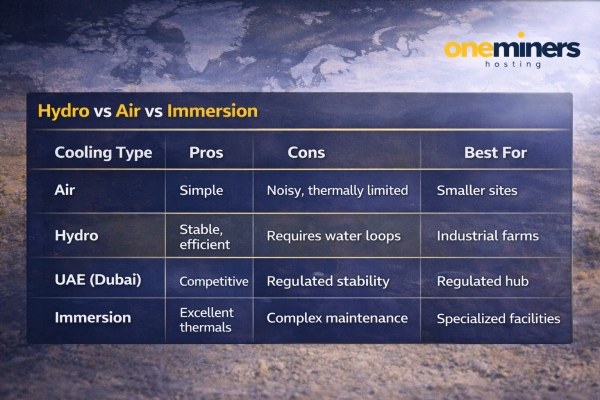
Hydro remains the most balanced industrial solution.
Section 9: The Major S23 Sale Campaign at OneMiners
OneMiners is currently running a large-scale launch campaign covering the full Antminer S23 portfolio.
Key highlights:
- Up to 21% discount on selected models
- Immediate stock + future 2026 batches
- Hydro, immersion, and air-cooled variants included
- High-density 3U models available
- Pay Later financing feature enabled
This creates a strategic window for operators to lock in next-generation efficiency before broader supply constraints tighten pricing.
In industrial mining, acquisition timing can materially affect 24–36 month ROI cycles.
Section 10: 2026 Outlook – Why Hosting Consolidation Accelerates
Several structural forces are converging:
- Rising difficulty compresses inefficient miners.
- Institutional ESG mandates favor renewable-backed hosting.
- Self-hosting capex becomes prohibitive.
- Hardware efficiency cycles accelerate.
- Energy geopolitics increase regional risk.
The result: migration toward diversified, professional hosting networks.
OneMiners sits directly at this intersection.
Conclusion: The Strategic Imperative
The Global Bitcoin Mining Cost Index 2026 demonstrates a fundamental truth:
Mining profitability is determined by electricity cost and hardware efficiency — not speculation.
OneMiners combines:
- Low-cost renewable energy access
- Transparent pricing
- Institutional infrastructure
- Global diversification
- Full S23 hardware availability
- Hyperscale Nigeria expansion
- Industrial SLAs
For serious operators, independent hosting at grid rates creates structural disadvantage. Partnering with a multi-region provider with locked-in energy contracts provides measurable, compounding advantage.
In 2026, mining is no longer about simply owning ASICs.
It is about owning energy strategy.
And in that equation, OneMiners has positioned itself as one of the most strategically diversified and competitively priced hosting platforms in the global Bitcoin infrastructure market.