
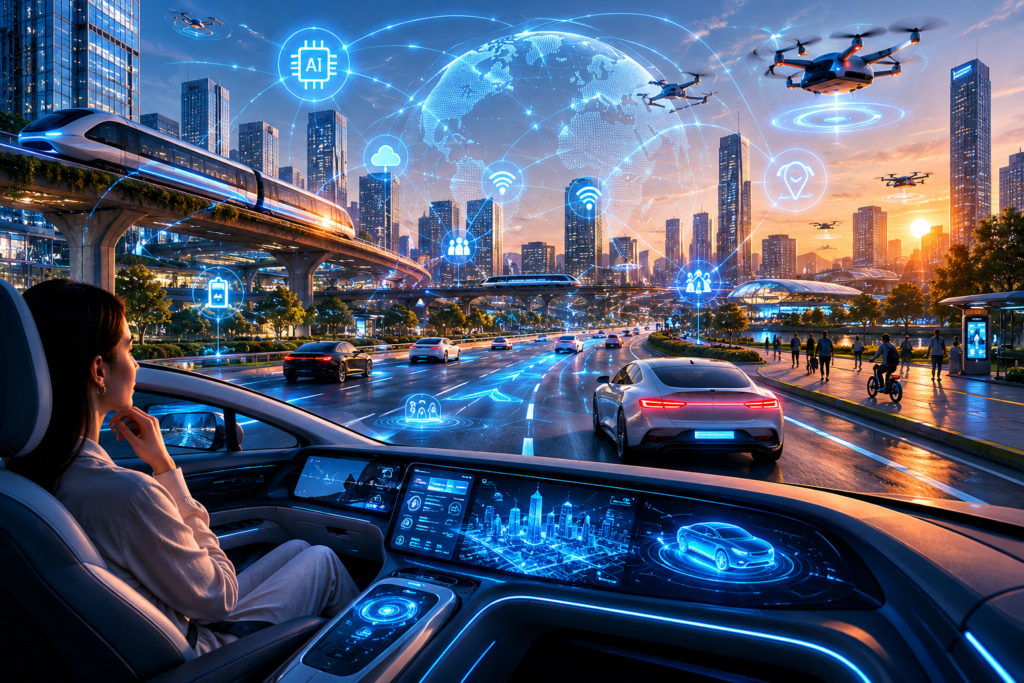
Introduction: Transportation Is Becoming a Connected System, Not a Product
For more than a century, transportation has been defined by ownership: a driver, a vehicle, and a journey from A to B. That model is now shifting. Over the next decade, mobility will increasingly operate as a connected ecosystem where vehicles, infrastructure, and digital systems communicate continuously.
Artificial intelligence (AI), the Internet of Things (IoT), and advanced automation are converging to reshape not just how vehicles move, but how entire transport networks function. Cars are becoming nodes in a wider intelligent system rather than standalone machines.
This transformation is subtle in its early stages, but its long-term implications are profound.
AI as the New Driving Intelligence Layer
AI is moving from a supporting feature in vehicles to a core operational layer. Modern vehicles already use AI for navigation, driver assistance, and predictive maintenance, but future systems will go far beyond that.
The next generation of AI-enabled mobility will focus on:
- Continuous real-time route optimisation based on traffic, weather, and demand patterns
- Predictive energy management for electric vehicles
- Adaptive driving behaviour that learns from environment and user preferences
- Fleet-level coordination across shared mobility systems
Instead of reacting to conditions, vehicles will increasingly anticipate them. This shift moves driving intelligence from the human operator into a distributed computational system spanning cloud infrastructure, roadside sensors, and onboard processing units.
IoT Infrastructure: The Silent Backbone of Smart Mobility
The Internet of Things is the connective tissue that enables AI-driven transportation. Road infrastructure is gradually becoming instrumented with sensors that monitor traffic flow, congestion, surface conditions, and environmental data.
At the same time, vehicles themselves are becoming highly connected devices. Modern cars can already exchange data with:
- Traffic management systems
- Other vehicles (vehicle-to-vehicle communication)
- Smart city infrastructure (vehicle-to-infrastructure systems)
- Energy grids for EV charging optimisation
As this network expands, mobility becomes less about isolated decision-making and more about system-wide coordination. A traffic jam, for example, is no longer just a local disruption—it becomes a data event that can be predicted, rerouted, and mitigated dynamically.
Automation Beyond Autonomy: The Gradual Redefinition of Driving
While fully autonomous vehicles remain a long-term goal, the more immediate transformation lies in incremental automation. Most of the next decade will not be defined by driverless cars everywhere, but by layered autonomy:
- Assisted driving in dense urban environments
- Automated highway cruising systems
- Remote fleet management for logistics and delivery
- Semi-autonomous shared mobility services
This hybrid model creates a transitional phase where human drivers and AI systems coexist. In practice, this means transportation will feel increasingly automated even when full autonomy is not yet universal.
Mobility as a Service: The Decline of Pure Ownership Models
One of the most significant structural changes driven by AI and connectivity is the shift away from traditional vehicle ownership.
Mobility is increasingly being reframed as a service layer rather than a product purchase. This includes:
- On-demand ride services powered by AI dispatch systems
- Subscription-based access to vehicles
- Dynamic fleet allocation in urban environments
- Integrated multimodal transport platforms combining public and private options
In this model, the “car” becomes interchangeable infrastructure rather than a long-term possession. AI enables these systems to operate efficiently by balancing supply and demand in real time.
Data as the Fuel of Modern Transportation
If oil defined the 20th-century transport system, data defines the 21st.
Every connected vehicle generates continuous streams of information: location, performance metrics, driver behaviour, energy consumption, and environmental conditions. When aggregated, this data becomes the foundation for system-wide optimisation.
Key applications include:
- Predictive traffic modelling across entire cities
- Real-time fleet balancing for logistics networks
- Insurance models based on driving behaviour analytics
- Continuous improvement of autonomous driving algorithms
However, this also introduces new challenges around data ownership, privacy, and cybersecurity. As vehicles become more connected, they also become more exposed to digital risk.
Human Experience in an AI-Driven Mobility World
Despite the technological complexity, the human experience remains central. The most successful mobility systems will not simply be the most automated, but the most intuitive.
Designers and engineers are increasingly focused on:
- Reducing cognitive load for drivers and passengers
- Creating seamless transitions between manual and automated control
- Enhancing in-vehicle interfaces through voice, gesture, and predictive UI
- Building trust in AI decision-making systems
In parallel, personalisation is becoming more important. As vehicles become more standardised mechanically, differentiation shifts toward digital experience, interior design, and subtle physical details.
Even traditional automotive presentation elements continue to evolve in this context. Details such as exterior finishing, lighting signatures, and registration presentation contribute to how a vehicle is perceived within increasingly digital and visually driven environments. Specialist manufacturers like Plates Express operate within this broader ecosystem of vehicle presentation, where clarity, consistency, and design alignment matter as much as functionality.
The City as a Co-Processor: Smart Environments and Mobility Networks
Future transportation systems will not operate in isolation from their surroundings. Cities themselves are becoming computational environments that actively participate in mobility management.
Smart infrastructure will increasingly:
- Adjust traffic signals dynamically using AI predictions
- Prioritise emergency and public transport routing in real time
- Integrate energy distribution with EV charging demand
- Use digital twins to simulate traffic conditions before implementing changes
In this model, the city acts almost like a co-processor, extending the intelligence of individual vehicles into a larger distributed system.
Conclusion: From Vehicles to Ecosystems
The convergence of AI, IoT, and automation is redefining transportation at a systemic level. What is emerging is not simply a new generation of cars, but a new kind of mobility infrastructure—one that is intelligent, interconnected, and continuously adaptive.
Over the next decade, the boundaries between vehicle, road, and digital platform will continue to blur. Transportation will become less about isolated journeys and more about participation in a living network of data, infrastructure, and automated decision-making.
In this environment, mobility is no longer just something we use—it is something we are part of.