
Medical school admissions are still quite difficult. Universities are always creating new exams and evaluations in order to ascertain which applicants are most suitable for a medical degree and the ensuing medical profession, given the large volume of potential students.
One of them is the recently developed CASPer exam, which is being used as part of the medical admissions process by a few Australian institutions.
To ensure that you are as prepared as possible to ace every medical entrance stage, it is imperative that you have a solid grasp of the assessments used for medical entry and that you engage in focused preparation. We will talk about the new CASPer exam in this blog article, along with what it entails, which Australian universities use it for admissions, and some preparation advice for the day of the test.
Why use a test like CASPer?
Universities always seek for economic strategies to narrow down the pool of interview applicants since medical interviews are a costly means of assessing potential medical candidates. Using an exam where the student pays for the evaluation (like in UCAT) instead of the institution is even more advantageous for universities. Both of these goals are met by the CASPer exam, which is an additional obstacle that prospective medical students must clear to be admitted.
What is the CASPer test?
Computer-Based Assessment for Sampling Personal Characteristics is what CASPer stands for. McMaster University (in Canada) created and has been using it as an entrance exam since 2010. For context, it’s important to remember that McMaster University also created the Multiple Mini Interviews (MMI), which are frequently used for medical admission.
During the pre-screening phase of the application process, the CASPer exam was designed to evaluate the personal and professional qualities of academic applicants. Currently, more than 70 medical schools throughout the world use it. The major reason CASPer is criticized is because of its opaque scoring system.
CASPer is managed by a third-party supplier called Acuity Insights. In essence, CASPer is an online situational judgement test; that is, it presents students with made-up scenarios and asks them to make judgements.
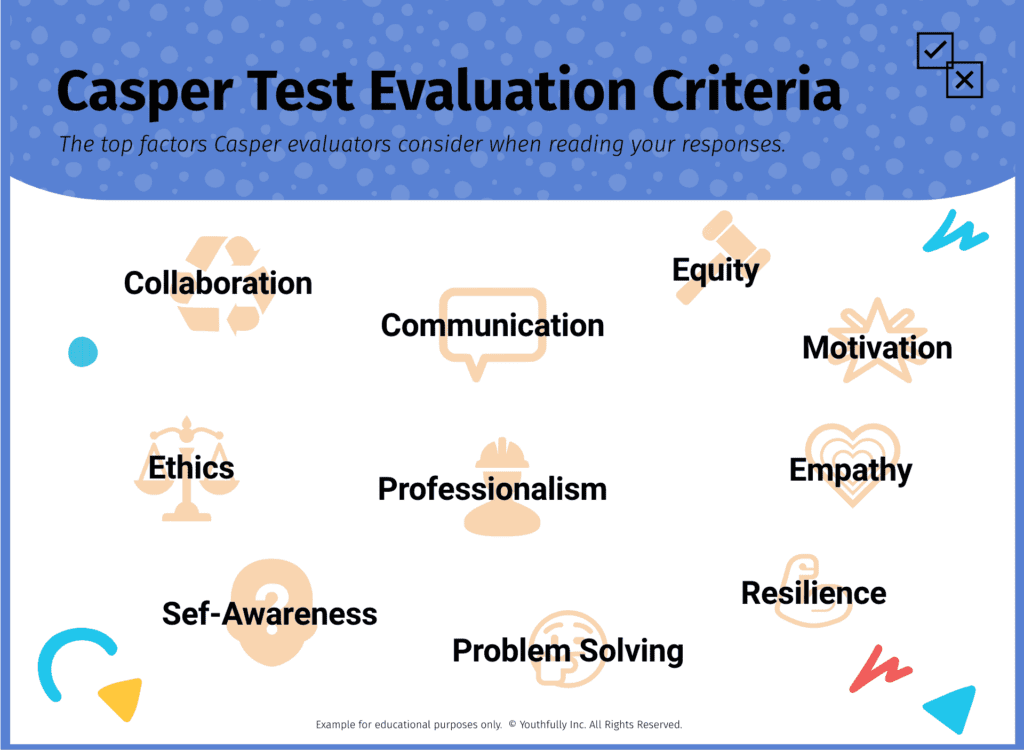
Ten domains that are thought to be crucial for successful medical practice but are not addressed by more conventional exams like the UCAT or GAMSAT are evaluated by CASPer:
- Collaboration
- Empathy
- Communication
- Equity
- Motivation
- Ethics
- Problem Solving
- Resilience
- Professionalism
- Self-Awareness
Students must answer open-ended questions on the provided scenarios—which are delivered in both written and video form—during the CASPer exam. Students reply to the CASPer test questions in two ways: first, they use their webcams to make brief videos, and second, they write answers. There is an optional brief break for students in between each segment.
The CASPer exam lasts between 90 and 110 minutes. Students film two one-minute videos in order to provide a video answer. Students create three written replies in five minutes while responding to questions.
The UCAT Situational Judgement Test, which has closed-ended, non-video questions, and interviews, which are often lengthier and live, are more similar to each other than the CASPer.
What part does CASPer play?
Universities have long endeavored to evaluate these areas instead of depending exclusively on academic scores like the ATAR when deciding which candidates to admit into medical schools, acknowledging the significance of less readily quantified qualities like empathy to excellent medical practice.
Most Australian medical schools have long used one-on-one or panel interviews in their medical admissions process as a means of increasing the weight of soft skills in the medical entry process. However, colleges must invest a significant amount of labor in conducting interviews, therefore only a select few applicants who succeed academically and on tests are invited to do so. Universities can evaluate these abilities across the board, at an earlier stage of the medical admissions process, thanks to the CASPer exam.
Before making an offer of admission, medical schools consider a variety of factors, usually including a candidate’s academic standing, UCAT score, and interview performance. Similar to this, universities that offer CASPer will evaluate candidates using it as one element. It may be possible to somewhat offset subpar performance in other domains with strong CASPer test performance, and vice versa.
Naturally, the best way to increase your chances of getting into any medical school for which you are applying is to prepare well for every exam component.
Which academic institutions employ CASPer?
Acuity reports that the following Australasian institutions will be utilizing CASPer as a required part of their evaluation matrix for the 2023–2024 medical admissions cycle:
- Curtin University (undergraduate medicine)
- University of Wollongong (postgraduate medicine)
- University of Notre Dame (postgraduate medicine)
Furthermore, CASPer has been embraced by several international medical schools as an evaluation tool for prospective physicians. If you want to apply to any university, be careful to review the admissions materials they have supplied to find out if they use Casper as part of their medical admissions process.
How can I prepare for CASPer Excellently?
Acuity Insights, the business that administers CASPer, offers several helpful tools on its website for prospective applicants, such as a video that explains how to apply for and take the exam.
There are several reasons why candidates should make sure they finish the mock test.
- Candidates who are familiar with the practice test will feel less nervous when taking the actual CASPer exam.
- Candidates who are exposed to the types of questions included in CASPer will be better able to develop appropriate responses to less familiar question categories, such as equity, resilience, and self-awareness.
- Candidates who have a solid understanding of the CASPer structure will be better able to manage their time.
Naturally, you should confirm that you have scheduled your CASPer test session well in advance, that your hardware—which includes a camera and steady internet—is up to par, that you’ve had enough sleep, and that you’ve had a satisfying meal before the test.
Our experience has shown that examinations like CASPer, which place a heavy emphasis on soft skills, can be disorienting for students accustomed to taking school exams. The following tips will assist students in getting ready for the CASPer exam:
- We advise students to take notes on the situations provided in the practice CASPer exam and generate thoughts and potential answers without using a timer, in addition to finishing the test within the allotted time.
- Speaking with friends and family may be a fantastic approach to acquire a variety of viewpoints. Acuity will examine applicants’ replies using a variety of markers with diverse viewpoints.
- Consider why you believe your prepared response to the CASPer exam questions is the best one. This will help you prepare for the test. To show the marker that you have a thorough comprehension of the situation, you might incorporate this information into your response.
- Think about which of the 10 domains practice questions are likely to fall into and how you might tailor your answers to those domains while answering them. Acuity is open about the domains that CASPer evaluates, and you can take advantage of this information. Think about coming up with fresh questions and possible answers that would fall inside the respective areas. (This is a fantastic assignment to complete in pairs!)
- Take some time to consider the various areas. For you, what does each mean? When was the last time you demonstrated that quality? Why is this relevant to a doctor or medical student?
CASPer is a cross between the Situational Judgement Test of UCAT and medical interviews, therefore it would be beneficial to practice both types of questions (Medic Mind offers them), especially the open-ended ones.
Students may record their responses to Medic Mind’s creative, interactive question bank, which gives them excellent preparation for the CASPer exam.