
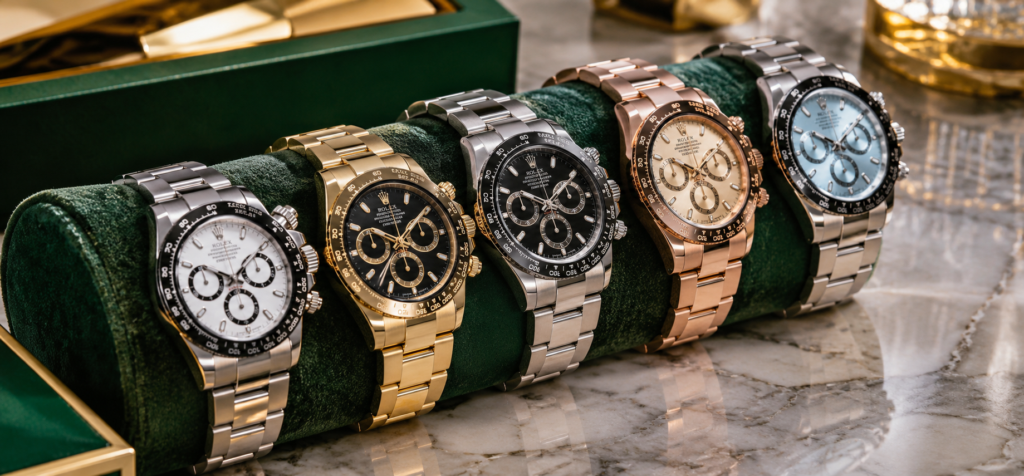
Ask anyone who follows the replica watch market which chronograph sells best, and the answer barely changes from year to year: the Rolex Cosmograph Daytona. In bestseller lists for replica watch collections, the Daytona usually ranks second overall, right behind the Submariner and ahead of the Omega Seamaster, the Patek Philippe Nautilus and the Audemars Piguet Royal Oak. That popularity has pushed factories to put more effort into the Daytona than into almost any other model, and buyers now have more versions, dial colours and movement choices to sort through than ever.
This guide ranks the Daytona references that buyers pick most often, explains what separates a strong version from a weak one, and walks through the movement and factory questions that matter before you pay. If you are still browsing the wider brand range, the Selected Premium Super Clone Rolex Watches collection is a useful way to see how the Daytona compares with the Submariner, GMT-Master II and Datejust options built on the same generation of clone movements.
Why the Daytona Became the Flagship of the Clone World
For a long time, a replica Daytona meant a modified 7750 chronograph movement hidden under a Rolex-style dial. Those watches worked, but they were noticeably thicker than the real thing, the sub-dial layout had to be faked, and the time-setting and chronograph behaviour did not match the original. Collectors could spot them simply by looking at the case from the side.
That changed when the Dandong movement factory produced a fully tooled clone of the Rolex calibre 4130. It was the first time a replica chronograph had an integrated movement with the same architecture as the original, and it reset the whole category. Today the 4130 and its successor, the 4131, are still the only clone chronograph movements built as true integrated calibres for a mainstream model. Most other replica chronographs, from Breitling to IWC, still rely on a 7750 base with a decorative plate on top, because only a model that sells in very large numbers justifies the cost of tooling a dedicated movement.
The result is that the Daytona is where factories compete hardest. Hands, centre pinions, dial printing and bezel engraving on the top versions are now close enough that, at normal conversational distance, telling them from a genuine watch is very difficult.
The white “Panda” dial with black sub-dials and a black ceramic bezel remains the most requested Daytona configuration.
How This Ranking Was Put Together
The ranking below is based on how often each reference appears at the top of replica bestseller lists, combined with how mature each version is in terms of build quality. Four things carry the most weight:
- Movement: whether the watch runs on a Dandong 4130 or 4131, a Shanghai-made 4131, a simplified 4801, or an older 7750-based movement.
- Dial and hands: colour accuracy, printing depth, the shape of the hour markers and the centre pinion.
- Case and bracelet: finishing, correct thickness and clasp construction.
- Weight and materials: especially important for the gold and platinum references, where the genuine watch is far heavier than steel.
No. 1: The Steel “Panda” Daytona (116500LN and 126500LN)
If you only ever buy one Daytona, odds are it will be this one. To Buy Super Clone Rolex Daytona Watches with the least risk, start with the white-dial steel model, because it is the reference every major factory treats as its showcase. It is also a steel watch in real life, so there is no weight gap to worry about: a well-made steel replica weighs around 142 grams against roughly 145 grams for a genuine example, a difference you cannot feel on the wrist.
There are now two generations to choose from. The older 116500LN uses the 4130 movement; the newer 126500LN uses the 4131. You can tell them apart from the front with a few details:
- The new 126500LN has a thin metal rim around the ceramic bezel; the 116500LN does not.
- The new hour markers are longer and slimmer, while the old ones are shorter and wider.
- The new sub-dial rings are thinner, and the crystal sits slightly higher.
- The newer case is slimmer. Measured figures commonly quoted are about 11.9 mm thick for the 126500LN, compared with roughly 12.2 to 12.4 mm for the 116500LN.
Dial colour is the main point of debate on the Panda. Genuine Daytona dials come in noticeably different whites across production batches, from cool white to warm ivory, and older watches can turn slightly cream after years of sunlight. Some factories have shipped a cool, slightly bluish white, others a warmer ivory tone. Neither is automatically “wrong”, but if you have a specific reference photo in mind, check which white the version you are looking at uses.
The newer 126500LN Panda on the wrist, with the thinner case and the metal rim around the ceramic bezel.
No. 2: The Black Dial Steel Daytona
The black-dial version of the same steel watch comes a close second. It shares the case, bracelet and movement options with the Panda, so the buying advice is largely the same. The details worth checking are on the dial:
- Sub-dial rings: on the better recent batches, the three sub-dial rings have a matte, grey finish closer to the original. Earlier versions were too bright and white.
- Crystal clarity: a black-dial ceramic and a black-dial steel bezel version can look like different dial colours, but often the difference is simply how clear the crystal is. The genuine crystal has a slightly soft look, so more transparency is not always more accurate.
- Centre pinion: look for a solid, rounded “mushroom” shaped pinion that catches the light. Hollow or dented pinions are a sign of a lower-tier build.
A black-dial 116500LN. The silver sub-dial rings and the depth of the bezel engraving are the details worth comparing between versions.
No. 3: The Oysterflex Models (116518LN, 116519LN, 126519LN)
The rubber-strap Daytonas, including the grey-dial white gold model and the yellow gold model with a black dial nicknamed after a famous musician, are the third most popular group. They look sportier, they are lighter, and they suit warm weather well.
The strap is where most buyers run into trouble. Oysterflex-style straps come in fixed lengths, and the older clasp only offers a small amount of adjustment. A wrist of around 18 cm is comfortable on the standard strap, while an 18.5 cm wrist is already tight. Measure your wrist before ordering, and ask which strap length is supplied, because some versions ship with a mix of sizes and others let you choose.
The newer generation brought a sliding quick-adjust system inside the clasp, similar to the one used on the current genuine models, which allows roughly 1.5 cm of extra adjustment without tools. If comfort matters more to you than reference year, this alone is a reason to pick a 4131-era version.
A yellow gold-tone 116518LN with a meteorite-style dial on the black rubber strap.
No. 4: Gold and Everose Daytonas (116508, 116515LN, 126515LN)
Full gold Daytonas, including the green-dial yellow gold 116508 and the Everose rubber-strap models, attract a lot of attention but involve more compromises. The genuine watches are solid 18k gold. Replicas use 904L steel cases with a plated gold finish, which creates two issues.
Weight. A plain plated steel case is far lighter than the real thing, often by 40 to 50 grams on a full bracelet model. Several factories now offer “weighted” versions that use a denser case material to close the gap. Reported figures for weighted rubber-strap models sit around 136 to 137 grams, compared with 150 grams or more for the genuine watch, so the difference is smaller but not gone.
Plating durability. Gold plating looks bright when new, but surfaces that rub against a desk or a sleeve will dull over time, and a heavy knock can expose the base metal. Opinions differ on weighted cases: some versions have been criticised for peeling after long use, while the more recent one-piece weighted cases from the larger factories have so far held up without peeling. If you are choosing between gold models, ask how the case is weighted and how the gold colour is applied. Also note that genuine 18k yellow gold is a soft, pale yellow; a replica that looks very bright yellow is less accurate, not more.
The Everose 126515LN with a black dial and rose-toned sub-dials. Plating colour and case weight are the main things to check on gold models.
The green-dial 116508 in yellow gold, one of the most recognisable full-gold Daytonas.
No. 5: The Ice Blue Platinum Daytona
The ice blue dial with a chestnut-brown ceramic bezel is the most expensive Daytona in real life, and it is popular as a replica because it looks so distinctive. It is also the reference where a replica is least convincing in the hand. The genuine watch is 950 platinum and weighs roughly 260 to 280 grams. Even the heaviest weighted replicas currently reported come in at around 165 to 176 grams, because the bracelet and clasp are usually not weighted.
If the look is what you want, it is a striking watch. Just accept that it will never feel like platinum, and do not pay a large premium expecting it to.
Movements Explained: 4130, 4131, 4801 and 7750
The movement is the biggest single difference between a top Daytona and an average one, and it is also where sellers are most often vague. Here is how the common options compare, based on the figures most often reported for each.
| Movement | Winding | Power reserve (reported) | Notes |
| Dandong 4130 | Bidirectional automatic | About 60 to 70 hours | The original integrated clone calibre; widely regarded as the most reliable clone chronograph movement |
| Dandong 4131 | Bidirectional automatic | About 70 hours | Same structure as the 4130, with updated decoration and a quieter rotor; used in the new 126500 generation |
| Shanghai 4131 | Bidirectional automatic | About 70 hours | Used by some factories; generally rated slightly below the Dandong version, though some batches were specially regulated |
| 4801 / 4802 | Single-direction automatic | About 50 to 60 hours | A simplified version of the integrated calibre for budget models; same external parts, still far more stable than a 7750 |
| 7750-based | Automatic | Varies | Older approach; thicker unless heavily modified, and generally less reliable |
A few practical points about these movements:
- Time-setting direction used to be a quick test. On a 4130, the hands move clockwise when you turn the crown one way, and on a 7750 they move the opposite way. Modified 7750 movements can now copy this behaviour, so it is no longer a reliable check on its own.
- Opening the caseback is the only certain check. A cheap rubber case-opener ball removes the screw-down back without scratching it. A genuine-architecture 4130 or 4131 is easy to recognise once you have seen one.
- Accuracy is good but not perfect. Daily rates of a few seconds are commonly reported, and many units ship running a few seconds fast and can be regulated. The chronograph itself can drift by several seconds over a long timing run.
- Service matters. After two or three years of daily wear, the movement typically needs cleaning and fresh oil to keep good timekeeping.
The integrated 4131-type movement behind an opened caseback. This view is the most reliable way to confirm which movement a watch uses.
Which Factories Lead on the Daytona
Factory names come and go, and the market has changed a lot in the past two years. This is the general picture based on the most consistent reports, but individual batches vary, so treat it as a starting point rather than a guarantee.
| Factory | Known for | Things to watch |
| VS | Dandong 4131 on the new generation, three movement tiers on the Panda, well-regarded weighted cases on precious-metal models | Gold plating on some earlier yellow gold models has been criticised; some recent Panda batches had slightly wide sub-dial rings |
| Clean / V (C+) | Long seen as the benchmark for dial printing, hands and bracelet finishing | The original Clean operation reportedly closed in 2025; a successor using much of its tooling sells under a new name, and reports on continuity differ |
| BT | Dandong 4130 from early on, accurate thickness, strong centre pinions and hand alignment | Quality control is less consistent than the top two; dial printing was the weak point on early versions |
| APS | Good value, accurate lume colour and engraving on recent batches | Uses a Shanghai movement rather than Dandong |
| QF, CBD and others | Focus on heavier weighted cases for gold and platinum models | Weighting methods differ; ask whether the bracelet is weighted as well as the case |
One point that experienced buyers repeat: once the parts of the top Daytonas are separated, even traders who handle them every day struggle to tell which factory made which component. The gap between the leading factories is small, and the movement inside matters more than the name on the listing.
Case profile with screw-down pushers. Correct thickness is one of the clearest signs of an integrated movement rather than a 7750 conversion.
A Short Pre-Purchase Checklist
- Confirm the movement in writing. Ask whether it is a Dandong 4130, Dandong 4131, Shanghai 4131 or a 4801-type movement, and ask for a caseback photo if the listing does not show one.
- Check the generation. Make sure the case details (bezel rim, marker shape, thickness) match the reference number you are paying for.
- Look at the centre pinion. It should be solid, rounded and slightly raised, not hollow.
- Ask about weight if you are buying gold or platinum, and whether the bracelet and clasp are weighted or only the case.
- Measure your wrist before ordering any Oysterflex model.
- Do not rely on stickers, cards or clasp codes. Packaging, protective stickers and clasp codes can all be copied by lower-tier sellers.
Living With a Daytona: Chronograph and Care Tips
A few habits will keep the movement healthy for years:
- Start, stop, then reset. Use the top pusher to start and stop the chronograph and the bottom pusher to reset. Never press reset while the chronograph is still running, and never press both pushers at once.
- Screw the pushers and crown back down. Water resistance depends on it.
- Wind gently when new. Twenty to thirty turns of the crown is enough to get the watch running; there is no need to force it.
- Use the chronograph sparingly. Running it constantly uses up power faster and adds wear. With the chronograph running, the watch may stop well before its normal power reserve.
- Keep it away from steam. Splashes and swimming are generally fine with the crown screwed down, but hot showers and saunas can cause condensation under the crystal.
Final Thoughts
The steel Panda remains the safest and most satisfying Daytona to buy, followed closely by the black dial version. Both are steel watches in real life, so a well-made replica gives up almost nothing in weight or feel. The Oysterflex models are a great choice once you have checked strap sizing, while the gold and platinum references look spectacular but always involve some compromise in weight. Whichever reference you choose, put the movement first: a Dandong 4130 or 4131 is what separates a Daytona you will enjoy for years from one that looks right but does not hold up.