
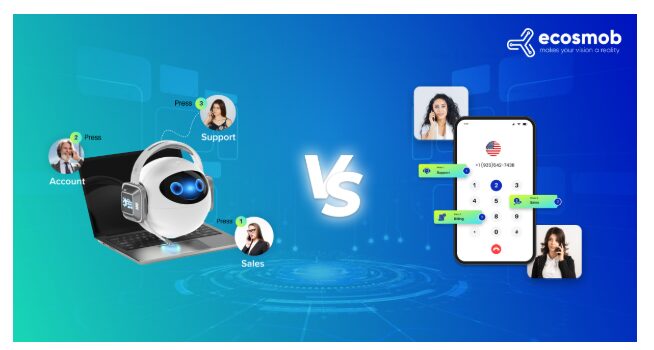
“Your call is important to us, please stay on the line…” — The most infamous sentence in customer service history.
If you’ve ever been trapped in a maze of robotic voice prompts, repeatedly pressing buttons with no resolution in sight, you’ve likely experienced a Traditional IVR system in action. While these systems were revolutionary in their time, the modern customer expects more!
- More instant solutions,
- intelligent routing, and
- human-like interaction.
That’s where Smart IVR solutions come in.
In today’s business landscape, where every second counts and customer experience is king, choosing between a Smart IVR and a Traditional IVR system is not just a tech decision, it’s a strategic one.
| According to a report by Zendesk, 70% of customers now expect personalized and intelligent interactions when they contact support.
Another study by Salesforce reveals that 75% of customers will leave a brand due to poor service. |
Clearly, the type of IVR you deploy directly impacts your customer satisfaction, operational efficiency, and even sales performance.
Whether you’re an enterprise leader, startup founder, or call center manager, understanding the difference between IVR systems can help you make the right investment and future-proof your communication infrastructure.
What is Smart IVR?
Smart IVR, also known as AI-powered or intelligent IVR, is a modern upgrade to traditional systems. Rather than relying solely on static menus and rigid call flows, a Smart IVR system leverages AI, machine learning, NLP (Natural Language Processing), and real-time analytics to handle customer calls more effectively.
Think of it as a virtual assistant for your business phone line. When customers call, Smart IVR doesn’t just route them based on button presses; it understands their voice input, context, past interaction data, and intent. It can make decisions, provide personalized responses, and escalate complex issues to human agents with full context.
Smart IVR features and benefits also include multilingual support, integration with CRM tools, self-service options, and real-time call analytics. These systems are dynamic, adaptive, and scalable, ideal for businesses wanting to improve efficiency without sacrificing user experience.
It’s no surprise that modern IVR for business is becoming synonymous with intelligent, AI-driven automation.
But, to fully appreciate the leap that Smart IVR represents, it’s essential to understand the foundation it builds upon, Traditional IVR.
What is a Traditional IVR?
Traditional IVR systems have been around for decades. They work on DTMF (Dual Tone Multi Frequency) signaling, allowing customers to navigate pre-recorded menu options by pressing specific keys on their phone. These systems are rule-based, static, and can only function within the framework of what’s been manually programmed.
While Traditional IVR use cases still exist, especially for small businesses or low-volume call centers, they come with clear limitations. They can’t adapt to user behavior in real-time, can’t learn from past interactions, and certainly don’t provide the fluid conversational experience that AI-powered systems offer.
That said, the traditional IVR benefits lie in their simplicity and lower upfront costs. They’re easier to implement, require less technical expertise, and are suitable for organizations with limited automation needs.
Now that we’ve defined traditional IVR, it’s time to examine the roadblocks businesses encounter when relying solely on these outdated systems.
What are the Challenges Faced in Traditional IVR?
Although Traditional IVR use cases exist in smaller setups or budget-limited operations, they come with significant downsides that can impact both customers and internal teams. Here are some of the common challenges businesses face:
- Rigid Call Flows – Traditional IVR systems work on static logic, meaning once the menu is built, it cannot adapt to caller behavior or preferences in real time. This rigidity frustrates users, especially during urgent or unique queries.
- Poor User Experience – Long, complex menus often lead to caller confusion or premature hang-ups. There’s no real engagement or personalization, and the caller feels like just another ticket number.
- Limited Scalability – Traditional IVR systems don’t scale easily. Adding new languages, departments, or support logic often requires reprogramming or rebuilding the entire structure, which is time-consuming and costly.
- Low Resolution Rates – Most traditional IVRs simply route calls and fail to resolve customer issues independently. This puts excessive pressure on live agents and increases wait times.
- No Contextual Awareness – These systems can’t remember previous interactions, caller data, or historical preferences. Each call is treated as a new one, causing repetitive inputs and slower responses.
- Lack of Insights – Traditional IVRs don’t offer deep analytics. You don’t know where users drop off, what issues are most common, or how to improve. This results in blind-spot decision-making.
Wrapping up our understanding of traditional IVR systems and their foundational role, it’s time to step into the world of next-gen IVR solutions. Now, let’s explore how a Smart IVR stands apart in functionality, intelligence, and outcomes compared to a traditional system.
How a Smart IVR Differs from a Traditional IVR
Choosing between a Smart and Traditional IVR is like deciding between a basic landline and a smartphone. One offers just the basics, while the other is loaded with advanced capabilities designed to make life easier. Here’s a detailed comparison of how Smart IVR differs from Traditional IVR systems:
- Input Handling & Interaction Style – Traditional IVR relies on DTMF tones (pressing buttons) for navigation. In contrast, Smart IVR uses natural language processing (NLP) to interpret voice commands, allowing users to speak freely, making interactions smoother and more human-like.
- Personalization & Context Awareness – Traditional IVR treats every caller the same, offering rigid, pre-set menus. Smart IVR adapts dynamically by analyzing previous interactions, caller behavior, and CRM data, providing a personalized experience each time.
- Decision-Making & Call Routing – Traditional IVRs follow linear logic trees and can’t deviate from scripted paths. Smart IVRs apply AI and machine learning to intelligently route calls based on user sentiment, urgency, and even predicted intent.
- Efficiency & Resolution Time – A key reason how Smart IVR reduces call handling time is its ability to understand queries accurately and respond with the right solution or direct them to the right agent instantly, unlike traditional systems, which often involve navigating endless menus.
- Scalability and Adaptability – Traditional IVR systems can’t easily scale with growing business needs. Smart IVR systems, however, scale seamlessly across geographies, languages, and time zones, ensuring consistent service delivery.
- System Integration – Traditional systems struggle to sync with CRMs or analytics tools. Smart IVR offers robust integrations with platforms like Salesforce, Zendesk, and HubSpot, creating a unified communication ecosystem.
Now that we understand the core differences, the natural question is, what do businesses actually gain from switching to Smart IVR?
Let’s explore the key benefits of intelligent IVR for enterprise communication and why it’s a game-changer.
What are the Benefits of a Smart IVR?
Modern businesses don’t just need automation, they need intelligent, responsive, and personalized automation. Smart IVR fits the bill perfectly. Let’s dive deep into the smart IVR benefits you can’t afford to miss:
- Enhanced Customer Experience – Customers don’t enjoy navigating long menu trees. Smart IVR simplifies this by using AI-powered IVR solutions to understand speech, intent, and emotions, leading to faster resolutions and happier callers.
- 24/7 Intelligent Availability – Unlike traditional systems that offer limited functionality after hours, Smart IVR delivers round-the-clock assistance with self-service capabilities. It reduces agent workload and ensures customers are never left hanging.
- Higher First-Call Resolution (FCR) – Smart IVRs use contextual data to resolve most issues on the first attempt, improving FCR rates. This means fewer repeat calls and a significant drop in overall call volume to live agents.
- Operational Cost Savings – By reducing agent dependency and automating repetitive queries, Smart IVRs help cut support costs drastically, making them a long-term investment with high ROI, unlike Traditional IVR costs that often escalate with expansion.
- Multilingual & Inclusive Communication – Smart IVRs come equipped with NLP engines capable of handling multiple languages and dialects, making customer support more accessible to a global audience.
- Real-Time Analytics & Insights – With Smart IVR, businesses gain insights into customer behavior, peak call times, and issue trends. This data can be used to optimize workflows, improve agent training, and enhance future support.
- Seamless Integration with Business Tools – Smart IVR works hand-in-hand with CRMs, ticketing systems, and knowledge bases. It offers modern IVR for business environments where data flow and continuity are vital.
Understanding both the and opportunities brings us to an important consideration, what lies ahead?
Let’s unpack how Smart IVR is poised to redefine enterprise communication in the near future.
What Can Be the Future Scope in Integrating Smart IVR?
The future of AI-powered IVR solutions goes beyond just automation. It’s about intelligent systems that anticipate needs, personalize at scale, and learn continuously. Here’s how Smart IVR is expected to evolve:
- Predictive Interaction Models – With historical data and AI, future Smart IVRs will predict the purpose of a call even before the customer finishes speaking. This will streamline interactions and reduce call times even further.
- Advanced Sentiment Analysis – Future IVRs will be able to detect customer emotions (anger, frustration, confusion) and escalate to human agents accordingly, enhancing empathy in automation.
- Omnichannel Synchronization – Choosing the right IVR system will also mean ensuring it works across phone, chat, email, and social media. Smart IVR will unify conversations across channels, maintaining context seamlessly.
- Voice Biometrics & Security – Authentication will become smarter with voice recognition, reducing fraud and making interactions more secure while removing friction in verification.
- Self-Optimizing Systems – With continuous feedback loops, AI IVRs will refine their own decision trees and interaction logic over time, making them smarter without manual intervention.
- Integration with Emerging Tech – As smart home devices, wearables, and AR interfaces grow, Smart IVR will integrate with these ecosystems, making support truly ubiquitous and effortless.
Wrapping Up
For businesses looking to modernize customer support, reduce overhead, and deliver a seamless user experience, integrating a Smart IVR solution is a strategic move. While Traditional IVR systems still serve basic needs, Smart IVR benefits far outweigh the limitations in today’s fast-paced digital world.
Key Takeaways
- Smart IVR uses AI and NLP to deliver personalized, efficient, and scalable customer interactions.
- Traditional IVR still works for basic call routing but lacks flexibility and user-friendliness.
- Choosing the right system impacts cost, satisfaction, and overall business performance.
How Ecosmob Can Help?
Ecosmob specializes in designing and deploying both Traditional IVR and Smart IVR solutions, tailored to your business needs. Whether you’re curious about what is Smart IVR, trying to understand the Traditional IVR costs, or looking to unlock the key benefits of intelligent IVR for enterprise communication, our experts can guide you.
We help you embrace modern IVR for business, reduce handling time, and elevate your customer support with AI-powered IVR solutions that are secure, scalable, and future-ready.
Read More From Techbullion