

Shipping label play an important role in modern shipping and logistics. They help businesses identify packages, communicate delivery information, and keep orders moving through warehouses, distribution centers, and transportation networks. Although a shipping label may look like a simple printed sticker, its material, adhesive, print quality, and overall durability can directly affect the delivery process.
For businesses that handle regular shipments, choosing the right shipping label is not just a purchasing decision. It is part of maintaining accurate order processing, reducing packaging problems, and creating a reliable shipping experience for customers.
Whether you operate an eCommerce store, manage a warehouse, or purchase packaging supplies for a distribution business, understanding how shipping label are made and what to look for in a supplier can help you make better decisions.
Quick Answer: What Should You Consider When Buying a Shipping Label?
When selecting a shipping label, businesses should focus on the following factors:
- Material quality: Choose a material that suits the packaging surface and shipping environment.
- Adhesive performance: Make sure the adhesive can hold securely during handling and transportation.
- Printing compatibility: Confirm that the shipping label works with your printing equipment.
- Print clarity: Ensure that addresses, tracking information, and barcodes remain easy to read.
- Durability: Consider exposure to handling, friction, moisture, and changing environmental conditions.
- Manufacturer reliability: Work with a supplier that can maintain consistent quality and meet your purchasing requirements.
These considerations help businesses select a shipping label that supports smooth operations rather than creating avoidable packaging and delivery issues.
1. Understand the Different Types of Shipping Label Materials
The material used for a shipping label affects its appearance, printing performance, and durability. Not every business has the same shipping requirements, so material selection should be based on the type of package, transportation conditions, and expected handling.
Paper shipping label are commonly used for everyday packaging. They are suitable for many standard shipping applications and offer a practical option for businesses that need to label a large number of parcels.
Synthetic materials may be more suitable when labels need additional resistance to moisture, friction, or rough handling. They are often considered for applications where ordinary paper labels may not provide the required durability.
Before selecting a material, buyers should consider:
- The surface on which the shipping label will be applied.
- Whether packages will be exposed to moisture or frequent handling.
- The expected storage and transportation conditions.
- The printing method used by the business.
- The level of durability required throughout the delivery process.
A suitable material helps keep shipping information visible and reduces the possibility of labels becoming damaged before packages reach their destinations.
2. Choose the Right Shipping Label for Your Business Application
Different industries use shipping labels in different ways. An eCommerce business may need labels for daily customer orders, while a warehouse may require consistent labeling across a large volume of outgoing packages.
Understanding the application before purchasing helps prevent unnecessary costs and ensures that the selected product supports the actual workflow. One important consideration is label size. Shipping labels are available in several dimensions, with each format designed to accommodate different amounts of delivery and tracking information.
Common Shipping Label Sizes
Some commonly used shipping label sizes include:
- 4 × 6 inches (100 × 150 mm): A widely used size for eCommerce and parcel shipping. It provides enough space for recipient and sender addresses, barcodes, tracking numbers, and carrier information.
- 4 × 4 inches (100 × 100 mm): Suitable for applications where a square label layout is preferred, such as certain package identification and shipping requirements.
- 4 × 2 inches (100 × 50 mm): A compact option for smaller packages or shipping workflows that require limited address and identification information.
- 4 × 8 inches (100 × 200 mm): Provides additional space for shipping details, handling instructions, and multiple identification elements when required.
The appropriate size depends on the carrier's label specifications, package dimensions, printer compatibility, and the amount of information that needs to be displayed. Buyers should always confirm the required dimensions before placing a bulk order.
Common Shipping Label Supply Formats
Shipping labels are also available in different supply formats. The right choice depends on the printing equipment, application process, and available workspace.
- Roll labels: Supplied in continuous rolls, these labels are commonly used with compatible thermal label printers. They are practical for businesses processing regular shipping orders and applying labels individually.
- Fanfold labels: Supplied as connected stacks of folded labels, fanfold formats are useful for high-volume shipping operations. They can be stored in stacks and fed through compatible printers without requiring a label roll.
- A4 label sheets: These contain multiple individual labels arranged on standard A4-sized sheets. They are suitable for businesses using compatible laser or inkjet printers and needing to print several shipping labels in one operation.
Business Application Important Shipping Label Requirements eCommerce businesses Clear printing, dependable adhesion, and consistent quality Warehouses Efficient application, readable information, and reliable supply Retail distribution Professional appearance and compatibility with packaging Manufacturing companies Consistent identification and dependable label performance Logistics providers Readable tracking information and durability during handling
For businesses processing frequent orders, consistency is especially important. A shipping label should perform reliably across repeated printing and application processes. Differences in material quality or adhesive performance can create operational difficulties when large quantities of packages are involved.
Before purchasing, buyers should check the required label dimensions, printer compatibility, supply format, roll or stack configuration, and adhesive performance. Selecting the correct combination helps improve printing efficiency and keeps shipping operations organized.
3. Select the Appropriate Adhesive for Shipping Label
Adhesive performance is one of the most important factors when choosing a shipping label. Even a clearly printed label can become ineffective if it starts peeling away during storage or transportation.
Different adhesives are designed for different surfaces and working conditions. A business shipping products in cardboard boxes may have different requirements from a company labeling plastic packaging or products stored in cold environments.
| Adhesive Type | Main Characteristics | Suitable Considerations |
|---|---|---|
| Permanent adhesive | Designed to provide strong, lasting attachment | Regular shipping and packaging applications |
| Removable adhesive | Allows labels to be removed more easily | Applications requiring temporary identification |
| High-tack adhesive | Offers stronger initial adhesion | Packaging surfaces that require additional bonding |
| Freezer-grade adhesive | Designed for specific low-temperature conditions | Cold storage and temperature-sensitive logistics |
The right adhesive should be selected according to the packaging surface and transportation environment. Buyers should not assume that one adhesive performs equally well on every material.
For example, cardboard, coated packaging, and plastic surfaces can respond differently to the same adhesive. Testing a shipping label on the actual packaging material is a practical way to evaluate its performance before placing a large order.
4. Check Printing Compatibility Before Purchasing
Printing compatibility is an important consideration when selecting shipping labels. A label must be suitable for the printer technology used by the business. Choosing incompatible materials can result in poor print quality, feeding problems, unclear barcodes, or unnecessary material waste.
Most thermal shipping label applications use one of two printing methods: direct thermal and thermal transfer. Although both technologies use heat to produce printed information, they work differently and require different label materials.
Direct Thermal Printing
Direct thermal printing uses specially coated, heat-sensitive label material. When the printer's heated printhead comes into contact with the label surface, the coating reacts to heat and produces text, barcodes, and other information.
This method does not require ink cartridges or thermal transfer ribbons, making it convenient for businesses that print shipping labels frequently. It is commonly used for eCommerce parcels, delivery labels, warehouse identification, and short-term logistics applications.
However, direct thermal labels can be sensitive to prolonged exposure to heat, sunlight, and certain environmental conditions. Buyers should consider the expected storage and transportation conditions before selecting this material.
Thermal Transfer Printing
Thermal transfer printing uses a heated printhead and a separate ink ribbon. During printing, heat transfers ink from the ribbon onto the label's surface, creating the required text, graphics, or barcode information.
This method can produce durable prints when the correct combination of label material and ribbon is selected. It is suitable for applications where shipping or identification labels may need to remain readable for longer periods or withstand more demanding handling conditions.
Thermal transfer printing requires compatible ribbons, so buyers should confirm the ribbon type and label face material before purchasing.
Key Differences Between the Two Methods
| Comparison Factor | Direct Thermal Printing | Thermal Transfer Printing |
|---|---|---|
| Printing process | Heat activates a coating on the label | Heat transfers ink from a ribbon |
| Ribbon requirement | No ribbon required | Requires a compatible ribbon |
| Label material | Heat-sensitive thermal material | Suitable face material compatible with the ribbon |
| Common applications | Parcel labels, delivery labels, and short-term shipping identification | Durable shipping labels, warehouse identification, and longer-term labeling |
| Print durability | More sensitive to heat, light, and environmental exposure | Can provide better durability depending on the material and ribbon |
| Consumables | Thermal label material | Label material and thermal transfer ribbon |
Before selecting a supplier, buyers should confirm the printing method supported by their equipment and check the following:
- Whether the label material is designed for direct thermal or thermal transfer printing.
- Whether the label feeds smoothly through the printer.
- Whether printed text, barcodes, and tracking information remain clear.
- Whether the selected material and ribbon combination is suitable for the intended application.
- Whether the supplier can provide samples for printer compatibility testing.
Testing samples before bulk purchasing helps identify compatibility problems early, reduce material waste, and prevent interruptions in daily shipping operations.
5. Maintain Clear Printing and Barcode Readability
A shipping label carries important information that helps packages move through the delivery network. This may include the recipient's address, sender details, tracking information, and machine-readable barcodes.
If this information becomes blurred, faded, or difficult to scan, it may create delays in package processing. Clear printing is therefore essential for businesses that depend on accurate shipment identification.
To maintain readable shipping label, companies should pay attention to:
Print quality: Text and barcodes should remain sharp and easy to recognize.
Material consistency: Uneven surfaces or poor-quality materials can affect printing results.
Adhesive placement: Adhesive should not interfere with important printed information.
Application process: Labels should be applied smoothly without wrinkles or folds.
Handling conditions: The selected material should suit the expected transportation and storage environment.
A reliable shipping label supports accurate package identification and helps reduce avoidable problems during sorting and delivery.
6. Why Choose a Reliable Shipping Label Manufacturer?
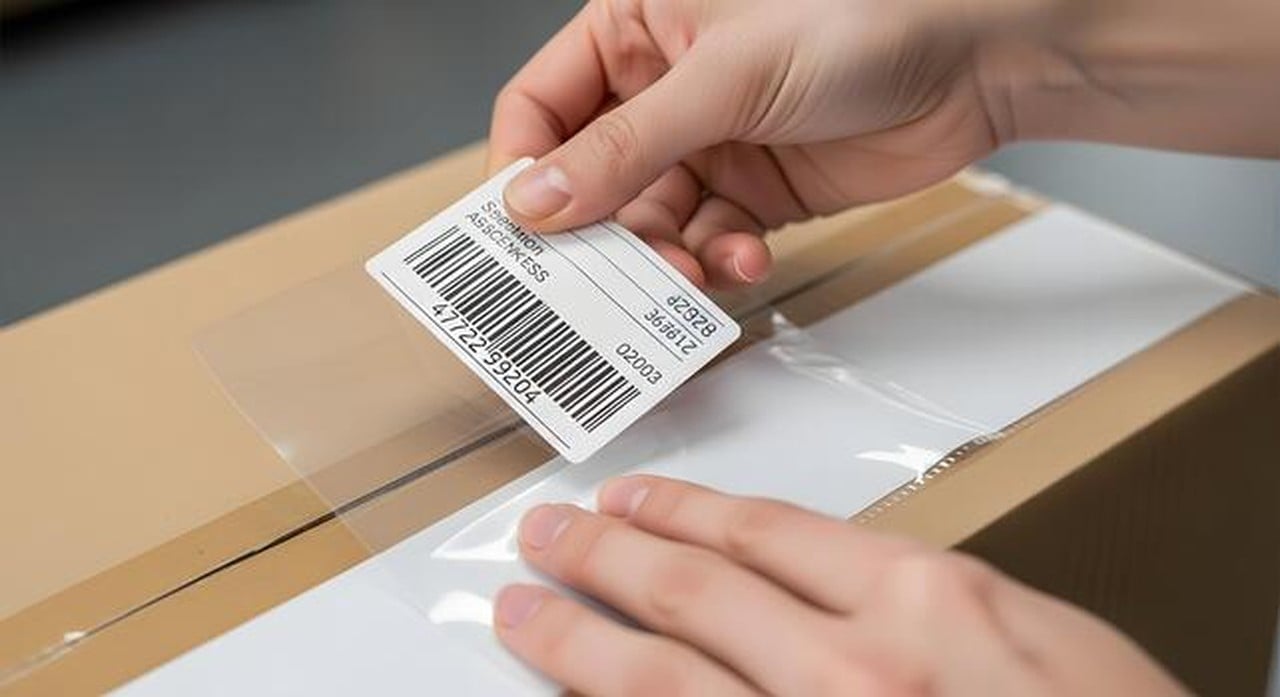
Choosing a manufacturer is about more than finding a supplier with competitive prices. Businesses need a manufacturing partner that understands their requirements and can provide consistent products over time. Production experience, material availability, customization options, and quality control all influence the reliability of a long-term supply relationship.
A reliable manufacturer should be able to discuss material options, adhesive requirements, printing compatibility, customization, and quality inspection. Clear communication is also important, particularly for international buyers who need to coordinate product specifications and delivery arrangements.
SailingLabel is a label manufacturer and supplier offering different labeling products for commercial and industrial applications. Its product range includes shipping labels, thermal labels, barcode labels, and other customized label solutions. Buyers can discuss requirements such as label dimensions, face materials, adhesive types, printing needs, and packaging according to their applications.
When evaluating a potential manufacturer such as SailingLabel, businesses should consider the company's production capabilities and its ability to support specific order requirements. It is important to confirm whether the manufacturer can provide the required label format, maintain consistent specifications across repeat orders, and accommodate the expected purchasing volume.
When evaluating a potential manufacturer, buyers should consider:
- Manufacturing experience: Experience with shipping labels and similar product applications.
- Material availability: Suitable face materials and adhesive options for different packaging surfaces.
- Customization options: Flexibility in label dimensions, layouts, printing, and packaging requirements.
- Quality inspection: Procedures for checking dimensions, cutting accuracy, printing quality, and adhesive performance.
- Sample availability: Opportunities to test label materials and printer compatibility before bulk purchasing.
- International order support: Clear communication about quotations, production schedules, packaging, and delivery arrangements.
Businesses can review available products and discuss their requirements through the SailingLabel official website.
Rather than choosing a supplier based only on its initial quotation, businesses should evaluate whether the manufacturer can meet their product requirements consistently. Comparing samples, confirming specifications, and discussing repeat-order arrangements can help establish a more reliable sourcing relationship.
7. Evaluate Shipping Label Quality Before Bulk Purchasing
Ordering samples before placing a large order is a practical step for businesses that want to reduce purchasing risks. A sample allows buyers to check whether the shipping label meets their expectations under actual working conditions.
Quality evaluation should cover more than the appearance of the product. Buyers should also assess its printing performance, adhesive strength, material consistency, and suitability for the intended packaging.
A useful quality-checking process includes:
Material inspection: Check whether the label surface is consistent and suitable for the intended application.
Adhesion testing: Apply the shipping label to the actual packaging material and observe whether it stays attached.
Printing evaluation: Print sample addresses and barcodes to check clarity and consistency.
Handling assessment: Check whether the label remains intact during normal package handling.
Application testing: Confirm that the label can be applied smoothly without unnecessary wrinkles or lifting.
These checks help businesses identify potential issues before committing to a larger purchase. They also give buyers a clearer basis for comparing different manufacturers.
8. Consider Packaging, Storage, and Long-Term Supply
Shipping label quality does not depend only on manufacturing. Proper packaging and storage also matter, particularly when businesses purchase labels in bulk.
Labels should be protected from excessive moisture, dust, direct sunlight, and unsuitable storage conditions. Poor storage can affect the adhesive or material and may reduce product performance before the labels are even used.
Businesses should also consider their long-term supply requirements. A supplier that can maintain consistent product specifications and communicate clearly about orders can make purchasing easier.
Before confirming an order, buyers should discuss:
- Product packaging and protection during transportation.
- Storage recommendations for unused labels.
- Availability of repeat orders.
- Consistency between different production batches.
- Customization and future purchasing requirements.
- Communication about order progress and delivery arrangements.
Planning these details helps businesses maintain a dependable supply of shipping label and avoid unnecessary interruptions in their packaging operations.
Frequently Asked Questions About Shipping Label
1. What is a shipping label used for?
A shipping label displays important delivery information, such as the recipient's address, sender details, and tracking information. It helps identify packages and supports sorting, handling, and delivery throughout the shipping process.
2. Which material is best for a shipping label?
The best material depends on the packaging surface and shipping environment. Paper materials are suitable for many everyday applications, while synthetic materials may be preferred when additional resistance to moisture or handling is required.
3. Why is adhesive quality important?
Adhesive quality determines how securely a shipping label stays attached to a package. Weak adhesion can cause labels to peel off during transportation, potentially affecting package identification and delivery.
4. Can shipping label be customized?
Yes. Depending on the manufacturer's capabilities, businesses may be able to customize material, adhesive, printing, and other product requirements according to their applications.
5. Should businesses test shipping label before bulk ordering?
Yes. Sample testing helps buyers evaluate printing compatibility, adhesion, material quality, and overall performance before making a larger purchasing commitment.
6. How can I choose a reliable shipping label manufacturer?
Compare manufacturers based on product quality, material options, customization support, inspection procedures, sample availability, communication, and their ability to maintain consistent supply.
Final Takeaway
Choosing the right shipping label requires more attention than simply selecting a product and comparing prices. Material quality, adhesive performance, printing compatibility, barcode readability, and supplier reliability all influence how well a label performs during everyday shipping operations.
Businesses should begin by understanding their packaging requirements and testing suitable products before placing bulk orders. Working with a manufacturer that can explain its available options and maintain consistent quality can also support long-term purchasing decisions.
By evaluating these factors carefully, businesses can select a shipping label that supports accurate identification, efficient packaging, and dependable delivery operations.
Previously in Business news: What Makes a Commercial Building Truly Intelligent?