
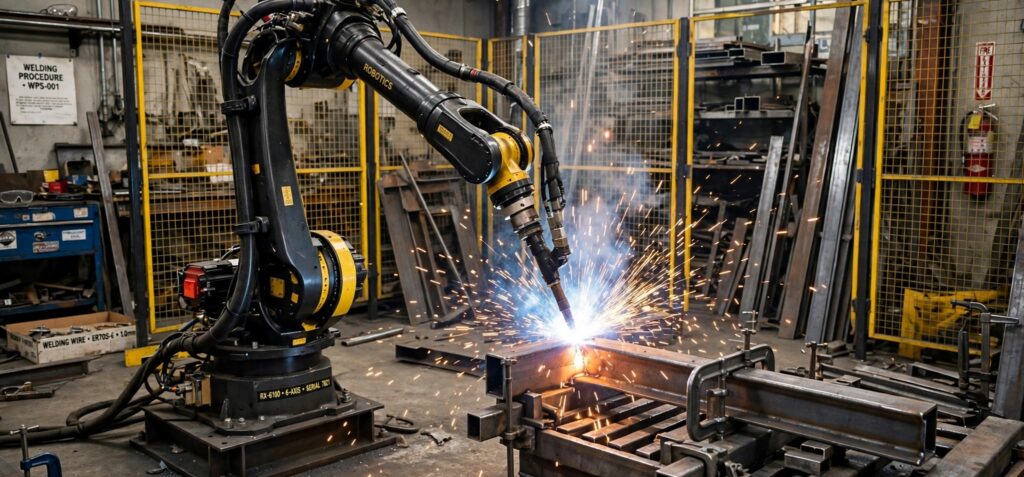
Most owners price their first robot the way they would price a press brake: one machine, one number, one payback line on a spreadsheet. Real quotations rarely work that way. By the time a cell is welding saleable parts, the arm is one entry among fixtures, a positioner, guarding, programming hours, training and a commissioning window during which that floor space earns nothing.
This piece is for owners and general managers of small and mid-sized structural steel and fabrication shops deciding whether the next capital dollar goes into automation or into another welding bay. It walks through the cost structure that Aubrik (Wuxi ABK Machinery), a welding equipment manufacturer in Wuxi, China, publishes for its robotic welding cell, machine and cobot routes, and sets it against workforce data from the American Welding Society and robot-safety guidance from OSHA.
What a robotic welding system actually includes
Start from an unglamorous definition: Aubrik describes the package as a robot plus its power source, positioner, tooling, guarding and controls, coordinated as one system. Each of those items carries its own price, its own lead time and its own owner on your shop floor, and each can stall the project on its own.
The arm is the smallest surprise. On the shared six-axis core Aubrik lists, payload runs 3–20 kg and reach runs 1,400–2,000 mm. That is plenty for a welding torch. It says nothing about whether your part can be presented to that torch at the right angle, which is where most of the money goes.
Budgets drift in the rest of the package. Aubrik's cell page states that robots usually comprise only 25 to 40 percent of total project cost, with engineering, integration design and fixture installation making up the balance. Treat any quotation that leads with the arm price as incomplete until every other line has a figure next to it.
Pick the part family before the robot
Repetition, not tonnage, decides which work goes first. A part family that returns every month with the same joints and the same fit-up is a candidate. One-off frames, however heavy or profitable, are not. Count them out.
Volume lines appear on Aubrik's robotic welding machine page. Below 50 parts/month in a family, it recommends investing in new jigs or a new welder instead. At more than 500 per month, it says a six-axis industrial system makes sense for output per dollar, and it places cobot welding in the band between those two figures.
In a structural shop the early candidates are usually repeat sub-assemblies: base plates on columns, clip angles, stiffeners and gussets on standard trusses. Long girders with variable fit-up, and pieces that get modified on site, should stay with your manual welders for now.
Where it stops: volume alone does not qualify a part. Aubrik itself notes that one-off, freeform geometry is still the domain of manual labour, and that a skilled welding engineer should inspect the first 50 parts from any new program. Put those inspection hours into the first month's plan rather than discovering them.
Fixtures and fit-up are the underpriced line
A robot follows its program; it does not compensate for a gap the way an experienced welder does. Aubrik's cell page puts the requirement plainly: workpieces have to be held within about 50% of the wire diameter in a fitted state. On plate that comes off a cutting table with an uneven bevel, holding that tolerance is the hard part of the project, not the robot.
Fixturing therefore deserves its own line. For a standard six-axis cell, Aubrik budgets fixturing and positioner at $15,000 – $60,000 inside a year-one, fully loaded band of $107,000 – $245,000. Its cell page goes further and warns that positioning and fixturing systems often cost more than the robot itself.
Positioners matter for structural work because they let the robot weld flat instead of out of position. The Q-Spark XY turntable is rated at 500 kg, the IT and 2X positioners at 300 kg, and heavier weldments move into custom tiers. Check early whether your candidate parts sit under those limits, because that answer moves the quotation more than the choice of robot brand.
Ask every supplier who designs the fixtures, from which drawings, and whether that design work sits inside the quoted price or arrives later as a change order. Without a fixture plan, a delivered cell is an expensive table. Get the plan first.
Build the labor case from your own payroll
Labor pressure behind automation is real. Workforce data endorsed by the American Welding Society projects 320,500 new welding professionals needed in the U.S. by 2029, and counts more than 157,000 current welding professionals approaching retirement. That same source lists average hourly earnings of $26.76.
Keep that last figure in view when reading any vendor spreadsheet. Wages are not fully burdened cost, yet the distance between your actual loaded rate and a brochure rate can move payback by many months in either direction.
Aubrik's worked example is open about its inputs: a mid-volume customer welding ~1,200 parts per month, a robot that replaces 2 welders, and U.S. skilled labor at $90/hr fully burdened. Those are reasonable assumptions for a busy U.S. job shop. Many smaller fabricators will find their own numbers are lower on every count.
On its systems page the company quotes a payback of 14-24 months, based on removing two to four welders' worth of per-part labor hours. It also tells buyers to evaluate return on investment using measured labor hours, material yield, and rework costs for their own production conditions. Take that advice literally. If payback only works at the brochure labor rate, the project is not ready. Wait.
Arc-on time is the other input to verify on your own floor. Aubrik says a manual welder holds an arc only 25-35% of the shift, and that its robotic welding system holds 85-95% arc-on time. Time-study one week of your own welding before accepting either figure; the robot number also depends on how quickly someone loads parts into the fixture.
Owners comparing routes can see how one manufacturer separates a standalone machine, a pre-engineered cell and a cobot on Aubrik's robotic welding systems page, which sets payload, footprint, programming method and changeover for each route side by side. Reading it next to a local integrator's proposal makes it easier to spot which costs one bid includes and the other leaves out.
Lead time is a cash-flow line
An ordered cell earns nothing. Counting from the order, Aubrik's cell FAQ says to expect your first weld in approximately 10 weeks for standard variants and 22 weeks for full custom OEM builds. That total covers build, factory testing and shipping. Once the cell is on your floor, the same answer states that installation runs 1–3 days and commissioning runs 1–2 weeks, and commissioning is when your best welder will be pulled off production to learn the system.
On the machine route, Aubrik lists a normal lead time of 60 days with a 30 day express option, and notes that rush lead times are +20% to 35% on price. Pay for speed only when a signed contract is already waiting for the capacity, because otherwise the surcharge buys a few weeks of an idle robot sitting in a corner of the shop while the team is still learning to program it.
Commitments worth getting on paper are the ones that protect that calendar. Aubrik says that once it understands a buyer's requirements, it will confirm a delivery schedule in writing. Each of its cells also goes through a Factory Acceptance Test in Wuxi that the customer may witness either on-site or remotely. Use that test to weld your own sample parts, not the supplier's demonstration coupon, and write the pass criteria into the purchase order.
Safety and floor space belong in the capital plan
OSHA's robotics guidance is blunt on two points. There are currently no specific OSHA standards for the robotics industry, and many robot accidents occur during non-routine operating conditions such as programming, maintenance, testing, setup or adjustment.
For a small shop, that means the guarding decision belongs to the owner, not the inspector. A caged industrial cell needs floor space, interlocked gates and light curtains. A fenceless cobot needs less room, but it still carries a hot torch and arc flash. The manufacturer makes the same point about its own cobots: force limiting reduces contact injuries, yet a live torch is still hot, so it offers arc shielding and torch interlocks with them.
Price the enclosure, the fume extraction and the training of whoever will program the robot. That person will spend the most time inside the working envelope, during exactly the non-routine tasks OSHA flags.
Limits and trade-offs: when a robot is the wrong purchase
Some shops should walk away, at least this year. Any two of these signals are enough to wait:
- No single part family repeats often enough to keep the cell busy most of a shift.
- Fit-up varies from batch to batch because cutting or forming upstream is inconsistent.
- Nobody on staff can own programming, fixture changes and first-article checks.
- Much of the work has to be welded in the field, which a factory cell cannot reach.
In those cases, spend first on jigs, on better cutting, or on a manual positioner that lets welders work flat. Fixing fit-up upstream is the cheapest automation step available, and it is also the one that makes a later robot pay.
Questions to settle before comparing quotations
- Which part family goes first, at what monthly volume, with fit-up measured on real parts rather than drawings.
- Who designs the fixtures and the positioner layout, and whether that work is inside the price.
- Which power source brand you already run, and whether the new system will talk to it.
- How long a part changeover takes; Aubrik quotes part number changeovers that take less than 30 minutes when programs are built offline.
- Order-to-first-weld time in writing, plus the surcharge for any rush option.
- What the warranty covers and who services it locally; Aubrik states that all products come with a one-year free warranty.
None of this makes automation less of a bet for a small fabricator. It makes the bet visible, line by line, which is what a lender, a partner or your own bank balance needs to see before the first weld.
Previously in Business news: From $50 Million in Content Revenue to International AI Film Presales, Reverse Clock Expands Its Global Entertainment Business