
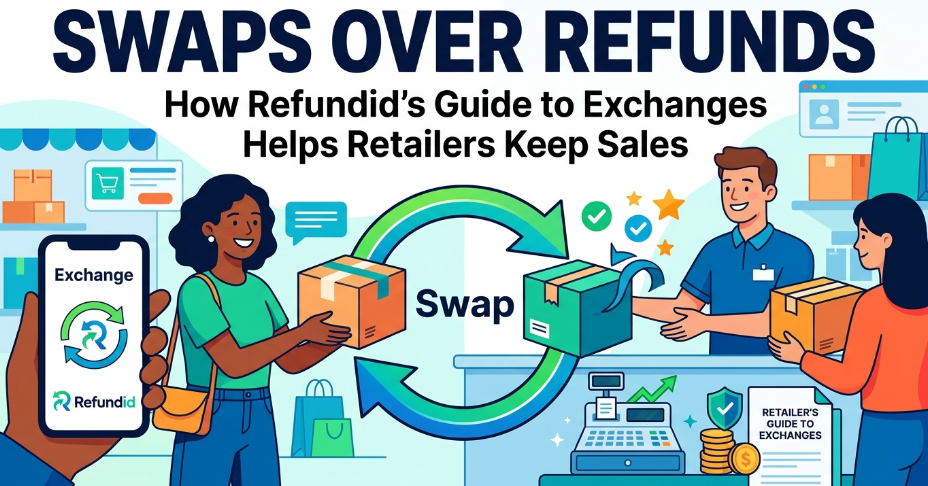
Key Takeaways
- A refund is the only outcome where money leaves the business.
- Shoppers choose exchanges when they are easy and fair.
- Bonus credit and flexible swaps make credit more appealing.
- Instant exchanges remove the wait for a replacement.
Introduction
Picture a shopper who orders a jacket, tries it on and finds it is a size too small. They still like the jacket. They would happily swap it. But the returns page puts a big refund button front and centre, and the exchange option takes three extra steps. So they take the refund, and the sale is gone.
This guide explains how retailers can make exchanges the easier choice, drawing on Refundid’s guide, from simple size swaps to Exchange for Anything, bonus credit, discount codes and instant exchanges.
Why exchanges matter
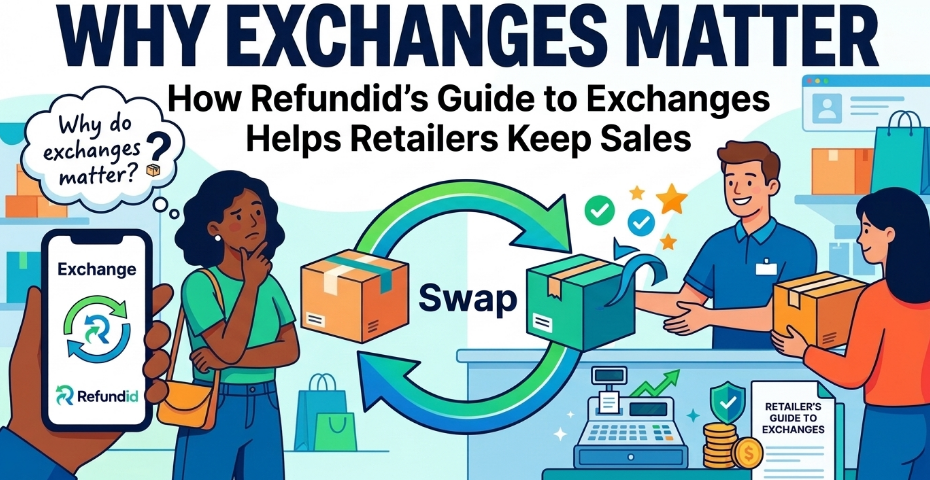
Refundid’s guide to exchanges starts with a simple point. A refund is the only return outcome where money leaves the business. An exchange keeps the sale, and store credit keeps the value in the store for a future order.
Most retailers would rather see an exchange or credit, and many shoppers would too, as long as it is easy. The guide notes that shoppers tend to pick the easiest option in front of them, which on many returns portals is the refund.
The aim, then, is to make exchanges just as easy, or easier, than refunds.
Start with an easy online exchange
Nobody wants to arrange an exchange over email. A self-serve returns portal, where shoppers organise the exchange themselves, is the starting point.
The most common exchange is a variant swap, the same product in a different size or colour. It has the fewest steps because the shopper only chooses from that product’s variants.
According to the guide, if the item was bought on sale and is now back at full price, Refundid can match the original price so the shopper is not charged the difference. It can also suggest a likely variant based on the return reason, such as one size up when the reason is too small, while still letting the shopper choose.
Exchange for Anything
A different size does not help when the shopper simply does not like the product. Exchange for Anything lets them spend the value of their return on anything in the store.
The guide describes two ways to run it in Refundid. In the returns portal, shoppers browse chosen collections and pick a new item without leaving the return. On the retailer’s own store, they are sent back to the website with their credit balance showing, so they shop using the store’s normal layout and then finish the return.
If the new item costs more, the shopper pays the difference by card, which adds revenue to a return that might otherwise have been a refund.
Keeping leftover value in the store
When a shopper chooses something cheaper, there is value left over. Sending it all back as a refund means money leaves the business on a return meant to keep the sale.
In Refundid, the leftover amount can go back as a refund, store credit or a gift card. Refunding is the default, and retailers can change it in their exchange settings. Shoppers are told where the difference will go before they finish.
Making credit the better deal
Bonus credit adds extra value when a shopper chooses store credit or Exchange for Anything instead of a refund. The portal shows the bonus on the option itself, so the shopper can see the benefit straight away.
Retailers choose a fixed amount or a percentage. Bonus credit can only be spent, never cashed out, so a shopper who takes it is staying with the store.
The guide also explains that bonuses do not need to be the same for everyone. Using Refundid’s Flows, retailers can offer a bigger bonus to VIP customers, a different one for certain products or none for frequent returners.
Discount codes on exchanges
A shopper with a discount code from a newsletter will want to use it on a new item, especially when it costs more than the original. If the code only works on a fresh order, refunding and buying again can look like the better deal.
On Shopify stores, Refundid can show a discount code field when the shopper confirms their exchange. The code is checked straight away, and the summary lists items, bonus credit, discount and shipping separately. The feature is off by default and can be enabled separately for size swaps and Exchange for Anything.
Instant exchanges
Waiting is one of the biggest barriers to exchanges. Traditionally, the replacement only ships once the original item arrives and is checked, which can take a week or more.
With Refundid’s instant exchanges, the replacement ships straight away. According to its website, Refundid carries the risk if the original item never comes back, and the retailer’s warehouse process stays the same.
For shoppers, that means the new item arrives sooner. For retailers, it removes one of the main reasons people choose a refund instead.
Exchanges in store and across channels
Many retailers sell both online and in physical stores. Letting shoppers exchange online purchases in store can be convenient, especially for size swaps where the customer can try the new item on the spot.
Refundid supports in-store returns alongside online ones, according to its website, with every return tracked in the same place. That keeps reporting consistent, whether the shopper uses the portal or walks into a store.
Free shipping on the replacement item also matters. If a shopper has to pay postage for an exchange but not for a refund, many will choose the refund. Covering shipping on exchanges, or including it in returns cover, removes that barrier.
Learning from exchange data
Exchange data tells you a lot about your products. Frequent size swaps on one item may point to a sizing problem, while many exchanges for different products may suggest the original did not match its photos or description.
Review exchange reasons regularly and share them with product, buying and marketing teams. Small changes, such as clearer size guidance or better photos, can reduce exchanges and returns over time.
Using rules to guide the choice
Return rules decide which options a shopper sees and what each costs. Retailers can use them to steer shoppers gently towards exchanges and credit, for example by offering free shipping on exchanges or bonus credit on store credit.
Rules can also protect margins, such as limiting options for frequent returners or keeping final-sale items out.
Picture two retailers. A footwear brand with many size returns uses variant suggestions and instant exchanges, so customers get the right size quickly. A lifestyle store uses Exchange for Anything and bonus credit, turning many refunds into new purchases.
Applying Refundid’s guide to exchanges
Refundid’s guide to exchanges shows how retailers can keep more sales when items come back. Make variant swaps simple, offer Exchange for Anything for shoppers who want something different and use bonus credit to make store credit more appealing. Then allow discount codes where sensible, decide where leftover value goes and consider instant exchanges to remove the wait.
Frequently asked questions
What is Exchange for Anything?
It lets shoppers spend the value of a return on any product in the store, not just another size.
What is bonus credit?
Extra value added when a shopper chooses store credit or an exchange instead of a refund.
How do instant exchanges work?
The replacement ships straight away, before the original item arrives back with the retailer.
Previously in ECommerce: AI Upsell Apps for Shopify: 6 Tools That Learn What Shoppers Add Next