
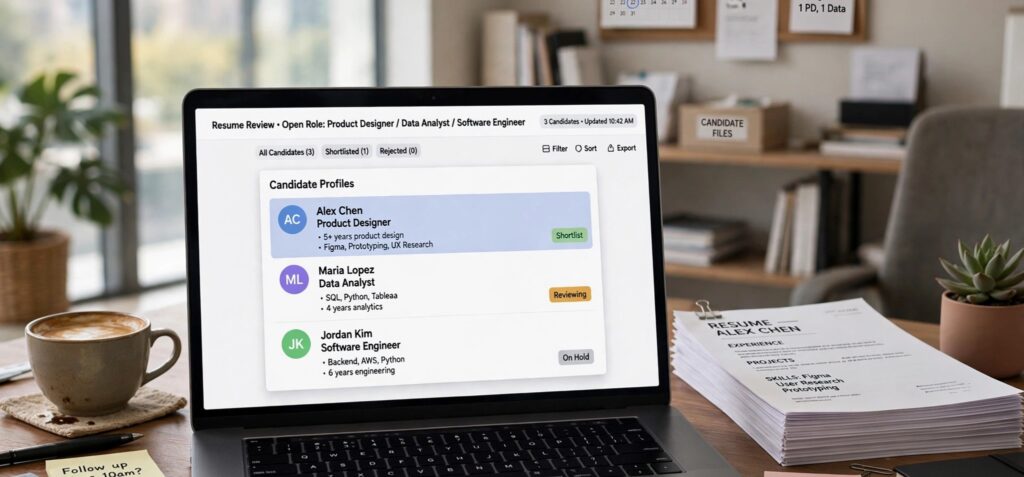
If you applied for a job this year, there is a good chance no person read your application before a decision was made about it. A screening system read it, scored it, and decided whether a human would ever see it.
This is where hiring has landed in 2026. Candidates use AI to write resumes and send out applications at a pace no human could keep up with. Employers answer with AI that screens, ranks, and increasingly interviews people before a recruiter learns their name. Each side is reacting to the other. Neither side is happy about it.
What follows is a practical guide for anyone stuck in the middle: what the employer's tools actually do, what gets an application flagged, and how to use AI on your side without handing those tools a reason to cut you.
What the employer's AI is actually doing
Three things, mostly.
Screening
Applicant tracking systems have parsed resumes for years. What's new is the layer on top: models that read the whole application, score it against the posting, and rank the pile before a recruiter opens it. In Greenhouse's 2026 AI in Hiring report, 62% of recruiters said their workload had grown, not shrunk. Application volume rose faster than the tools could absorb it, and ranking is how they cope.
AI interviews
This moved fast. A Greenhouse candidate survey published in May 2026 found that 63% of US job seekers have now been through an AI-led interview, usually a one-way video or a chat format. Thirty-eight percent said they had walked away from a hiring process because an AI interview was required. Employers kept using them anyway, because they filter hundreds of people at close to zero cost.
Fraud and identity checks
Fake candidates are a real problem, especially for remote roles. In the same Greenhouse report, 86% of UK recruiters said they had caught or suspected candidate fraud. So the software now looks for signs that the person applying is not who they claim to be, or that the details on the application do not line up with the person behind it.
Put those together and the picture is simple. The employer's AI is not hunting for the best candidate. It is hunting for reasons to make the pile smaller. Your job is to not give it one.
What changed on your side of the table
Candidates did not start this. They responded to a market where the average US job search now runs about 28 weeks, and where a single posting can draw several hundred applicants in two days.
So people reached for whatever tools were available:
- AI resume writers that turn a few rough bullet points into a polished page.
- Cover letter generators that produce a new letter for each job in seconds.
- Auto-apply agents that find postings, fill out the forms, and submit applications while you sleep.
None of these are wrong to use. I'd argue the resume tools are now table stakes. Your competition is using them, and a good AI resume builder will give you a format that parses cleanly in applicant tracking systems, which a surprising number of hand-made resumes do not.
The problem is not the tools. It is where most people point them: at every posting with a familiar job title, whether or not the role fits their experience. Mismatched applications are what the employer's AI is tuned to remove.
What actually gets you flagged
Talk to recruiters, read the vendor documentation, and the same four signals keep coming up.
- Inconsistency. Your resume says you managed a team of eight. Your LinkedIn says four. Your cover letter says twelve. Screening software will not catch that. The hiring manager will, usually in the interview, and it is the kind of thing that ends one.
- Invented specifics. AI writing tools fill gaps with plausible numbers. "Increased revenue 34%" reads well until an interviewer asks how you measured it. Recruiters now treat unusually round, unusually impressive, unsourced figures as a yellow flag.
- Identical answers. Screening questions like "Why do you want to work here?" get the same AI-generated paragraph from hundreds of applicants. Some screening tools flag near-duplicate answers. If yours matches forty others, it reads as spam, not interest.
- Mismatched applications. Applying for a director role with two years of experience, or for jobs in a field your resume never mentions, tells the system you are not reading the postings. Those get cut first.
Notice what is not on the list: using AI at all. Nobody gets penalized for a clean, well-formatted resume. People get penalized for applications that look like nobody was home when they were sent.
A playbook for the candidate in the middle
Here is what works, from watching a lot of job searches up close.
Start from facts you can defend. Before you touch any AI tool, write down the plain truth: job titles, dates, team sizes, the real numbers. Feed the tool that, and tell it not to invent anything. If a draft comes back with a figure you did not supply, delete it. A bracketed blank is better than a number you will have to walk back in an interview.
Apply to roles that match your profile, not every role with the right title. Apply to as many as you like, but filter on fit first: the experience level, the skills the posting actually lists, the location rules. Then measure replies per twenty applications. If that number is zero, the problem is targeting, and extra sending will not fix it.
Keep approval on. This is the big one for job auto-apply agents. The good ones queue each application, show you the tailored resume and the answers before anything is submitted, and wait for you to approve, edit, or skip. The bad ones just send. If a tool will not let you review before it submits in your name, do not use it.
Keep a record of what went out. Save the exact resume and the exact answers you sent for every job. When an interviewer asks about the third bullet point, you need to know what the third bullet point said. Some tools store this for you. A folder on your desktop works too.
Write the human parts yourself. The two sentences about why this company. The answer to the odd screening question. The follow-up email. These are where a real person shows through, and they take five minutes.
Match the format to the system. Use a clean single-column layout, standard section headings, and no text boxes or tables. Most parsing failures are formatting failures, and they are the easiest ones to prevent.
Know the rules, because they are changing
Regulation is starting to catch up, unevenly.
- Ontario now requires employers to state in publicly advertised job postings whether AI is used to screen, assess, or select applicants. It is the first rule of its kind in North America, and it means candidates there can at least know when a machine reads first.
- The European Union treats AI used in hiring as high-risk under the AI Act, with transparency and human-oversight obligations attached. Those rules were due in August 2026 and have been pushed back to December 2, 2027.
- The United States has no federal rule. New York City requires bias audits of automated hiring tools, Illinois and Colorado have passed their own laws, and most states have nothing.
The practical point: in most places, employers are not required to tell you an AI screened you. Assume one did.
The quiet advantage
The arms race framing is accurate, but it misses something. Most candidates are using AI to apply to roles they were never a fit for, only faster. The employer's software is built to remove exactly those.
Which leaves an opening. The candidate who uses AI for the repetitive parts, applies only where the profile fits, keeps a human hand on everything that goes out, and never sends a claim they cannot back up has become rare. Rare is what gets noticed.