
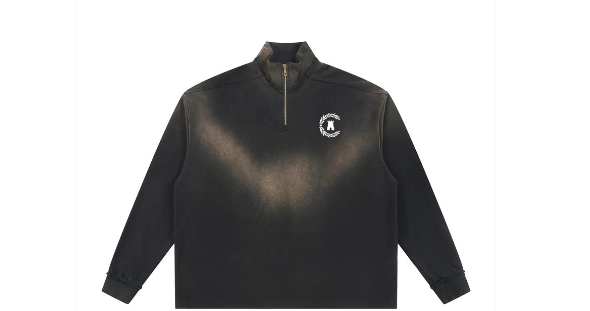
A Toronto morning in mid-October sits at about 3 °C, and by two in the afternoon the same day has climbed to 14. Whatever you pulled on at breakfast is wrong by lunch. That gap is the entire shoulder-season problem, and it’s why the choice between a quarter zip and a pullover hood actually matters in April and October in a way it never does in January, when the whole lot disappears under a parka anyway. On the fleece rail at Crooks & Castles the two sit at roughly the same number, somewhere in the CA$111 to CA$123 band, so price isn’t making this decision for you.
What is making it, mostly, is the collar. One of them opens. The other doesn’t.
A zip you can open halfway
Heavyweight fleece holds heat. That’s the point of it, and in a Calgary February that’s exactly what you want. But a shoulder season asks the opposite question — you need something that can shed heat on a crowded streetcar at 8:40 and then shut itself again when you step off into wind. A quarter zip does that in one movement. Pull it down four inches and the collar falls open, your neck is exposed, and the warm air that’s been sitting against your chest goes out the top.
A pullover hood has no equivalent. You can push the sleeves up, you can let it hang loose off the shoulders if the cut is boxy enough, and that’s about the limit of your options. It’s warm or it’s off.
Which sounds like an argument for the zip, and for commuters it usually is. But the zip gives up something in return, and anyone who has spent an October in Vancouver knows what it is.
Rain, wind, and the thing the hood is for
Vancouver autumn rain doesn’t fall so much as hang around. It isn’t heavy, it’s persistent, and it arrives without a cloud warning you first. A hood handles that. A stand collar with a zip at the throat does not, no matter how high you zip it.
So geography decides a lot of this. Prairie cities get dry cold and wind, and a high zipped collar seals the throat better than a hood that blows off your head. Coastal autumn is wet and mild, and the hood earns its place every other day.
| Shoulder-season job | Quarter zip | Pullover hood |
| Dumping heat indoors | Open the zip, done | Sleeves up and hope |
| Wind at the throat | Zipped collar seals it | Depends on the drawcord |
| Surprise drizzle | No cover at all | Hood goes up |
| Worn under a jacket | Collar sits flat | Hood bunches at the neck |
| Smarter settings | Reads closer to a sweater | Reads casual, always |
That fourth row is the one people forget until they’re standing in a hallway with a lump of fabric wedged between their shoulder blades and a coat collar. If a jacket goes over the fleece on colder mornings — and in Canada it does — the quarter zip layers flat and the hood fights you.
Key Takeaways
|
Fit matters more on a zip than you’d think
Here’s where people get caught. A hood is forgiving — go a size up and you’ve got longer sleeves and more drop at the hem, and it reads as a choice. Nobody sees an oversized hood and assumes you guessed wrong at the checkout.
A quarter zip sized up does something less flattering. The placket runs down the centre of your chest, so it draws a straight vertical line that shows every bit of excess fabric either side of it. The collar stands away from your neck instead of against it, which also means it stops blocking wind, which was half the reason you bought the thing.
What to do about it
Take the stated size. The product FAQ says the fit runs true, and with a quarter zip that’s worth trusting rather than hedging. If you plan to wear a long sleeve tee underneath — and at 3 °C you will — the heavyweight fleece has enough room built in already. Going up a size for a base layer is how you end up with a collar that flaps.
Where the second store comes in
The catalogue is a mirror on both sides of the border, same pieces and same photos, with the only real difference being which currency shows up at checkout. Readers down in Chicago or Atlanta buy the identical quarter zips from Crooks and Castles in US dollars, which is handy if you’re shipping to a friend’s place in Buffalo or Blaine instead of paying to bring it over the line yourself. Delivery on either side normally takes seven to fourteen days, so order in late September if October is the plan.
The details that survive a season of wear
Fleece this heavy lives or dies on construction, not on fabric weight alone, and there are a few things worth putting your hands on before you commit:
- Double-stitched shoulder and side seams, because those are the ones that go first
- Embroidery rather than print on the chest motif, so it survives repeated washing
- A collar with enough structure to stand up when the zip is closed
- Cuffs and hem ribbing that spring back when you stretch them with your hands
The motifs run to the Medusa head, the chain-link C, the castle and the crown, often in Old-English lettering, and they’re stitched rather than printed — which is the bit that counts when a garment gets washed thirty times a season. The label started in Los Angeles back in 2002 and the heavy pieces have leaned on embroidery ever since.
Frequently Asked Questions
Can a quarter zip handle a Canadian winter on its own?
Not past about −5 °C, no. It’s a shoulder-season layer and a mid-layer in January, and the open neck that makes it good in October works against it in a Winnipeg cold snap. Under a parka, though, it’s excellent.
Which one works better under a coat?
The quarter zip, comfortably. No hood means nothing bunching behind your neck, and a flat collar sits neatly inside a jacket collar instead of pushing it out of shape.
Do the two styles fit the same?
Roughly, since they’re cut from the same heavyweight fleece in the same S to XXXL range. The zip tends to feel a touch closer through the chest because the placket holds the front panel together, so it moves less than an open-faced pullover.
April and October are short, and they’re the two months when getting dressed takes actual thought. Pick the collar that suits how your days run rather than the one that photographs better, then forget about it until the parka comes out. Have a look through the fleece rail and see which one your week wants.