
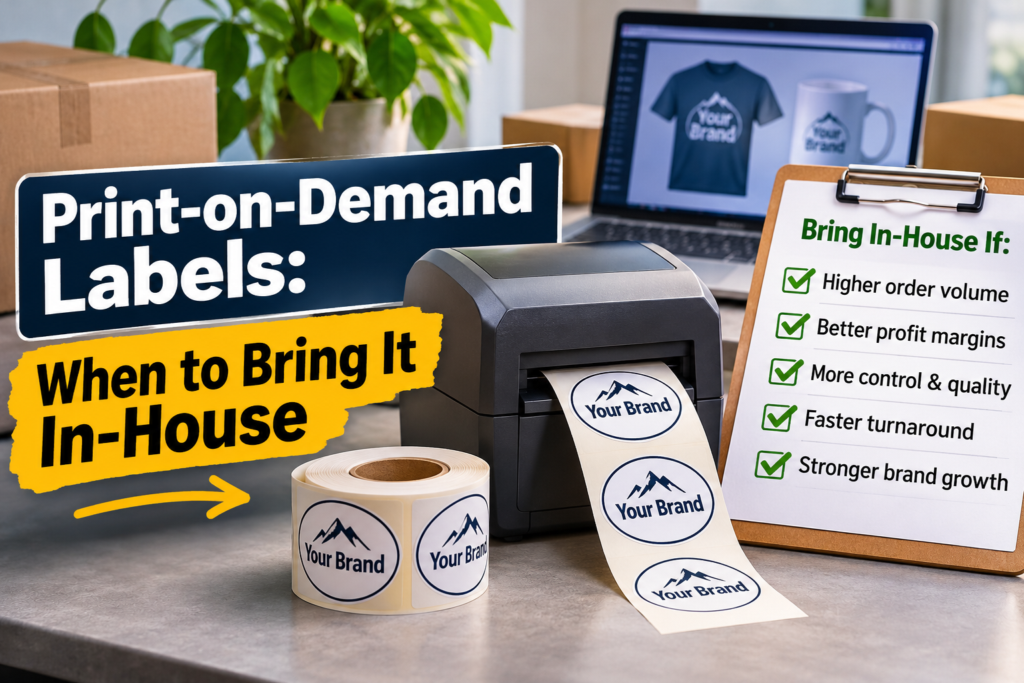
Every growing business that relies on labels, whether for product packaging, shipping, promotions, or branding, eventually asks the same question: should we keep ordering print-on-demand labels from an outside vendor, or is it time to bring label printing in-house? It is not a small decision. The answer depends on your order volume, the complexity of your designs, your budget, your timeline expectations, and how much control you want over quality and turnaround. This guide walks through the full picture so you can make a confident, informed choice about print-on-demand labels in-house versus outsourced printing.
What Print-on-Demand Labels Actually Means
Print-on-demand labels are produced only when they are needed, rather than printed in bulk and stored in a warehouse. A business places an order with a label provider, the provider prints the exact quantity requested, and the labels are shipped out. This model is popular because it reduces waste, keeps inventory lean, and allows for quick updates to designs, pricing, or compliance information without wasting unsold stock.
For many small and mid-sized businesses, outsourcing print-on-demand labels to a specialized vendor makes sense in the early stages. It requires no equipment investment, no training, and no dedicated staff time. You simply upload your artwork, place an order, and wait for delivery. But as a business scales, the calculus often shifts. The same flexibility that made outsourcing attractive can start to feel limiting once order volume grows, turnaround times become critical, or design needs become more frequent and specific.
Signs Your Business Has Outgrown Outsourced Labels
There is no single moment when a company should flip the switch from outsourced to in-house label printing. Instead, there are a handful of warning signs that tend to appear together, and recognizing them early can save you money and frustration.
One of the clearest signs is the frequency of orders. If you are placing label orders weekly or even daily, the cumulative cost of per-order markups, shipping fees, and rush charges can quickly outpace what it would cost to print labels yourself. Vendors build their pricing around convenience, and that convenience has a price tag that becomes harder to justify at scale.
Another sign is the need for frequent design changes. Businesses that test new flavors, seasonal packaging, limited runs, or rotating promotions often find that sending each new design to an outside printer introduces delays. Even a minor text change, like an updated ingredient list or a corrected barcode, can mean another round of proofing, another invoice, and another wait for shipment. When design agility becomes part of your competitive advantage, in-house printing starts to look like the more sensible investment.
Turnaround time is a third factor. If your supply chain depends on same-day or next-day labeling, relying on a third party introduces a variable you cannot fully control. Shipping delays, production backlogs at the vendor, and holiday rushes can all throw off your fulfillment schedule. Businesses in industries like food and beverage, cosmetics, or e-commerce fulfillment often find that even a two- or three-day delay in receiving labels can create a bottleneck that ripples through the rest of their operation.
Finally, consider your quality control needs. If you are noticing inconsistencies between print runs, color variations, or adhesive issues that affect how your product looks on a shelf or during shipping, that inconsistency can hurt your brand. In-house printing puts the quality checks directly in your hands, which matters more as your product line grows and your reputation becomes tied to consistent presentation.
The Real Costs of Bringing Label Printing In-House
Switching to in-house printing is not free, and it is important to go in with realistic expectations about what the transition involves.
The most obvious cost is equipment. Label printers range widely in price depending on print resolution, speed, and whether you need color, monochrome, or specialty finishes like gloss, matte, or waterproof coatings. Entry-level desktop label printers can cost a few hundred dollars, while industrial-grade color label printers capable of high-volume runs can run into the thousands. You will also need to budget for label stock, ribbons or ink, and ongoing maintenance.
Software is another consideration. Depending on your printer, you may need design software, label templates, and inventory management tools that integrate with your existing systems. Some businesses find that their current point-of-sale or warehouse management software already supports label design, which can reduce this cost significantly. Others discover they need to invest in a separate labeling solution to get the flexibility they want.
Training and staff time should not be overlooked either. Someone on your team needs to learn how to operate the equipment, troubleshoot common issues like misalignment or ribbon jams, and manage the design files. For small teams, this can mean pulling someone away from other responsibilities, at least during the initial learning curve.
Finally, there is the cost of space. Industrial label printers and rolls of label stock take up physical room, which matters if you are working out of a smaller warehouse or shared facility.
Despite these upfront costs, many businesses find that the investment pays for itself within months once order volume reaches a certain threshold. The key is running the numbers honestly rather than assuming in-house printing is automatically cheaper.
How to Calculate the Break-Even Point
Before committing to print on demand labels in-house, it helps to do a straightforward cost comparison. Start by calculating your current average cost per label when outsourcing, including the base print cost, shipping, and any rush fees you regularly pay. Multiply that by your monthly label volume to get your current monthly spend.
Next, estimate your in-house costs. Factor in the one-time equipment purchase, divided over an expected useful life of the printer (often three to five years), plus the ongoing cost of label stock, ink or ribbon, and a reasonable estimate of labor hours spent on printing and design.
If your current outsourced spending is higher than your projected in-house monthly cost, and that gap is expected to persist or grow, bringing printing in-house is likely the financially sound choice. If your label needs are seasonal, unpredictable, or still relatively low in volume, outsourcing may continue to make more sense for now.
It is also worth factoring in intangible costs that are harder to quantify but still matter. These include the time saved by not waiting on shipments, the flexibility to make last-minute changes, and the reduced risk of running out of labels during a busy period.
Choosing the Right Equipment for In-House Printing
Once you decide to move forward, selecting the right printer is critical. The best choice depends on your label type, volume, and whether you need color printing.
For businesses printing shipping labels or simple black-and-white product labels, thermal transfer or direct thermal printers are usually sufficient. These printers are reliable, relatively inexpensive to maintain, and widely used in warehouse and fulfillment settings. Direct thermal printers do not require ink or ribbon, which simplifies supply management, though the labels can fade over time if exposed to heat or sunlight, making them less ideal for long-term product labeling.
For businesses that need full-color labels, such as food and beverage packaging, cosmetics, or retail products with branded designs, inkjet or laser color label printers are the better fit. These machines cost more upfront and require more maintenance, but they allow for vibrant, professional-looking labels that match the quality customers expect from outsourced printing.
Specialty finishes like waterproof labels, gloss coatings, or tamper-evident seals may require additional equipment or coated label stock, so it is worth mapping out your full range of label needs before purchasing.
Building the Right Workflow
Equipment alone does not guarantee a smooth transition. A well-organized workflow is just as important. Start by standardizing your label templates so that updates can be made quickly without redesigning from scratch each time. Many businesses create a master template library organized by product line, making it easy for staff to swap in new text or barcodes without starting over.
Set up a clear approval process for new designs, even if it is informal. Having one person responsible for final sign-off helps avoid errors slipping through, especially for labels that include regulatory information like nutrition facts, safety warnings, or compliance codes.
It also helps to keep a buffer stock of commonly used label sizes and materials on hand, so you are not caught waiting on a shipment of blank label stock in the middle of a production run. Tracking your usage over the first few months will help you fine-tune your reorder points.
When Outsourcing Still Makes Sense
Bringing labels in-house is not the right move for everyone, and that is worth saying plainly. Businesses with low or irregular print volume often save money by sticking with an outsourced print-on-demand provider, since the equipment investment would sit idle much of the time. Companies that need highly specialized finishes, such as foil stamping, embossing, or unusual die-cut shapes, may find that outsourcing to a vendor with specialized equipment produces better results than what a standard in-house printer can achieve.
Seasonal businesses, or those testing new products before committing to long-term packaging designs, may also benefit from the flexibility of outsourcing while they are still figuring out their final branding. There is no shame in staying with a vendor longer if your volume and needs do not yet justify the switch. The goal is matching your printing approach to your actual business needs, not following a one-size-fits-all rule.
A hybrid approach is also worth considering. Some businesses handle their everyday shipping and inventory labels in-house while continuing to outsource specialty labels, limited runs, or anything requiring finishes beyond their equipment’s capability. This middle ground can offer the best of both worlds without requiring a full equipment overhaul.
Frequently Asked Questions
How do I know if my order volume justifies in-house printing?
A general rule of thumb is that if you are spending more on outsourced labels each month than the estimated monthly cost of owning and running a printer, including stock and labor, it is time to consider making the switch. Tracking your actual monthly label spend for a few months gives you a clearer picture than guessing.
What is the difference between direct thermal and thermal transfer printers?
Direct thermal printers use heat-sensitive paper and do not require ink or ribbon, making them simpler but less durable over time. Thermal transfer printers use a ribbon to apply ink, producing labels that last longer and resist fading, which matters for products with a longer shelf life.
Can I print color labels in-house affordably?
Yes, though the upfront cost is higher than monochrome printers. Common affordable options include:
- Inkjet color label printers for low to moderate volume
- Laser color label printers for higher volume and durability
- Hybrid printers that combine thermal printing with limited color capability for specific use cases
Will in-house labels look as professional as outsourced ones?
With the right printer and label stock, yes. Many businesses find that in-house labels match or exceed the quality of outsourced printing once they dial in their settings and materials, since they can test and adjust until the result meets their standards.
How long does it take to transition from outsourced to in-house printing?
Most businesses can make the transition within a few weeks, including time to select equipment, train staff, and build out design templates. Running both systems in parallel for a short period can help smooth the changeover and avoid disruptions to your supply chain.
What ongoing costs should I expect after switching to in-house printing?
Expect to budget for label stock, ink or ribbon replacement, occasional printer maintenance, and the labor time needed to manage design updates and print runs. These costs are generally predictable once you have a few months of usage data to reference.
Making the Decision That Fits Your Business
There is no universal answer to whether print-on-demand labels in-house is the right move. The decision comes down to your order volume, your need for design flexibility, your turnaround requirements, and a clear-eyed look at the costs on both sides. Businesses that are scaling quickly, making frequent design changes, or need tighter control over quality often find that the investment in equipment and training pays off within months. Businesses with lower or seasonal volume may continue to benefit from the simplicity and low commitment of outsourcing.
Whichever path fits your current stage, revisit the decision periodically. As your order volume grows, your design needs evolve, and your margins tighten or loosen, the right answer today may not be the right answer a year from now.