
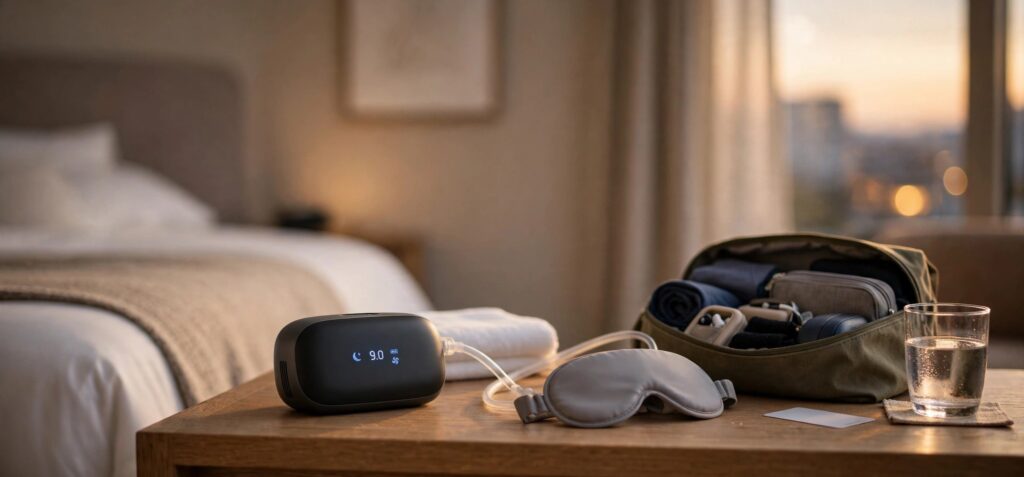
Individuals with obstructive sleep apnea have frequent recourse to Continuous Positive Airway Pressure (CPAP) in order to keep their breathing pattern normal even when sleeping. Business-night Sleeping with a CPAP machine can help minimize breathing pauses and increase the quality of sleep. Nevertheless, it may not always be easy to travel with a conventional CPAP machine due to its size and all the extra accessories. A portable CPAP machine serves as an easy way to carry around a copy of your sleep therapy machine.
Being mobile, portable CPAP machines are typically smaller and less heavy than regular bedside machines. They enable patients to continue with their treatment prescription even when they are on holidays, business trips, camping and other types of activities.
What Is a Portable CPAP Machine?
A portable CPAP machine is a small equipment that provides a continuous supply of positive airway pressure to assist in ensuring that the airway remains open as one sleeps. It also operates with the same principle as a standard CPAP machine; however, they are made in such a way that they are transportable at ease.
The device is connected to a compatible mask via flexible tubing. It provides pressurised air to assist in breathing once it is turned on to alleviate airway obstruction.
There are also some portable ones with automatic pressure adjustment, and digital housekeeping and humidification. Smartphone connectivity and rechargeable battery options are also available depending on device.
Portable CPAP devices come in handy especially where an individual travels a lot but requires to take frequent sleep apnea medication.
Benefits of Using a Portable CPAP
When individuals change to an easy to carry CPAP device, there are various reasons why they would prefer to use it.
1. Compact and Lightweight Design
Portability is one of the greatest benefits. Conventional CPAP machines may take up a lot of space in suitcases. Small-size ones can be put in travel bags and carry-ons.
This will make them convenient to individuals who drive, commute by train or aircraft regularly.
2. Maintaining Regular Sleep Therapy
Redundancy plays a role in regulating sleep apnea. Missing a regular CPAP therapy during travelling might enable the symptoms to re-occur.
The device can be carried everywhere and therefore, when away in a hotel or even in other places, the device can still be used to receive treatment during sleep time.
3. Convenient for Frequent Travellers
Portable CPAP equipment can be helpful to business people, to holiday makers and with family members with whom they pay frequent visits. It is conveniently smaller in size to prevent the hassle of carrying more bulky sleep therapy equipment.
There are also models that accommodate specialised accessories that can help in travelling easily.
4. Simple Operation
Most of the contemporary handheld CPAP devices have simple controls and screens. Others are also linked with smartphone apps enabling an individual to look through therapy data and track their progress.
Features to Consider When Choosing a Portable CPAP
What to look into when selecting a portable CPAP?
All portable CPAP machines are not the same in terms of functions provided. One should consider individual treatment requirements in comparison to the features of the purchased one before buying a particular one.
- Pressure Settings: Determine whether the machine has a fixed-pressure or an automatic pressure adjustment. The right choice would be based on the treatment plan.
- Battery Compatibility: Certain portable CPAP machines may work with external batteries that are compatible. This is handy in travelling to areas where electricity is not easily accessible.
- Humidification: Humidification can aid in decreasing throat and nose dryness. Other travel equipment has waterless humidification rather than the conventional water chambers.
- Mask Compatibility: Not every portable machine is compatible with all CPAP masks. Confirm the check nature before buying other accessories.
- Noise Levels: The lower the noise a machine produces, the more comfortable it can be to its users and their sleeping partners, in the event they are sharing rooms.
- Maintenance Requirements: Consider how easy it is to clean the mask, tubing, filters and other components.
Portable CPAP vs Traditional CPAP Machines
Portable and conventional CPAP devices are used to deliver airway pressure in people whom sleep. Their size, design and purpose is the primary distinction.
Repeated use in a bedside machine Traditional machines frequently feature a larger humidifier, and other comfort measures, and are therefore designed to be used on a regular basis. Portable models place an emphasis on compact construction and easy transport.
Other users would want it to be both: a custom machine to use at home and a mobile device to go with. This would enable them to continue with their routine without the need to carry their main equipment and unload it every now and then.
Depending on the design, however, portable models can be limited in humidification, in the mask they can support or allow, and so on.
Tips for Travelling With a Portable CPAP
Travelling with CPAP equipment can be made easily with a bit of preparation.
- Put the machine into a protective carrying case.
- Transporting masks, tubing and power adapters.
- Do money order procedures prior to travelling.
- Rinse and dry reusable parts prior to packaging.
- Go through airline regulations regarding medical equipment.
- Have the machine and other important accessories readily available.
Perseverance of using the machine too is a key factor that requires following the provisions of the healthcare professional.
Conclusion
Portable CPAP machine will make the use of sleep apnea more convenient to individuals who have to travel frequently or want to use small sleep therapy devices. Its portability, mobility and ability to use with selected accessories, allow individuals to continue their treatment plan on the road. To select a device, it is worth while taking into account the pressure needs, battery, and mask compatibility/maintenance requirements. With the equipment and medical advice, it will be easier to carry on with the CPAP therapy even when travelling.