
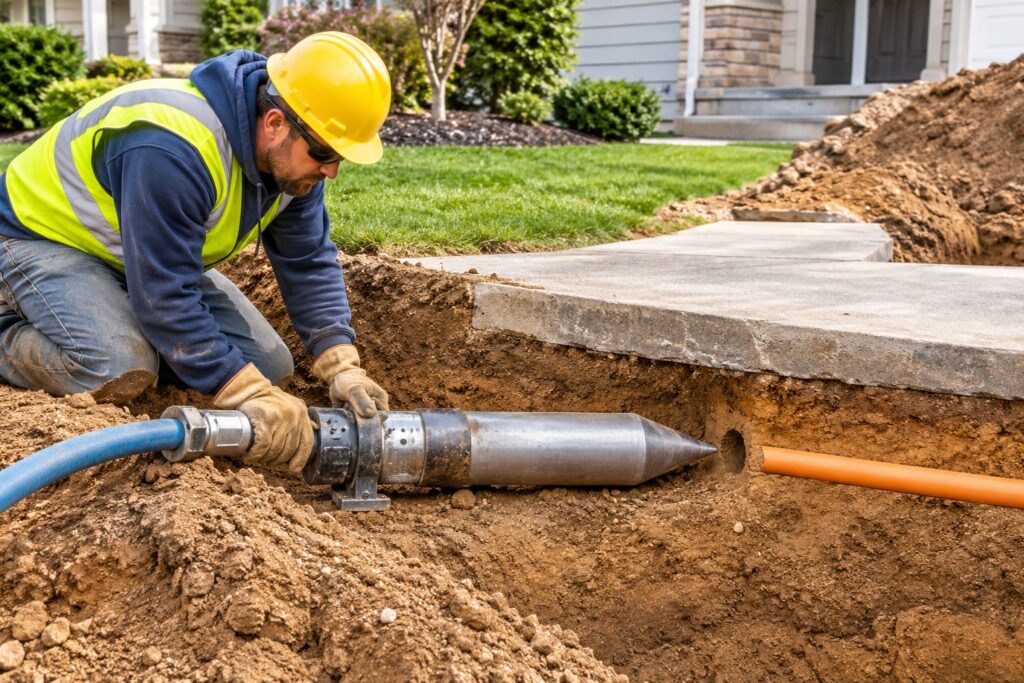
Installing underground utilities doesn’t always require digging a trench or bringing in a large directional drilling rig. For short crossings beneath driveways, sidewalks, roads, and landscaped areas, pneumatic piercing tools offer a practical alternative that can reduce surface disruption and restoration work.
Also known as pneumatic moles, impact moles, or underground boring missiles, these compact machines use compressed air to create underground pathways for pipes, conduits, and utility lines.
But how exactly do they work? What types of projects are they best suited for? And what should contractors consider before investing in one?
Understanding the capabilities and limitations of pneumatic piercing equipment can help construction crews select the right method, avoid costly mistakes, and complete underground installations more efficiently.
What Is a Pneumatic Piercing Tool?
A pneumatic piercing tool is a compressed-air-powered machine designed to create underground bores without excavating a continuous trench.
Unlike conventional excavation equipment, which removes soil from above, a pneumatic piercing tool advances horizontally through the ground by repeatedly striking forward and displacing surrounding soil.
The process creates a passage through which utility pipes, cables, or protective conduits can be installed.
Pneumatic piercing tools are commonly used for:
- Water service line installations
- Gas service connections
- Electrical conduit installation
- Fiber-optic and telecommunications infrastructure
- Irrigation systems
- Underground crossings beneath sidewalks and driveways
Their compact design makes them particularly useful in residential neighborhoods, commercial developments, and locations where preserving existing pavement or landscaping is important.
How Do Pneumatic Piercing Tools Work?
Despite their relatively simple appearance, pneumatic piercing tools rely on a powerful internal impact mechanism.
Most models consist of a cylindrical steel body, a hardened front head, an internal reciprocating piston, and an air supply connection.
When compressed air enters the tool, it drives the internal piston back and forth. The piston repeatedly strikes an internal impact surface, transferring energy to the tool body and pushing it forward through the soil.
As the machine advances, it compresses and displaces soil around the bore rather than excavating and removing it.
The process generally involves four stages.
1. Preparing the Launch and Receiving Pits
The crew excavates a launch pit at the starting point and prepares a receiving pit or suitable exit area at the opposite end.
The launch pit must provide enough space to position the tool correctly and establish the required installation depth.
Before excavation or boring begins, existing underground utilities must be identified and the work area assessed for possible conflicts.
2. Positioning and Aligning the Tool
The piercing tool is positioned at the required depth and aimed toward the receiving pit.
Accurate initial alignment is essential because conventional pneumatic piercing tools generally cannot be actively steered once underground.
An incorrect starting angle can cause the bore to miss its intended destination.
3. Advancing Through the Ground
The tool is connected to a suitable air compressor through a rated air hose.
Once activated, its internal impact mechanism propels it forward through the soil.
Depending on the machine design, soil composition, and operating conditions, progress may vary significantly.
Some models also feature a reversing mechanism that can help retrieve the tool if it becomes obstructed or cannot complete the crossing.
4. Installing the Utility Line
After a successful bore, the pipe or conduit is installed through the newly created underground passage.
Depending on the application and equipment, the product may be pulled behind the tool or installed after the tool reaches the receiving pit.
The installation method must be compatible with the pipe material, bore size, ground conditions, and manufacturer’s instructions.
When Should Contractors Use Pneumatic Piercing Tools?
Pneumatic piercing equipment is most effective when a project involves a relatively short, straight underground crossing with suitable ground conditions.
Several applications are particularly well suited to this technology.
Crossing Beneath Driveways and Sidewalks
Removing and replacing concrete or asphalt can add significant labor, material, and restoration expenses to a relatively small utility installation.
A pneumatic piercing tool can create an underground crossing while leaving most of the surface undisturbed.
For residential water, gas, or electrical service connections, avoiding extensive pavement removal can be a major advantage.
Installing Utilities in Landscaped Areas
Open trenching can damage lawns, garden beds, irrigation systems, and established landscaping.
Pneumatic boring allows contractors to limit excavation primarily to the launch and receiving areas, reducing the amount of surface restoration required.
Completing Short Utility Service Connections
For relatively short and straight service installations, mobilizing a horizontal directional drilling rig may be unnecessary.
A correctly sized pneumatic piercing tool can provide a simpler equipment setup, particularly when the crew already has access to a compatible air compressor.
However, the suitability of the method depends on more than distance alone. Soil conditions, existing utilities, required depth, and bore diameter must also be considered.
Pneumatic Piercing vs. Horizontal Directional Drilling
Both pneumatic piercing and horizontal directional drilling (HDD) are trenchless construction methods, but they are designed for different operating requirements.
Pneumatic piercing tools are primarily used for short, relatively straight bores. They generally require a smaller equipment footprint and simpler setup than an HDD rig.
Horizontal directional drilling uses a steerable drilling system, making it more appropriate for installations requiring controlled bore paths, longer distances, or more complex alignments.
HDD equipment may also be better suited to certain ground conditions or installations where precise underground navigation is essential.
The choice ultimately depends on the project.
For a straightforward service connection beneath a driveway, pneumatic piercing may be a cost-effective solution. For a longer installation crossing multiple obstacles or requiring changes in direction, HDD may be the more suitable approach.
Neither method is universally better.
Choosing the Right Pneumatic Piercing Tool
Selecting underground boring equipment involves more than choosing a machine with the appropriate diameter.
Contractors should evaluate several technical and operational factors before making a purchase.
Tool Diameter
Pneumatic piercing tools are available in different diameters to accommodate various installation requirements.
Smaller tools are commonly used for narrow utility services and conduit, while larger models can create passages for bigger pipes.
The required bore size depends on the outside diameter of the product being installed, any necessary clearance, and the installation method.
A tool that is too small may not create adequate space for the pipe. An unnecessarily large tool may increase air consumption and ground displacement.
Soil Conditions
Soil composition has a significant influence on performance.
Many pneumatic piercing tools perform well in compactable soils that can be displaced around the tool body.
Very loose sand, heavily saturated ground, large rocks, and certain other difficult soil conditions can reduce effectiveness or cause the machine to deviate from its intended path.
Contractors should assess the ground before selecting the equipment and consult the manufacturer’s recommendations.
Air Compressor Requirements
Pneumatic piercing tools require a compressed air supply that meets the manufacturer’s specified pressure and airflow requirements.
Airflow is commonly measured in cubic feet per minute (CFM), while operating pressure is measured in pounds per square inch (PSI).
Larger tools often require greater air delivery, although requirements vary by model.
Using an undersized compressor can reduce performance, while operating outside the specified pressure range can damage equipment or create safety hazards.
Bore Length and Accuracy
Manufacturers typically specify recommended operating ranges based on tool design and expected soil conditions.
However, these figures should not be treated as guaranteed distances.
Actual performance depends on ground resistance, tool alignment, air supply, and other site-specific factors.
Because most conventional piercing tools are not actively steerable, accurate setup and an unobstructed bore path are critical.
Equipment Support and Accessories
Before purchasing, contractors should also consider the availability of compatible hoses, lubricators, fittings, replacement parts, and technical support.
A lower initial purchase price may not provide the best long-term value if replacement components are difficult to obtain or the equipment cannot be serviced efficiently.
For contractors looking for a pneumatic boring missile for sale, UCG Underground Supplies offers a selection of pneumatic piercing tools and underground boring equipment. Comparing available models, tool diameters, and compressor requirements can help buyers find the right equipment for their projects.
Reviewing multiple configurations can help buyers identify equipment that matches their application rather than purchasing a tool that is either undersized or unnecessarily expensive.
What Are the Main Advantages?
When used in suitable conditions, pneumatic piercing tools provide several operational benefits.
Reduced surface disruption. Contractors can install utilities beneath existing surfaces without excavating the entire crossing.
Lower restoration requirements. Preserving pavement and landscaping can reduce the additional work needed after installation.
Compact equipment footprint. Many pneumatic piercing systems can be transported and deployed without the space required for larger drilling machinery.
Straightforward operation. Compared with more complex trenchless systems, pneumatic piercing equipment generally requires fewer major components.
Versatility. Different tool sizes can accommodate many common utility service applications.
These advantages can translate into lower project costs, particularly when surface restoration would otherwise represent a substantial portion of the installation budget.
However, actual savings depend on job conditions, crew experience, equipment costs, and the chosen construction method.
Limitations Contractors Should Understand
Although pneumatic piercing is a proven trenchless technique, it is not appropriate for every underground installation.
The most important limitation is directional control.
Conventional pneumatic piercing tools rely primarily on accurate initial positioning and cannot make controlled underground steering corrections in the way an HDD system can.
Unexpected rocks, buried debris, and inconsistent soil conditions may deflect the tool or prevent it from advancing.
Another consideration is ground movement. Because these tools displace rather than remove soil, adequate cover and clearance from nearby structures and utilities are essential.
Contractors should never assume that trenchless installation eliminates the risk of damaging underground infrastructure.
Existing utilities must be located and verified using appropriate procedures before work begins. Where required, crews should expose conflicting utilities and follow applicable regulations, utility-owner requirements, and safe excavation practices.
Frequently Asked Questions
Can a pneumatic piercing tool go through rocky soil?
Performance depends on the size, concentration, and distribution of rocks, along with the tool design. Some machines can handle limited small obstructions, but large rocks and heavily rocky ground may deflect or stop the tool. Manufacturer specifications and site conditions should determine whether pneumatic piercing is appropriate.
How far can an underground boring missile travel?
There is no universal distance. Recommended bore lengths depend on the model, tool diameter, soil conditions, air supply, and alignment. Contractors should use the manufacturer’s stated capabilities when planning a crossing.
Do pneumatic piercing tools require an air compressor?
Yes. These tools operate using compressed air and require a compatible compressor capable of delivering the specified airflow and pressure. The compressor, hoses, fittings, and lubrication system must be appropriate for the selected model.
Can pneumatic piercing tools be used under roads?
Yes, when soil conditions, cover depth, utility clearances, and applicable permits allow it. Road crossings require particular attention to existing infrastructure, ground movement, and local construction requirements.
Are pneumatic piercing tools suitable for every trenchless project?
No. They are especially useful for shorter, relatively straight installations in suitable soils. Longer crossings, complex alignments, and projects requiring precise steering may be better served by horizontal directional drilling or another trenchless method.
Final Thoughts
Pneumatic piercing tools remain a practical option for installing underground utilities without the disruption associated with continuous open trenching.
Their relatively compact design, compressed-air operation, and ability to create underground passages make them valuable for service connections beneath driveways, sidewalks, roads, and landscaped areas.
But successful installations begin with choosing the correct equipment and understanding its limitations.
Tool diameter, soil conditions, compressor compatibility, bore length, alignment, and service support all influence the outcome.
For contractors handling frequent short utility crossings, investing in a properly matched pneumatic piercing system can improve operational flexibility and help reduce unnecessary excavation and restoration work.
The key is selecting the tool based on actual project requirements rather than assuming one machine will perform equally well in every situation.