
Cryptocurrency marketplaces may be hard to assess since the market price of a token tells only half of the story. The willingness of investors, the actual use of a digital asset, and the trustworthiness of a project can affect the market value of a digital asset. Pi Network is a fascinating case due to the fact that its distribution model and the emerging ecosystem should be taken into account together with its market price.
Whether the token will increase or decrease is not the question that is most helpful to investors doing their research concerning Pi price. It is what may impact that motion, the level of uncertainty that may exist, and the suitability of a certain trading strategy to their financial risk profile.
What Can Influence Pi’s Market Value?
The price of a cryptocurrency is an indication of the ratio between buyers and sellers at a given time. But the determining factors in that balance can vary significantly among projects.
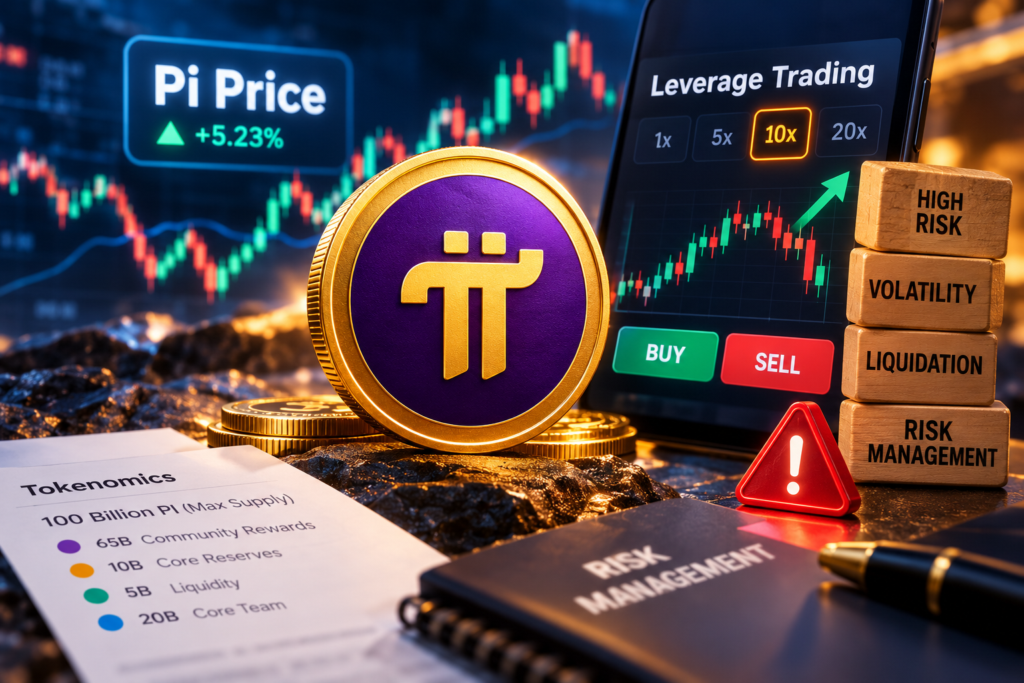
The economics of Pi Network have a starting point in a token model. When the tokenomics of the project are published, there are 100 billion PI specified as the maximum supply. It is planned to allocate:
- 65 billion PI to mining rewards going to the community
- 10 billion to core reserves
- 5 billion to liquidity
- 20 billion to the Core Team
These distributions have no implication that such is in the market today. The supply of tokens can be distributed gradually, and the maximum supply is not equal to the actual circulating supply. For anyone calculating the costs of Pi, a variation in the supply available, as well as the demand to hold or utilize the token, is a consideration.
The demand is also occasioned by the fact that a cryptocurrency is creating applications that are viable, but which are yet to be established on the basis of trade. The program implementations, development operations, and involvement in the greater ecosystem can assist in contributing to lasting project opportunity ratings in the consciousness of individuals. Nevertheless, adoption does not ensure an increase in prices. Ironically, it takes a project a longer time to adjust to market expectations than the actual performance does.
Why Charts Alone Cannot Explain Price Movements
The price charts can be used by traders to determine past trends, volatility, and the possible support or resistance levels. But these tools explain the behaviour of the market, but do not determine the future with minimal uncertainty.
As an illustration, a token can be subject to a sudden surge due to new interest, but this movement may not necessarily translate into a further increase in price. Equally, a reduction does not demonstrate the fact that a project is no longer long-term.
A more moderate evaluation would be a combination of market information and information that is specific to the project. Investors can look at:
- The circulating supply
- The trading of the supply
- Liquidity
- Network building
- Broader crypto markets
They are also supposed to distinguish confirmed announcements from community speculation. This method is especially important in the volatile market, where the short-term sentiment can take the price out of what can be deemed reasonable by the investors.
How Leverage Changes the Trading Decision
Spot trading and leverage trading have varying degrees of financial exposure. In spot trading, a trader will typically buy an asset at a spot price. Through leveraged trading, a trader opens a position that is higher than the amount deposited as margin.
Various simplified examples can be given:
- A trader places a bet of $200 as margin and buys a spot with a value of 1,000 with 5x leverage.
- When the underlying market changes by 3 percent in favour of the trader, the position would make about $30 in profit, after accounting for other expenses.
- Any adverse change in the same direction will mean a loss of approximately 30.
Such a loss would be 15 percent of the original margin of 200. Even a further development would cause the margin to be consumed at a faster rate, and the margin might be sold at the will of the platform and under the conditions of the position.
The implication of leverage is that the movement of price is caused to change, but it does not reduce the direction of the market. Pre-birth of a position: Risk Management.
Risk Management Before Opening a Position
A possible futures user ought to be familiar with the margin requirements, liquidation policies, trade costs and potential financing costs prior to making a trade. The BTCC Exchange will enable the readers to understand the basics of leveraged trading.
Position size is another aspect to be taken into consideration:
- Reduced leverage does not do away with market risk, but can cause a particular price change to have a less significant effect on the trader’s margin.
- The traders will also have to predetermine how much they will be prepared to lose compared to acquiring a position size based on the probability of making a profit.
Exposure can be controlled by the application of stop-loss orders, but in fast markets the execution price may be lower than the expected one. In any market situation, there is no risk-controlling measure that would guarantee that its losses are within a precise amount.
Final Thoughts
This does not simply mean the alterations of the prices which can assist in locating the market value of Pi. Besides the ability of a specific supply and a particular demand to shape the demand procedures, the jump in its own development, the fluidity, or the quantity of investor soul is also an ingredient of the larger image: no one can be certain about the specific outcome.
This is even enhanced by the aspect of leverage, considering the perception that leverage amplifies the financial impact of the changes in prices. Better advice is to separate the asset and the trading method and make sure investors have the faintest idea of what is going on in the market, and not bet their money. A moderate position is better than savings made by shortcuts such as price forecasts or high leverage multipliers as a shortcut to profit.