

Phuket’s hotels were almost as full in the first nine months of 2026 as they were a year earlier. Occupancy slipped just 0.6%. The average daily rate fell 4.1%. Put simply, the island’s hotels kept their guests and gave away money to do it.
That gap, between how full a hotel is and what it earns per room, is where a general manager’s technology budget should go first. Not a chatbot in the lobby, but the unglamorous systems behind three daily decisions: what to charge tonight, how many people to roster next week, and what the front desk has to file before the night shift ends. Across Asia, all three are under pressure at once.
Rate: the discount that outlives the crisis
The monthly Phuket figures, from C9 Hotelworks’ November market update using STR data, show how it happened. January’s ADR was down 10.6% on 2025 while occupancy was almost flat. April was the worst month, with occupancy down 9.9% and rate down 8.8%. Then the market turned. ADR beat the previous year in July, August and September, by 6.0%, 1.6% and 4.2%.
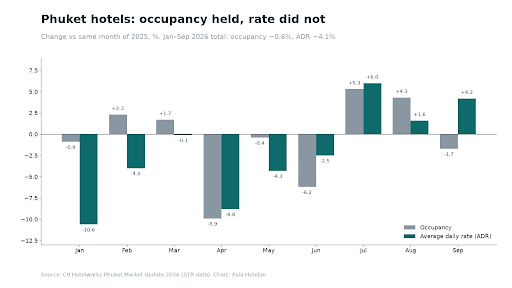
Chart: Asia Hotelier. Data: C9 Hotelworks, STR
Read that as a GM and it looks like a price war that cooled, not demand that disappeared. Passenger arrivals at Phuket’s airport were only 2% lower over the same period. Hotels did not lose a fifth of their guests. Some of them cut rate early, competitors matched, and the cuts took months to unwind.
Bangkok shows the same habit in a different form. Cushman & Wakefield put the city’s third-quarter occupancy at 70%, against 73% in the second quarter, while ADR fell 3.9% to THB 3,516. Its explanation was the low-season playbook: promotions, in-house credit packages and Thai resident rates aimed at staycation guests. That kept rooms full. It also pulled the average down.
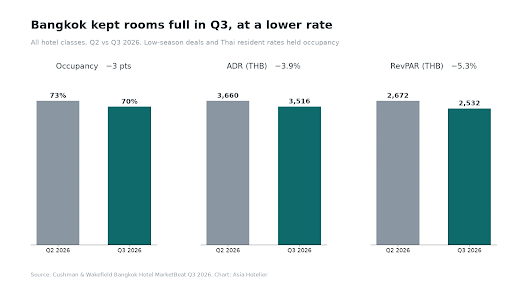
ld
There is nothing wrong with a resident rate in August. The damage comes when nobody switches it off. This is exactly where revenue management software earns its fee, because the job is dull, constant and easy to forget. A good system watches pickup night by night, flags dates where demand is building faster than usual, and closes cheap rates before a busy weekend, not after it. Cushman expected a fourth-quarter recovery, and October brought the IMF and World Bank annual meetings, with more than 15,000 participants, to the city. The hotels that gain most from weeks like that tend to be the ones that priced them months ahead.
A practical test for any GM: pull last year’s ten highest-demand nights and check what you sold the last 20 rooms for. If the answer is your normal rate, the tool you need is a forecast, not more marketing.
Rotas: the wage bill is about to move
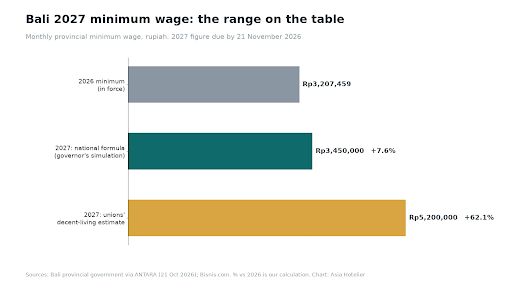
Labour is the second decision, and in Bali it is about to get more expensive. The island’s 2026 provincial minimum wage is Rp3,207,459 a month. On 21 October, Governor Wayan Koster ran the national formula in front of protesting workers and said that, at its highest setting, it would give a 2027 minimum of about Rp3.45 million, a 7.6% rise. Unions want something close to their decent-living estimate of Rp5.2 million. Koster called the formula figure too low, but said that using Rp5.2 million as the base would close many companies. Provinces must set the 2027 figure by 21 November.
RA
At the top of that range, the rise per worker would be 62%. Few hotels can pass that straight into room rates, especially with about 1,700 new five-star rooms due on the island by 2029, according to Colliers. The lever a GM does control is how many hours are worked, and when.
Where the rota is still built on a spreadsheet and a head of department’s memory, there is money on the table. Workforce scheduling tools that read the occupancy forecast from the property management system can build next week’s housekeeping and F&B shifts from arrivals, departures and covers, rather than from last week’s pattern. On a 200-room resort, sending two fewer room attendants on a 55% night and two more on a 95% night is not a cut. It is the same payroll spent where the work is.
The caution is the same as with pricing. The software only knows what the PMS tells it. If group blocks are loaded late or cancellations sit unprocessed, the rota will be wrong with great confidence.
The front desk: rules that change on a Sunday
The third decision is compliance, and Vietnam just showed why it belongs on a GM’s technology list. Decree 392/2026/ND-CP took effect on 15 November. It updates the list of identity documents hotels must check at check-in. The new can cuoc ID card is now named, and the old people’s ID card, the CMND, is gone from the list. It also settles what to do with a guest who has no ID at all: the hotel may give them a room, but the owner or manager must notify the local police immediately.
For a branded hotel full of passport holders, this is a small change. For a city or airport hotel with late walk-ins, it lands on the night shift. That makes it a systems question. Does the PMS ID dropdown still offer the old card? Does the check-in screen force a decision when no document is scanned? Is each police notification logged with a time and a name, so the hotel can prove it called?
None of this needs anything clever. It needs a property system that can be updated in days, not quarters, and a vendor with local support who knows the rule changed.
How to buy without regret
The pattern across all three is the same. The useful technology in a hotel is the kind that makes a routine decision more consistent, and that a manager can check quickly. Before signing, ask each vendor which PMS, channel manager and POS systems it already connects to in your country, not globally. Ask who answers the phone at 2am in your time zone. Ask to speak to a hotel of your size that uses it.
Then test the tool on one task first, with a pass mark agreed in writing before anyone sees a demo. Pick one decision, such as closing discount rates on high-demand nights, and run it for a month against last year’s results.
Those vendor questions are the same ones behind Asia Hotelier’s directory of hotel technology suppliers working in Vietnam, which sits alongside its market data, hotel news and jobs board for the people running hotels in the region.
Phuket’s year is the clearest lesson. The guests came. The hotels that held their nerve, and had the numbers to prove they should, kept the money.