

Why Display Protection Starts Before Assembly
A display surface can be damaged long before a finished device reaches a customer. Cover lenses, touch panels and optical components pass through cutting, coating, lamination, inspection, assembly and transportation. Dust, abrasion, fingerprints and contact with fixtures can mark a surface. Damage found at final inspection can mean rework, delayed delivery or rejected parts.
Temporary protection is part of process control, not simply packaging. PET film is considered for flat display components because its dimensional stability can support converting accuracy and consistent handling. Clarity alone does not determine suitability. The substrate, adhesive, process conditions, optical requirements and removal stage matter. Manufacturers selecting PET protective film for electronics should start with the production route and the surface being protected.
Before assembly, a display component may be cleaned, coated, laminated, inspected and transferred between workstations. It can contact worktables, rollers, gloves, separators and adjacent parts. Temporary film creates a contact barrier that can help reduce scratches, handling marks and contamination during specified operations.
The film must suit the route. A grade suitable for storage may behave differently during lamination or die cutting. A film that adheres to glass may lift on coated plastic. Confirm protection period and removal stage.
PET Film for Precision Display Components
PET is a practical carrier for flat components requiring dimensional stability during converting. Under suitable web tension, it can help maintain flatness and registration during slitting, lamination and precision die cutting, supporting accurate positioning through downstream processing.
Optical performance matters when operators or automated systems inspect a component through the film. Check haze, light transmission, cleanliness and appearance on the actual component after processing, not only on a sample roll. The film should not obscure inspection criteria or introduce visible defects.
PET is not ideal for every shape. PE films may offer greater conformability on curved surfaces. For flat cover lenses and glass panels, PET may be preferred for dimensional stability. Consider panel geometry, surface energy, machine tension, temperature and removal point. AOBERISFILM offers PET screen protection film for manufacturing, with construction selected for the process.
Matching Adhesion to the Surface and Process
Adhesion is critical in temporary display protection. If tack is too low, the film may lift at corners or edges, allowing dust to enter. If tack is too high, removal force can increase after extended dwell time or heat exposure. Excessive adhesion may leave transfer, ghosting or changes on sensitive coatings.
Adhesion varies across glass, hard-coated PET, PMMA, polycarbonate and other plastics. Low- and medium-tack options are starting points; qualify the final grade on the actual substrate. Reproduce pressure, dwell time, temperature and handling in a production trial.
Inspect edge stability while the film is in place, then check peel behavior after processing. Look for transfer, residue, coating disturbance, haze and marks. Treat clean removal as a verified result. For roll-fed processing, confirm width, core diameter, winding direction and liner requirements.
For critical display assemblies, agree acceptance criteria before testing. Record the test method, sample conditioning, peel angle, peel speed and inspection lighting so results can be compared consistently across suppliers, production batches and repeat orders.
Temporary Protection and Anti-Fingerprint Films
Screen protection describes different needs. Temporary manufacturing film protects a component during production, storage or transportation and is removed at a defined stage. An anti-fingerprint PET surface manages visible oil marks and wiping behavior on a touch surface during use. The functions are not interchangeable.
For temporary display processing, manufacturing-grade PET film can be evaluated for LCD panels, cover lenses and touch panels undergoing lamination, die cutting, inspection, assembly and transport. Match its structure, adhesive and tack level to the surface and process cycle.
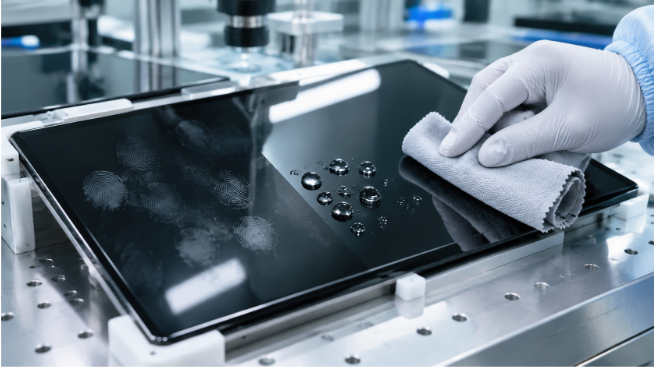
For a cleaner-looking touch interface, anti-fingerprint PET protective film addresses a different need. An oleophobic treatment can reduce fingerprint visibility and support easier wiping. Assess optical appearance, haze, surface finish and cleaning durability together. Water contact angle indicates wettability but does not fully predict fingerprint or cleaning performance.
Qualification Before Volume Production
Apply representative fingerprint contamination, record mark visibility, and compare the surface after agreed wiping cycles. Check for coating changes.
Before volume production, qualify the film on the actual part and process. A sample demonstration alone cannot predict full-cycle performance. Use a documented checklist:
- Confirm the substrate, coating and finish. Test the actual glass, PET, PMMA, PC or other production surface, not a generic substitute.
- Reproduce application pressure, equipment, dwell time and relevant process exposure, including lamination, cutting, inspection, storage and handling.
- Review haze, light transmission, visibility and surface appearance before and after processing where optical inspection matters.
- Record edge lifting and peel behavior at the planned removal point, rather than checking adhesion only immediately after application.
- Inspect the exposed surface for residue, adhesive transfer, ghosting, scratches, coating damage and changes in gloss or clarity.
- Confirm roll width, length, core size, liner, winding direction, slit-edge quality and compatibility with production equipment.
- Retain an approved sample and record the grade, substrate, process conditions and inspection results. Requalify after significant changes.
Maintaining Consistency Across Repeat Orders
A protective film is a small part of a display assembly, but its behavior can affect several steps. A stable carrier can support converting accuracy; suitable adhesion can reduce edge lifting; verified optical performance can allow inspection while protection remains in place. Demonstrate these results rather than assuming them from a material name.
Specify the film by surface, process stages, protection period, optical requirements and removal point. Retain approved samples, batch identification and inspection criteria to maintain consistency across repeat orders.
AOBERISFILM manufactures industrial protective films, including PET, PE and functional film materials for electronics, displays and precision surface protection. Its customizable products support screen manufacturing, touch panels, optical components and electronic surfaces during production, assembly, handling and transportation.
As displays become thinner and surface requirements more demanding, protection must be considered earlier. Matching the carrier, adhesive and surface function to production conditions helps protect component quality without creating avoidable problems downstream.
About the Author
Johnnie Au is the Sales Manager at AOBERISFILM, a manufacturer specializing in industrial protective films, including PET, PE and functional film materials for electronics, displays and precision surface protection. AOBERISFILM supplies customizable film solutions for screen manufacturing, touch panels, optical components and electronic product surfaces during production, assembly, handling and transportation.
Previously in Technology: Why Tulip Contact Alignment Matters in VCB Assemblies