
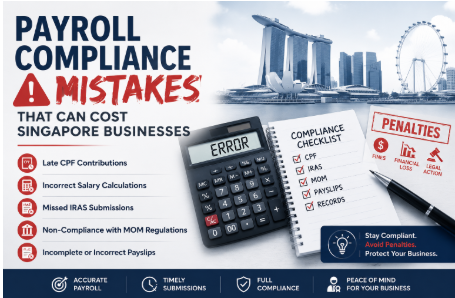
Payroll is one of the most critical functions in any business. Get it right, and employees are paid accurately and on time, compliance is maintained, and trust is built. Get it wrong, and the consequences can be severe—ranging from hefty fines and penalties to employee dissatisfaction, MOM audits, and even legal action. For many companies, the smartest way to avoid these costly errors is by partnering with Singapore payroll outsourcing services that specialize in local compliance and accuracy.
In Singapore, where employment regulations are strict and enforcement is rigorous, payroll compliance mistakes can quickly escalate into costly problems. From CPF miscalculations to missed IRAS deadlines, the pitfalls are numerous—and expensive.
Here’s what you need to know about the most common payroll compliance mistakes Singapore businesses make, the real costs involved, and how the right partnership can help you avoid these pitfalls entirely.
The High Cost of Payroll Non-Compliance
Before diving into specific mistakes, let’s talk about what’s at stake.
Potential penalties for payroll non-compliance in Singapore include:
- CPF late payment: 1.5% per month (minimum S$5), capped at 25% of outstanding contributions
- Salary payment violations: Fines up to S$20,000 and/or imprisonment up to 2 years
- Missing or incorrect payslips: S$100–S$200 per employee per breach
- Poor record-keeping: S$100–S$200 per employee per breach
- IRAS reporting failures: Fines up to S$1,000 per omission
- SDL late payment: 10% penalty on outstanding amount
- Work pass violations: Fines up to S$30,000 and/or imprisonment up to 12 months
For a company with 50 employees, a single compliance failure across multiple areas can easily result in penalties exceeding S$10,000–S$20,000. Multiply this by multiple violations or repeat offenses, and the costs become staggering.
Beyond financial penalties, non-compliance damages your reputation, erodes employee trust, and can even derail business plans (e.g., fundraising, grants, expansion).
Top 10 Payroll Compliance Mistakes Singapore Businesses Make
Mistake #1: Miscalculating CPF Contributions
The Problem:
CPF calculation errors are among the most common—and costly—payroll mistakes in Singapore. Errors include:
- Using incorrect contribution rates (based on employee age or PR status)
- Applying rates to wages above the OW ceiling (S$8,000 from Jan 2026)
- Exceeding the AW ceiling (S$102,000 − Total OW)
- Failing to adjust rates for PRs in their first two years
- Misclassifying ordinary wages (OW) vs. additional wages (AW)
The Cost:
- 1.5% monthly penalty on late/underpaid CPF (capped at 25%)
- Demand for arrears plus penalties
- Potential prosecution for serious or repeated violations
Real-World Example:
A tech startup with 30 employees miscalculated CPF for three months, underpaying by S$8,000 total. The penalty? S$1,200 in the first month alone, plus S$2,000 in cumulative penalties over three months. Total cost: S$11,200—more than the original underpayment.
How to Avoid:
- Use payroll software with built-in CPF calculation logic
- Regularly update CPF rates based on employee age and PR status
- Track cumulative OW and AW to ensure ceiling compliance
- Conduct quarterly CPF audits to catch errors early
Mistake #2: Missing CPF and SDL Payment Deadlines
The Problem:
CPF contributions must be paid by the last day of each month, with enforcement action taken if not paid by the 14th of the following month. SDL (Skills Development Levy) is due by the 14th of the following month.
Many businesses miss these deadlines due to:
- Manual payment processes
- Poor calendar management
- Cash flow issues
- Lack of automated reminders
The Cost:
- CPF: 1.5% per month penalty (minimum S$5), capped at 25%
- SDL: 10% penalty on outstanding amount
- Repeated violations trigger MOM audits and potential prosecution
Real-World Example:
A retail chain with 80 employees missed CPF deadlines for two consecutive months due to manual GIRO setup errors. Penalties totaled S$3,600—money that could have been avoided with automated payments.
How to Avoid:
- Set up automatic GIRO payments for CPF and SDL
- Maintain a payroll compliance calendar with all deadlines
- Assign accountability for deadline management
- Use payroll software with automated deadline alerts
Mistake #3: Late or Incorrect Salary Payments
The Problem:
Under the Employment Act, salaries must be paid:
- At least once a month
- Within 7 days after the end of the salary period
- No later than 7 days after payday
Common violations include:
- Paying salaries later than 7 days after the salary period ends
- Making unauthorized deductions
- Paying incorrect amounts due to calculation errors
The Cost:
- Fines up to S$20,000 per violation
- Imprisonment up to 2 years for serious offenses
- Employee complaints to MOM, triggering investigations
- Damage to employer brand and employee trust
Real-World Example:
A F&B company with 45 employees consistently paid salaries 10–12 days after the salary period end due to manual payroll processing. After multiple employee complaints, MOM investigated and imposed fines of S$18,000.
How to Avoid:
- Automate payroll calculations and approval workflows
- Set fixed payroll dates and stick to them
- Maintain sufficient cash flow for salary payments
- Implement multi-level approval processes to catch errors before payment
Mistake #4: Non-Compliant or Missing Payslips
The Problem:
All employers in Singapore must issue itemized payslips to employees within 3 working days of salary payment. Payslips must include:
- Basic salary
- Allowances and bonuses
- Deductions (with breakdown)
- Net salary
- CPF contributions (if applicable)
- Leave entitlements and usage
Common violations:
- Not issuing payslips at all
- Issuing incomplete payslips (missing required fields)
- Providing payslips later than 3 working days after payment
- Using non-compliant formats
The Cost:
- Fines of S$100–S$200 per employee per breach
- For a company with 50 employees: S$5,000–S$10,000 per violation
- Employee complaints and MOM investigations
Real-World Example:
A logistics company with 60 employees failed to issue payslips for three months during a system migration. When employees filed complaints, MOM imposed fines of S$36,000 (S$200 × 60 employees × 3 months).
How to Avoid:
- Use payroll software that auto-generates compliant payslips
- Set up automated email delivery of payslips on payday
- Conduct regular payslip audits to ensure all required fields are included
- Maintain payslip records for minimum 2 years
Mistake #5: Poor or Missing Payroll Records
The Problem:
Employers must maintain detailed employment and payroll records for:
- At least 2 years for current employees
- At least 1 year after employees leave
Records must include:
- Personal details (name, NRIC/work pass number, address)
- Employment details (start date, job title, salary)
- Salary records (monthly payments, overtime, bonuses, deductions)
- Leave records (annual, sick, maternity, etc.)
- CPF contributions
- Attendance and overtime records
Common violations:
- Not maintaining records at all
- Incomplete or inaccurate records
- Records not accessible for MOM audits
- Failing to retain records for required period
The Cost:
- Fines of S$100–S$200 per employee per breach
- Inability to defend against employee claims or MOM investigations
- Increased risk of penalties for other compliance failures
Real-World Example:
A professional services firm with 35 employees couldn’t produce attendance records during a MOM audit. The result? Fines of S$7,000 (S$200 × 35 employees) plus additional penalties for overtime violations that couldn’t be disproven.
How to Avoid:
- Use digital HRIS/payroll systems with built-in record-keeping
- Implement standardized templates for all payroll records
- Conduct quarterly audits to ensure records are complete and accurate
- Archive records systematically with backup and access controls
Mistake #6: Missing IR8A Filing Deadlines
The Problem:
All employers must report employee income to IRAS annually by 1 March for the previous calendar year. This includes:
- Basic salary, bonuses, allowances
- Benefits-in-kind (company cars, housing, etc.)
- Employer CPF contributions
- Retrenchment and retirement benefits (if taxable)
Common violations:
- Missing the 1 March deadline
- Not reporting all income components
- Failing to report for resigned/terminated employees
- Not using Auto-Inclusion Scheme (AIS) for electronic submission
The Cost:
- Fines up to S$1,000 per omission
- Additional penalties and interest for late submissions
- Potential prosecution for serious or repeated violations
- Employees unable to file tax returns on time, causing frustration
Real-World Example:
A startup with 25 employees missed the IR8A deadline by 3 weeks due to a change in HR staff. IRAS imposed fines of S$5,000 (S$200 per employee × 25 employees) plus additional penalties for late filing.
How to Avoid:
- Start preparing IR8A data in January each year
- Use AIS for electronic submission to IRAS
- Maintain comprehensive payroll records throughout the year
- Set calendar reminders for IR8A deadlines
- File IR21 for departing foreign/SPR employees at least 21 days before departure
Mistake #7: Incorrect Overtime Calculations
The Problem:
For employees covered under the Employment Act, overtime must be calculated correctly:
- Overtime rate: At least 1.5 times the hourly basic rate
- Overtime cap: Maximum 72 hours per month
- Eligibility: Only for non-managerial/non-executive employees
Common violations:
- Paying less than 1.5x the basic hourly rate
- Not tracking overtime hours accurately
- Approving overtime beyond the 72-hour monthly cap
- Paying overtime to ineligible employees (or not paying eligible ones)
The Cost:
- Fines up to S$5,000 per employee
- Employee claims for underpaid overtime
- MOM investigations and audits
- Reputational damage
Real-World Example:
A manufacturing company with 100 production workers paid overtime at 1.2x instead of 1.5x for six months. When employees filed claims, the company owed S$45,000 in back pay plus S$15,000 in penalties.
How to Avoid:
- Use automated time tracking systems integrated with payroll
- Set up system alerts for overtime approaching 72-hour cap
- Train managers on overtime eligibility and approval processes
- Conduct regular overtime audits to catch calculation errors
Mistake #8: Failing to File IR21 for Departing Foreign Employees
The Problem:
When foreign or SPR employees cease employment or leave Singapore for 3+ months, employers must:
- File Form IR21 with IRAS at least 21 days before departure
- Withhold all monies payable to the employee until tax clearance is obtained
- Release withheld monies only after IRAS issues tax clearance
Common violations:
- Not filing IR21 at all
- Filing IR21 too late (less than 21 days before departure)
- Releasing salary/bonuses before tax clearance is obtained
- Not withholding all monies (including bonuses, leave encashment, etc.)
The Cost:
- Employer becomes liable for employee’s unpaid taxes
- Penalties and interest on unpaid taxes
- Potential prosecution for serious violations
- Difficulty obtaining future work passes for foreign employees
Real-World Example:
A tech company allowed a departing foreign employee to leave without filing IR21 or withholding salary. IRAS later assessed S$12,000 in unpaid taxes, which the employer was forced to pay plus penalties.
How to Avoid:
- Implement offboarding checklists that include IR21 filing
- Set up automated alerts when foreign employees resign
- Train HR and payroll staff on IR21 requirements and timelines
- Never release final payments until IRAS tax clearance is received
Mistake #9: Not Paying SDL (Skills Development Levy)
The Problem:
All employers must pay SDL for all employees (including foreign workers):
- Rate: 0.25% of monthly remuneration
- Minimum: S$2 per month
- Maximum: S$11.25 per month (for employees earning S$4,500+)
- Deadline: 14th of the following month
Common violations:
- Not paying SDL at all
- Incorrect calculations (wrong rate or remuneration base)
- Missing monthly deadlines
- Not paying for all employees (e.g., missing foreign workers)
The Cost:
- 10% penalty on outstanding SDL
- Legal action and potential prosecution for repeated violations
- Ineligibility for certain government grants and schemes
Real-World Example:
A consultancy with 20 employees forgot to pay SDL for 12 months. When discovered during an audit, they owed S$1,350 in SDL plus S$135 in penalties—plus significant administrative time to rectify.
How to Avoid:
- Integrate SDL calculation into payroll system
- Pay SDL together with CPF through GIRO
- Conduct quarterly SDL audits to ensure all employees are covered
- Use payroll software that auto-calculates SDL based on remuneration
Mistake #10: Inadequate Data Security and PDPA Compliance
The Problem:
Payroll data includes highly sensitive employee information:
- NRIC/work pass numbers
- Bank account details
- Salary and bonus information
- CPF and tax data
- Personal contact information
Under the Personal Data Protection Act (PDPA), employers must:
- Obtain consent for data collection and use
- Implement reasonable security measures
- Allow employees to access and correct their data
- Notify employees of data breaches
- Appoint a Data Protection Officer (DPO) if required
Common violations:
- Storing payroll data in unsecured spreadsheets or systems
- Sharing payroll information without proper authorization
- Not encrypting sensitive data
- Failing to obtain consent for data processing
- Not having breach notification procedures
The Cost:
- Fines up to 10% of annual turnover or S$1 million (whichever is higher)
- Criminal prosecution for serious breaches
- Reputational damage and loss of employee trust
- Mandatory breach notifications and remediation costs
Real-World Example:
A retail chain suffered a data breach when an unencrypted payroll spreadsheet was emailed to the wrong recipient, exposing 150 employees’ personal and salary data. The company faced S$250,000 in fines plus S$100,000 in remediation costs.
How to Avoid:
- Use secure, encrypted payroll systems with role-based access controls
- Implement data retention and disposal policies
- Train staff on PDPA requirements and data handling best practices
- Conduct regular security audits and penetration testing
- Have a data breach response plan in place
The Hidden Costs Beyond Penalties
While financial penalties are significant, the hidden costs of payroll compliance mistakes can be even more damaging:
1. Employee Dissatisfaction and Turnover
Late or incorrect payroll destroys trust. Employees who don’t receive accurate, on-time payments become frustrated, disengaged, and likely to leave. Replacing employees costs 50–200% of their annual salary in recruitment, onboarding, and lost productivity.
2. Management Distraction
Dealing with payroll errors, employee complaints, and MOM investigations consumes management time and attention—time that should be spent on growth, strategy, and innovation.
3. Reputational Damage
Word spreads quickly. Companies known for payroll problems struggle to attract top talent, secure investment, or win new business.
4. Increased Scrutiny
Once a company is flagged for compliance violations, MOM and IRAS may subject it to more frequent audits and inspections—creating ongoing administrative burden and stress.
5. Lost Opportunities
Non-compliance can disqualify companies from government grants, incentives, and schemes that require clean compliance records.
The Solution: Why Singapore Payroll Outsourcing Services Make Sense
Given the complexity and high stakes of payroll compliance in Singapore, many businesses are turning to Singapore payroll outsourcing services to mitigate risk and ensure accuracy.
What Are Singapore Payroll Outsourcing Services?
Singapore payroll outsourcing services involve partnering with a specialized third-party provider to handle all aspects of your payroll function, including:
- Payroll calculations and processing
- CPF and SDL submissions
- IRAS reporting (IR8A, AIS, IR21)
- Payslip generation and distribution
- Record-keeping and compliance management
- Employee queries and support
Benefits of Singapore Payroll Outsourcing Services
- Expertise and Compliance Assurance
Professional payroll providers employ specialists who stay current with all regulatory changes—CPF rate updates, IRAS requirements, MOM guidelines, and PDPA obligations. You benefit from their expertise without needing to hire and train in-house specialists. - Advanced Technology Without Capital Investment
Leading Singapore payroll outsourcing services providers use enterprise-grade payroll software with built-in compliance logic, automated calculations, and integration with CPF Board, IRAS, and MOM systems. You get access to this technology without the upfront cost. - Reduced Risk of Errors and Penalties
Professional providers have multiple layers of quality control, audit trails, and compliance checks. Their track record and reputation depend on getting payroll right—every time. This significantly reduces your risk of costly mistakes. - Cost Savings
Outsourcing payroll is often more cost-effective than maintaining an in-house payroll team when you factor in:
- Salaries and benefits for payroll staff
- Software licensing and maintenance costs
- Training and certification expenses
- Opportunity cost of management time spent on payroll issues
- Scalability
As your business grows, Singapore payroll outsourcing services scale with you—whether you’re adding employees, expanding to new locations, or managing complex compensation structures. - Focus on Core Business
By outsourcing payroll, your HR and finance teams can focus on strategic initiatives—talent development, workforce planning, financial analysis—rather than getting bogged down in administrative tasks. - Data Security and PDPA Compliance
Reputable payroll providers invest heavily in data security—encryption, access controls, secure data centers, regular audits—ensuring your employee data is protected in compliance with PDPA requirements. - Peace of Mind
Knowing that your payroll is in expert hands, compliant with all regulations, and processed accurately and on time provides invaluable peace of mind—especially for business owners and CEOs.
When to Consider Singapore Payroll Outsourcing Services
You should consider partnering with Singapore payroll outsourcing services if:
- You’re spending too much time on payroll administration
- You’ve experienced payroll errors or compliance issues
- You’re growing rapidly and need scalable payroll solutions
- You lack in-house payroll expertise
- You want to reduce payroll-related risks
- You need to focus HR/finance teams on strategic work
- You’re expanding regionally and need multi-country payroll support
- You want access to advanced payroll technology without capital investment
Choosing the Right Singapore Payroll Outsourcing Services Provider
Not all providers are created equal. When evaluating Singapore payroll outsourcing services providers, consider:
- Local Expertise
Ensure the provider has deep knowledge of Singapore-specific requirements—CPF, IRAS, MOM, SDL, Employment Act, PDPA—and a proven track record of compliance. - Technology Platform
Look for modern, cloud-based payroll systems with:
- Automated CPF and SDL calculations
- IRAS AIS integration
- Employee self-service portals
- Real-time reporting and analytics
- Mobile accessibility
- Security and Compliance
Verify the provider’s security certifications (e.g., ISO 27001), data protection measures, and PDPA compliance procedures. - Service Level Agreements (SLAs)
Ensure clear SLAs for:
- Payroll processing timelines
- Error resolution procedures
- Customer support response times
- Compliance guarantees
- Scalability
Confirm the provider can scale with your growth—adding employees, new entities, or regional expansion—without service disruption. - References and Reputation
Ask for client references, check online reviews, and verify the provider’s reputation in the Singapore market. - Pricing Transparency
Understand the full cost structure—setup fees, per-employee pricing, additional services (e.g., IR21 filing, tax advisory), and any hidden charges.
The Bottom Line: Payroll Compliance Is Too Important to Get Wrong
Payroll compliance mistakes can cost Singapore businesses dearly—financially, operationally, and reputationally. From CPF miscalculations to missed IRAS deadlines, the pitfalls are numerous and expensive.
The good news? These mistakes are entirely preventable with the right systems, processes, and expertise in place.
For many businesses, especially SMEs and fast-growing startups, partnering with Singapore payroll outsourcing services is the smartest way to ensure compliance, reduce risk, and free up internal resources for strategic growth initiatives.
By outsourcing payroll to experts who live and breathe Singapore compliance every day, you gain:
- Accuracy: Payroll processed correctly, every time
- Compliance: All statutory requirements met consistently
- Efficiency: Payroll completed faster with fewer resources
- Security: Employee data protected to PDPA standards
- Scalability: Payroll that grows with your business
- Peace of Mind: No more sleepless nights worrying about payroll errors
In a business environment where compliance is non-negotiable and penalties are severe, Singapore payroll outsourcing services aren’t just a convenience—they’re a strategic imperative.
Don’t let payroll compliance mistakes hold your business back. Invest in the right solution today, and focus on what really matters: growing your business.
Disclaimer: This information provides general guidance and is not legal, tax, or payroll advice. Regulations and penalties are subject to change. For specific guidance about your payroll obligations, consult with qualified payroll, tax, and legal professionals in Singapore.
Previously in Technology: Monorale V4.1 Expands Multi-Model AI Platform With Redesigned Chat, Reasoning Controls and Enterprise Foundations