
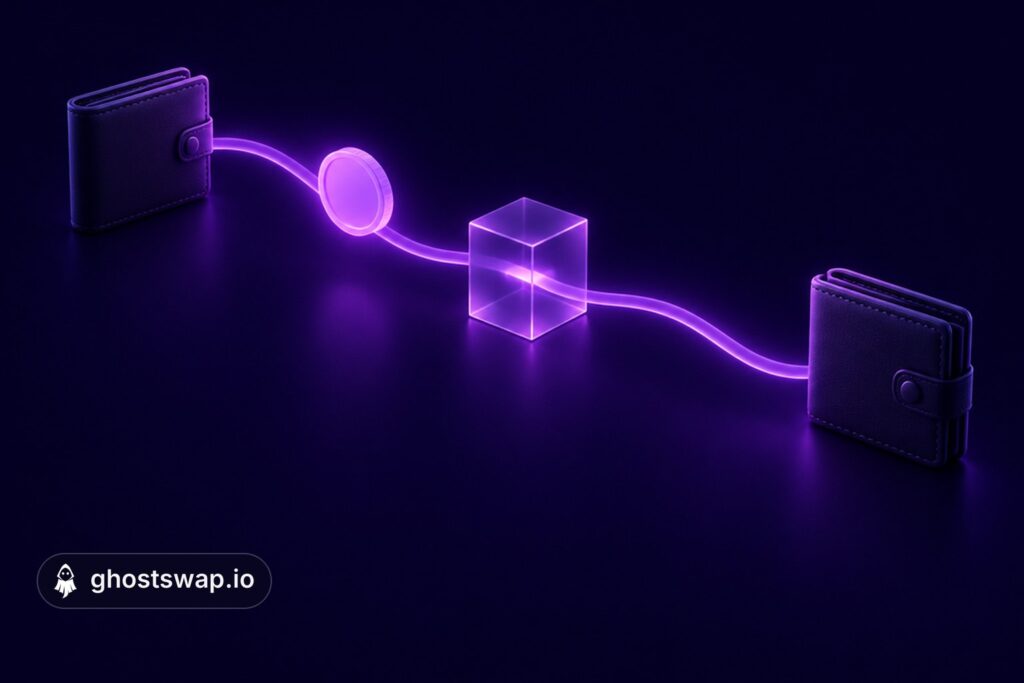
Crypto was supposed to make paying people simple. In one way it has: you can send USDT to a contractor on the other side of the world in a minute, with no bank in between. But every payment on a public blockchain also hands the recipient something most people never meant to share, which is a full view of the wallet they paid from.
GhostSwap Private Send is a tool built around that problem. The person you pay receives the coin they asked for, from a payout address that is not yours. They never see your wallet, your balance or your history.
The problem with a normal crypto payment
On Bitcoin, Ethereum, Tron and most other chains, a transaction records the sending address. Anyone holding that address can open a free block explorer and see what is still in the wallet, every payment it has received and everyone it has paid.
Take an everyday case. A small business pays a designer 850 USDT on Tron. With a direct transfer, the designer can click the sending address and see the 14,920 USDT left in the company wallet and 312 earlier transactions, including payments to other suppliers. Nothing has gone wrong. That is simply how public chains work.
Addresses carry no names, but they rarely stay anonymous for long. Once a wallet has touched an exchange account, a shop with a delivery address or a public post, it can be tied to a person or a company.
How Private Send works
GhostSwap (ghostswap.io) is a no-KYC crypto swap service with more than 1,600 coins and tokens. Private Send uses the same swap engine to pay a third party instead of yourself:
1) Pick the route. Choose the coin you pay with and the coin the recipient wants, for example XMR to USDT on Tron, or BTC to USDT.
2) Paste their address. Enter the address the recipient gave you, plus a memo if they are receiving into an exchange account that needs one.
3) Add a refund address. This is the wallet you pay from, used only if the payment cannot be completed.
4) Send to a one-time address. GhostSwap shows a deposit address created for this one payment. You send the amount from your own wallet.
5) They get paid. After your deposit confirms, the coins arrive in their wallet from a separate payout address. Most payments arrive in 5 to 30 minutes, and every step is shown on a status page tied to a swap ID.
There is no account to create, and standard swaps need no email or ID.
Why paying with Monero matters
Private Send removes the direct link between your wallet and the recipient’s. It does not make a public chain private. Your own deposit is still an ordinary transaction on the chain you pay from, and on Bitcoin or Ethereum the amount the recipient gets, and when, stays visible.
That is why the page points users to Monero (XMR) for the strongest setup. Monero hides the sender, the receiver and the amount on every transaction. If you pay with XMR and the recipient receives BTC, ETH or USDT, your side of the payment never appears on a public chain, and theirs comes from an address that is not yours.
GhostSwap is open about these limits on the Private Send page itself, in a section called “What Private Send does not hide”. It also gives practical advice: pay from a wallet you control, and ask the recipient for a fresh receiving address.
Who it is for
The use cases are ordinary ones:
- Freelancers and contractors: settle an invoice in USDT or BTC without showing a client or supplier your whole wallet.
- Family: send support or a gift without exposing your savings.
- Online purchases: pay a BTC invoice from an XMR wallet.
- Donations: support a creator or an open-source project without tying it to your main holdings.
Questions people ask
Can someone see my wallet balance if I send them crypto?
With a normal transfer, yes. With Private Send, they only see the payout address.
Can the recipient get a different coin from the one I pay with?
Yes. You might pay in XMR while they receive USDT or BTC.
What if a payment fails?
The coins go back to the refund address you entered.
The bottom line
As more people get paid in crypto, more of them are learning that a payment can show far more than the amount. Private Send gives anyone paying a freelancer, a relative or a shop a simple way to keep their wallet out of the transaction. Paying with Monero keeps their own side private too.