
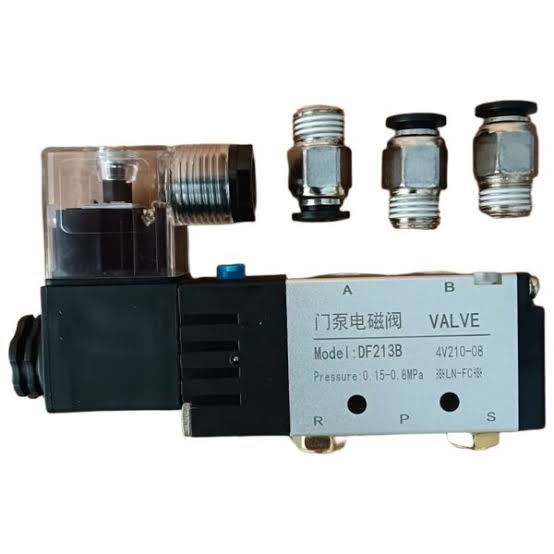
A purchase request that says ‘4V210-08, one piece’ looks specific. It identifies a valve family, a control arrangement and a nominal port size. What it does not necessarily tell the buyer is which coil belongs on the machine, how the cable connects or which thread is cut into the body. Those details can turn a straightforward replacement into a second order.
The useful starting point is a clear photograph of the body marking and another of the coil label, taken when access is safe. A photograph of the surrounding installation helps too. It shows whether the valve sits alone or on a manifold, where the fittings point and how much room there is to remove the connector. Treat those photographs as part of the specification, not just a way to recognize the color of the valve.
Separate the valve function from the electrical specification
AirTAC’s 4V200 ordering table identifies the 4V210 as a single-solenoid, five-port, two-position valve. The 08 option denotes nominal 1/4-inch working ports. In that same table, B specifies DC24V, C specifies AC110V and A specifies AC220V. The letters are ordering information; they are not interchangeable labels for the same electrical device. [1]
Read the installed coil rather than guessing from the machine’s incoming supply. A machine connected to AC mains can still use DC control outputs. Likewise, ’24V’ on a requisition is incomplete if nobody has recorded whether the circuit is AC or DC. The replacement has to match the actual control circuit, including any connector or suppression requirements established by the machine builder.
The catalog also distinguishes terminal entry from grommet entry. In the published table, a blank electrical-entry field denotes terminal connection, while I denotes grommet entry. A buyer comparing an AirTAC 4V210-08 solenoid valve should therefore confirm the selected configuration, not stop at the headline model number. [1]
The fittings need their own check
There is an easily missed detail in the port table: the 4V210-08 has 1/4-inch inlet and outlet ports, but its exhaust ports are 1/8 inch. Ordering every fitting and silencer as 1/4 inch would not follow that specification. [1]
Nominal size is only one part of the connection. Record the thread specification as well, and match it to the replacement drawing and fittings. The European ordering sheet explicitly lists a G-thread option; it should not be used to infer the code for every version sold in every market. Where an existing order uses another thread option, obtain confirmation of that exact version before buying.
An old fitting starting to turn into a new port is not a compatibility test. Nor should a convenient-looking adaptor distract from installation clearance. Look at the connector removal space, mounting holes and access to the exhaust silencers with the complete assembly in mind. The bare valve body is only part of what must fit.
Check the air supply before condemning the replacement
A correctly matched coil does not resolve an unsuitable pneumatic supply. The standard 4V200 data lists an operating pressure of 0.15-0.8 MPa, or 1.5-8 bar. A low-pressure process may therefore need a different arrangement rather than a like-for-like internally piloted valve. Do not assume a special external-pilot configuration has the same limits without its own documentation. [1]
Consider an illustrative fault: a valve changes state when the machine is idle, but cylinder movement becomes inconsistent when several stations operate together. That observation does not prove the valve is defective. A qualified technician needs to compare pressure and flow conditions during the demand event, then check the supply path, exhaust path and control signal. The Department of Energy’s compressed-air guidance identifies filters, regulators, hoses and couplings as possible restrictions. [2]
It is worth keeping the operating limit separate from the proof-pressure figure on a data sheet. Proof pressure is not an invitation to run the machine above its specified operating range. Increasing plant pressure to hide a local restriction can also leave the underlying problem untouched.
Give purchasing a configuration, not a guess
A useful order record brings together the full body code, coil voltage and AC/DC designation, electrical entry, thread type, mounting arrangement and any required accessories. Keep the manufacturer’s drawing with it. If one item remains unclear, mark it for confirmation instead of filling the gap from a similar-looking online photograph.
When sourcing AirTAC pneumatic components, send that record with the inquiry. It gives the supplier something definite to check and gives receiving staff a way to inspect the delivered item. This is especially helpful when the original description has been shortened in a maintenance system or copied through several purchase orders.
Replacement work still belongs within the machine’s isolation procedure. Electrical disconnection alone does not deal with trapped air or a load that can move when pressure is released. Qualified personnel should control both stored pressure and mechanical movement before removing the valve. [3]
The aim is not to make a small purchase complicated. It is to capture the few details that decide whether the new valve is actually the same configuration. The time to read the coil label is before the order is placed.
Sources
- AirTAC. 4V200 Series Solenoid Valve catalog (2025), PDF p. 1.
- U.S. DOE / Compressed Air Challenge. Improving Compressed Air System Performance, printed pp. 31-32.
- OSHA. Control of Hazardous Energy.
Previously in Business news: How Saoud Shahzad Is Advancing AI Cybersecurity and Secure Digital System