

Two years ago, artificial intelligence lived in a browser tab. You typed a question, a distant server answered, and that was the whole experience. In 2026 the thinking is moving out of the data centre and into the products themselves. On-device AI now runs inside the phone in your pocket, the vacuum cleaning your floor and the watch on your wrist, answering in a blink and keeping your data at home. This shift, from AI as a website to AI as a built in feature of everyday hardware, is the real technology story of the year.
The economics explain why makers rushed to make the move. Running AI on a server farm costs money on every single query, and it adds delay plus a privacy question to even simple tasks. A chip inside the product answers faster, works without a connection and keeps personal data where it was created. As those chips have become cheaper, the same smarts that once needed a data centre now fit inside a vacuum cleaner, a watch and a doorbell.
The clearest sign is how people now use their own computers. Tools that once demanded a powerful cloud account run happily on an ordinary laptop, and guides to running AI models locally on a PC (https://www.dailyoffs.com/run-ai-models-locally-on-pc/) have become some of the most read technology content of the year, because readers want the speed and privacy of on-device AI that never leaves their own machine. Local processing has turned into a selling point, not a compromise.
Hardware makers have answered in kind, and the intelligence is spreading to accessories nobody used to think of as computers. A modern 4 in 1 car charger (https://forwardgadgets.com/the-ultimate-4-in-1-car-charger-fast-clean-and-powerful-charging-for-every-journey/) , for example, carries a smart protection chip that watches temperature and shares 120W of power safely between four devices, a small act of automation that would have sounded like science fiction in a car accessory a decade ago. The pattern repeats across the whole market: sense, decide, act, all inside the product.
What Is On-Device AI and Why Does It Matter?
On-device AI means the model runs on the product in your hand or your home, not on a remote server. The engine of the shift is the neural processing unit, a small block of silicon now built into mainstream laptop, phone and appliance chips. It handles tasks like face unlock, photo sorting, live translation, voice commands and background blur on video calls without sending anything away. The building blocks behind it, from image recognition to predictive maintenance, are well documented in explainers on artificial intelligence in electronics (Demystifying Artificial Intelligence in Electronics: Applications and Implications – TechBullion), and they have been maturing for years. What changed in 2026 is where the processing happens, and who controls the data it produces.
For buyers, the practical gains are easy to feel. Features work on a plane, in a basement and during an outage. Answers arrive instantly instead of after a round trip to another continent. And a growing group of buyers, tired of paying a subscription for every small feature, actively look for products that do the work locally and charge once at the till.
On-Device AI in the Home: Machines That Learn the Floor Plan
Nowhere is the change easier to see than at home. A current robot vacuum builds a map of your rooms with its own sensors and processor, learns which doorway leads where, and spots cables, socks and pet accidents before they become a mess. Smart thermostats learn the rhythm of a household and heat rooms before anyone asks. Video doorbells tell the difference between a visitor, a parcel and a passing cat, and they send three very different alerts because of it.
These are not party tricks. Each one replaces a small daily chore or worry, and each one depends on the same recipe: sensors to gather the picture, a model to understand it, and enough local processing to act in the moment. Homes are also where the privacy debate is sharpest, which is why the better products now process camera and voice data on the device and say so plainly on the box.
On-Device AI in Wearables: Health Data That Talks Back
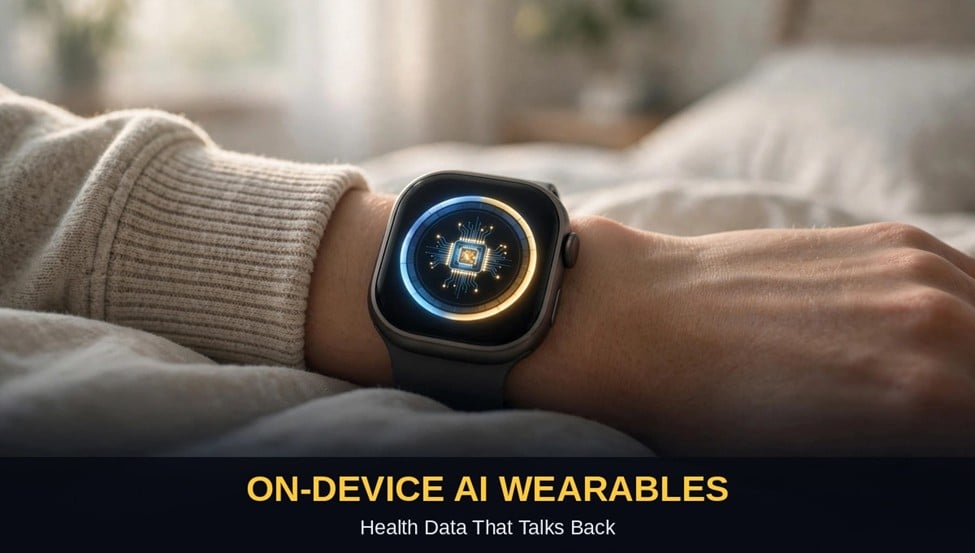
Wearables have made the same jump. A fitness ring or watch used to be a counting machine: steps, heartbeats, hours of sleep, presented as raw numbers. The newest models interpret those numbers on the wrist itself. They turn a week of sleep and strain into a plain recovery score, warn when resting heart rate drifts in a way that often precedes illness, and coach in sentences rather than charts.
The value is not the sensor, which has barely changed, but the interpretation layered on top of it. That is also the risk. Health suggestions from a gadget are guidance, not medicine, and the honest brands say so. Buyers should treat recovery scores as a prompt to rest or to see a doctor, never as a diagnosis.
The Business Lesson Behind On-Device AI
For the technology industry, on-device AI marks a change in where the money is made. Cloud software alone has become a crowded, copyable market, where a feature launched in spring is matched by rivals before autumn. Hardware with good local AI inside is harder to copy, because it depends on chips, sensors, industrial design and years of gathered data working together.
It also changes the relationship after the sale. A device that learns a home or a body becomes personal in a way a generic product never is, and owners replace it less often and recommend it more. The temptation for makers is to rent the intelligence back as a monthly plan. The brands winning trust in 2026 are the ones resisting that temptation for core features and charging subscriptions only for genuinely ongoing services, such as cloud backup or advanced coaching.
What to Check Before You Buy
Four questions separate a genuine on-device AI product from a label on a box.
First, does it still work without an internet connection? If the smart features die when the Wi-Fi drops, the intelligence lives on a server you do not control. Second, what does it send to the cloud, and can you turn that off? Third, are the headline features included in the price, or do they need a subscription after a free trial? Fourth, how long will the maker support it with updates? A smart gadget is a small computer, and an unsupported computer becomes a liability, in the home above all.
FAQs
What is on-device AI?
On-device AI is artificial intelligence that runs inside the product itself, on its own chip, instead of on a remote server. It powers features like face unlock, robot vacuum mapping and voice commands, and it keeps working without an internet connection.
What are some on-device AI examples?
Common examples include a phone sorting and improving photos the moment you take them, a robot vacuum mapping your home and avoiding cables, a doorbell recognising a parcel, live translation on a laptop, and a watch turning sleep and heart data into a recovery score.
Is on-device AI better for privacy?
Usually, yes. Data that never leaves the device cannot leak from a server, and features keep working offline. Privacy still depends on the maker, so look for clear data settings, a physical mute or camera cover where relevant, and a policy written in plain words.
Will on-device AI remove subscriptions?
It removes the need for many of them, because features that run locally cost the maker nothing per use. Some brands still charge for cloud backup or advanced coaching. A subscription you cannot cancel without losing basic functions is a warning sign worth walking away from.
Conclusion
The browser tab era of AI was only the beginning. On-device AI has carried the technology into the objects people touch every day by moving the thinking onto the device itself. That move buys speed, privacy and products that feel personal, and it sets the test every maker now has to pass: intelligence that serves the owner, on the owner’s terms. The products that pass it will define the next decade of consumer technology.
Previously in Technology: Smart Well Pump Maintenance: What You Need to Watch Before a Small Issue Becomes a Full System Failure