
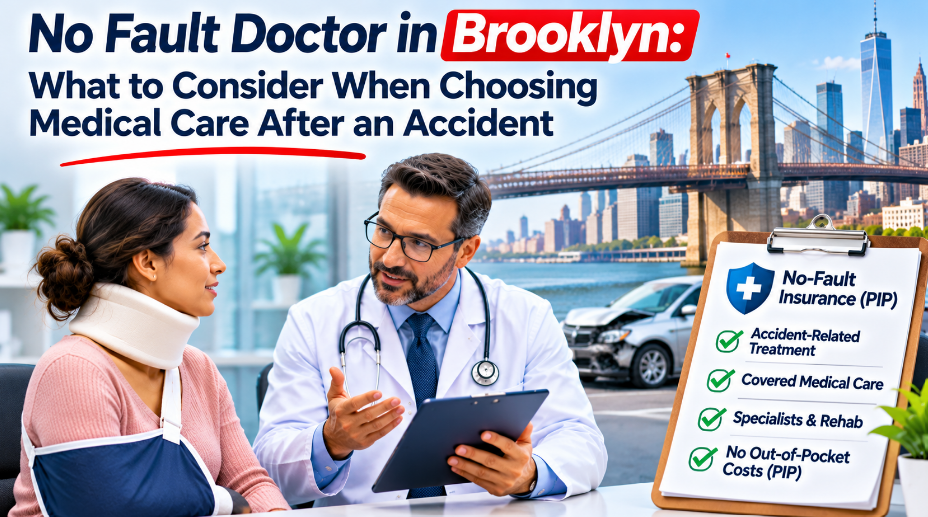
When you’ve been in a car accident, the damage to your vehicle and the insurance paperwork are only part of what you have to handle. Your body may be sore or uncomfortable, normal everyday activities might take more effort, and you may not be sure how the medical expenses are going to get paid. That makes the whole thing more stressful. For accident victims in Brooklyn, getting to a healthcare provider who is familiar with motor vehicle accident cases is a big part of moving forward.
Searching for a no fault doctor in Brooklyn is usually where it starts, and the process goes on from there. Finding a medical professional is part of it, but you also need to understand how the different providers work together, how your medical records get handled, and what you can expect if the insurance company wants more information. If you make informed choices at each step, there’s less chance of unnecessary confusion while you recover.
Choosing Medical Care Based on Your Injury, Not Just Your Location
Brooklyn is made up of a lot of different communities. There’s Downtown Brooklyn and Brooklyn Heights, and there’s also Flatbush, Bay Ridge, Bensonhurst, Bushwick and Crown Heights. Having medical care that’s convenient to get to matters, especially when your injury makes it uncomfortable to travel.
Still, being close by shouldn’t be the only thing you look at. Your decision should also take into account the type of injury you have, what professional qualifications the provider has, and which services are available.
Take persistent back discomfort as an example. A person dealing with that may need a different medical evaluation than someone with a knee injury or ongoing headaches. Based on the circumstances, an appropriate healthcare professional might recommend further examination or diagnostic testing, or suggest a consultation with another specialist.
Before you schedule an appointment, find out if the provider regularly handles automobile accident cases and whether their professional expertise fits your medical needs. It’s also a good idea to make sure the office accepts your specific No-Fault claim.
Why Coordinated Medical Care Matters After an Accident

Something people sometimes overlook in accident-related healthcare is how well the different medical professionals coordinate with each other.
Depending on the nature of the injury, a person may end up getting care from more than one provider. An initial medical evaluation, for example, could lead to a recommendation for diagnostic imaging, and after that there might be a specialist consultation or rehabilitation services.
If the offices don’t communicate properly, important information can end up scattered between them. Previous examination findings, imaging reports, medical recommendations and progress notes might not always be there when another provider needs them.
When care is well coordinated, it’s easier for medical professionals to understand the patient’s history and to make decisions based on relevant clinical information.
When you connect with a healthcare provider, these are some questions you could ask:
- How does the office share medical records and diagnostic reports with the other professionals treating me?
- If I need another specialty, can the office help coordinate the referral?
- Who do I contact if my medical documentation needs to be updated?
- How will changes in my symptoms and my recovery progress be recorded?
Clear communication can make ongoing medical care easier to manage, and it can cut down on gaps in information that could have been avoided.
Understanding Medical Billing and Assignment of Benefits
You should also know how medical expenses work under New York No-Fault insurance.
Your healthcare provider may bill the insurance company directly once the paperwork for payment authorization or assignment is properly done. These two documents aren’t necessarily the same, though, and one can’t always be used in place of the other.
New York’s No-Fault regulations don’t treat an authorization to pay benefits and an assignment of benefits the same way. An assignment can give the healthcare provider certain rights that come with the claim.
Ask the office to explain any medical or insurance paperwork before you sign it. You’ll want to know what you’re authorizing, whether any of your claim rights move to the provider, and how they’re going to bill for your care.
New York also has its own medical reimbursement rules and fee schedules. When a procedure has no specific unit value listed in the applicable schedule, some services need extra written justification. The New York Department of Financial Services covers this in its No-Fault Fee Schedule guidance.
Knowing this ahead of time helps you have more informed conversations with the provider’s administrative team.
What Happens When an Insurance Company Requests Additional Medical Information?

Not every insurance claim goes through without any questions. As part of its review, an insurer may ask for additional verification or set up an independent medical examination.
Getting a request like that can be confusing when you’re injured, and even more so when you’re still dealing with ongoing medical concerns.
Read any letters or messages from the insurer carefully so you know exactly what information they’re asking for. Hold on to copies of the relevant correspondence, and take any medical questions to your treating healthcare professional.
Medical examinations and peer-review reports are also covered in New York’s No-Fault regulations. When an insurer’s denial is based on an examination or a peer-review report, the regulations provide for a copy to be released on written request to the injured person, their attorney or their treating physician.
All of this is part of how the insurance claim gets reviewed. It does not take the place of an independent medical professional’s responsibility to assess the patient’s actual condition.
If you want more detail, you can look at New York’s No-Fault insurance regulations.
How We Help Brooklyn Accident Victims Connect With Medical Providers
When you’re already dealing with an accident and everything that comes after it, finding appropriate medical care can take up a lot of time.
Our connection service helps people identify and connect with independent healthcare professionals who accept or work with No-Fault insurance. We don’t run a medical facility, and we don’t employ doctors to provide treatment. What we do is make it simpler to reach the relevant medical providers.
You can look through potential connections based on your medical needs and the location you prefer. That can make it easier to start talking with healthcare offices, without having to do the whole search on your own.
We don’t diagnose injuries or prescribe treatment, and we don’t provide medical examinations or make insurance coverage decisions. Those responsibilities stay with the independent healthcare professionals and the applicable insurance companies.
What we’re trying to do is simple. We want to help accident victims reach medical providers who are familiar with No-Fault cases, and make finding and contacting those providers more convenient.
Making Informed Decisions About Your Recovery

No two accidents are the same, and neither are two recoveries. Some injuries may only need medical attention for a limited time. Others can mean continued evaluations and coordination between several healthcare professionals.
When you choose a provider, a convenient appointment location is only one part of the picture. You should also think about their professional qualifications and their experience with accident-related cases. How they communicate, their documentation practices and the way they handle insurance procedures matter too.
Going in better informed can cut down on administrative uncertainty, so you can put your attention on your medical needs.
You might be just starting your search for a no fault doctor near me, or you might be looking for a no fault doctor near me in Brooklyn specifically. In either case, our connection service can help you explore independent medical providers who accept No-Fault insurance and take the next step toward appropriate care.
This article is meant for general informational purposes only and is not medical, legal or insurance advice. Please confirm provider participation, medical suitability and insurance coverage directly with the relevant healthcare provider and insurer.