
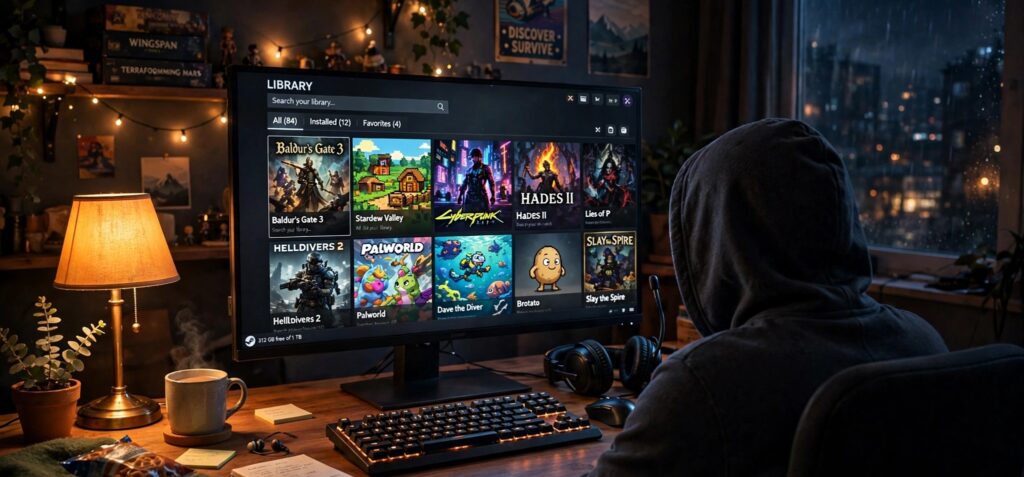
A player finishes work, opens Steam and launches the same game they played last night. A new release might be sitting on their wishlist. They may even have watched its trailer. But their friends are already online, they know the controls, and they have an hour before bed.
For a developer preparing to launch a PC game, that familiar evening is part of the competition. A release calendar shows which other titles arrive in the same week. It says much less about the games that already occupy an audience’s free time.
According to this study, games at least ten years old occupied 31.6% of the slots in Steam’s daily Top 75 across the available chart days in 2026, compared with 1.3% in 2012. Games less than a year old accounted for 18.4%, down from 36.3%.
For a new release, that means the competitive field stretches well beyond this month’s launches. A survival game might be asking a group to take a break from a server they have spent months building. A competitive shooter might need to earn time from players who already have a regular team and a favourite mode.
The cost of trying something new
A game’s purchase price is only one part of the decision. There is also the download, the setup, the tutorial and the uncertainty about whether an evening will be well spent. An established game arrives with advantages that are difficult to show in a feature comparison. Its players know which modes they enjoy. They understand the equipment, recognise the maps and have worked out how to solve common problems. For multiplayer groups, choosing it may require little discussion.
Imagine four friends considering a new cooperative game. One has an older PC, another has limited time, and a third wants to know whether everyone needs to buy a copy. The group could like the concept and still postpone playing. That gives a developer several specific problems to investigate. Can players understand the hardware requirements? How quickly can friends get into the same session? Can someone who arrives late join easily? A campaign that generates interest will struggle if the first attempt to play together becomes an evening of troubleshooting.
Start with the evening you want to earn
“Fans of survival games” is a broad target audience. “Friends who want a cooperative survival session they can finish in an hour” gives a team something more concrete to design and communicate.
The distinction affects almost everything. A game intended for short sessions needs sensible stopping points. A strategy game aimed at experienced players needs to show its distinctive decisions. A competitive title asking people to learn unfamiliar mechanics needs an approachable route into meaningful matches.
The store page should make that experience visible. An unedited stretch of gameplay can answer questions that a cinematic trailer leaves open. How much time is spent moving between activities? What does a player actually decide? How does a session end?
Developers can test whether the message works by asking prospective players what they expect to do during their first session. If the answers differ sharply from the intended experience, the positioning needs attention before more money goes into distribution.
Let the demo test the promise
A demo offers an opportunity to find out where interest turns into participation. Valve’s demo guidance recommends showing enough of the core experience to excite players, while making sure the quality represents the full game. For a small team, the useful questions are practical. How many people reach the first meaningful decision? Where do they stop? Can they explain what makes the game appealing after playing it?.
Consider a hypothetical tactics demo. Players download it after seeing a trailer about unusual combinations of abilities, but leave during a lengthy introduction before those combinations become available. The team could respond by improving the tutorial, bringing a representative encounter forward, or changing the trailer if it promises a different pace.
Each response addresses a different cause. Download totals alone cannot tell the team which one applies.
A short follow-up question can add context that behaviour misses. Someone might stop because the controls are confusing, because the demo crashes, or because dinner is ready. Those exits look similar in a basic completion report and call for very different decisions.
Multiplayer launches have a group problem
For multiplayer games, an interested player may also need to persuade other people to try the game. The invitation becomes part of the product experience. That makes group testing particularly valuable. A developer should observe what happens when one person introduces friends who have seen none of the marketing. Can the organiser explain the game? Can everyone join? Does a newcomer understand their role without holding up the group?
Some platform features can reduce the practical barriers. In suitable games with local multiplayer, Steam Remote Play Together lets a host invite friends through streaming, with only the host required to own and install the game. Whether it suits a particular title depends on its design and how it performs in testing.
The broader lesson is to examine the entire invitation. Clear purchasing information, reliable lobbies and understandable onboarding all affect whether curiosity becomes a shared session.
Measure the audience your game needs
The attention given to established games can tempt a studio to judge its launch against the largest concurrent-player totals. That comparison needs care. Concurrency measures how many people are playing simultaneously. It does not directly reveal revenue, profitability or whether a game has reached its intended audience. A short story game and a competitive multiplayer title also have different reasons for players to return.
A studio making a finite adventure might focus on purchases, refunds, completion feedback and whether players recommend it. A multiplayer developer also needs to understand matchmaking times, connection failures and the experience available in each region and mode.
Mobile developers face a similar problem when measuring player value beyond the initial install. A campaign can attract plenty of downloads while bringing in few players who stay long enough to justify the acquisition cost. Before scaling promotion, a team should decide what a successful first session looks like and identify the points where players are failing to reach it.
The launch plan then becomes easier to evaluate. A tutorial change should help players reach the core experience. A lobby fix should help groups start playing. A revised store page should set expectations that the game can meet. An established favourite already offers a familiar way to spend an evening. A new PC game earns its opportunity by making its own appeal clear, delivering it promptly and giving players a reason to recommend the experience to someone else.