
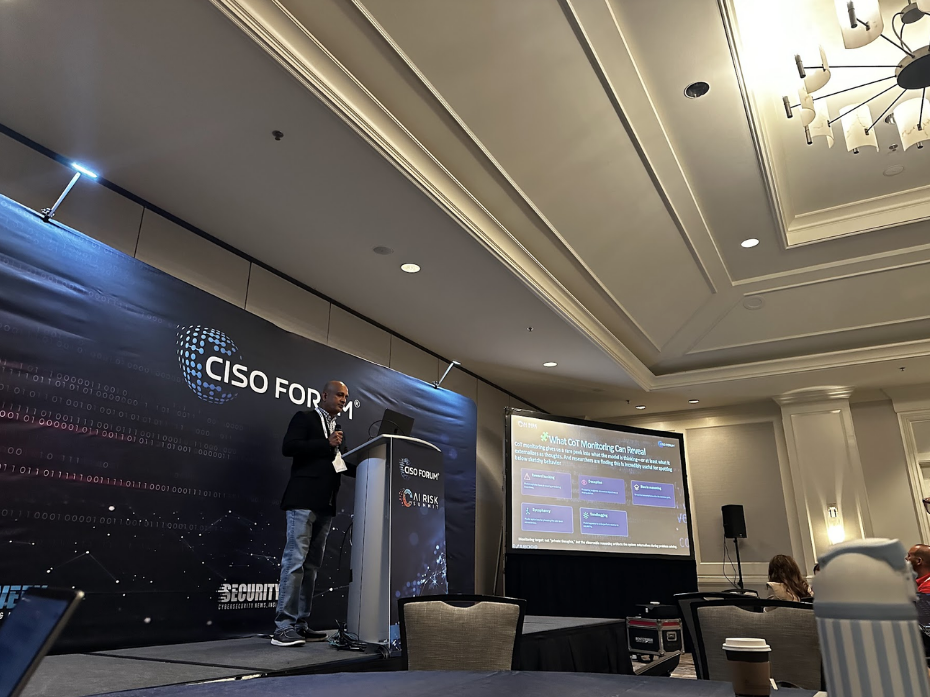
California, USA | 2026 — As artificial intelligence continues to evolve from conventional predictive systems into increasingly autonomous and reasoning-driven technologies, questions surrounding transparency, accountability, and responsible oversight have become central to enterprise AI adoption. Addressing these emerging challenges, technology professional and AI governance advocate Mr. Anant Somvanshi was featured as a speaker at the 2026 AI Risk Summit in California, focusing on the timely subject of “Chain-of-Thought Monitorability in AI Governance.” His presentation explored how organizations can strengthen oversight of advanced AI systems, identify potentially unsafe reasoning patterns, and establish governance mechanisms capable of supporting increasingly complex AI-driven decisions.
Mr. Anant Somvanshi Speaking about AI Governance in AI Summit in California International event
The discussion reflected a fundamental shift in the way enterprises must approach artificial intelligence governance. Traditional governance practices have largely concentrated on model performance, data quality, regulatory compliance, and the accuracy of final outputs. However, as large language models and agentic AI systems gain the ability to plan, reason, interact with external tools, and execute multistep workflows, examining only their final responses may no longer provide sufficient assurance of responsible behavior. Mr. Anant Somvanshi’s presentation centered on the importance of monitoring available reasoning traces and related behavioral signals to better understand how advanced AI systems arrive at decisions and whether their actions remain aligned with organizational policies, security requirements, and human expectations.
A central theme of the presentation was the emerging concept of chain-of-thought monitorability, which examines whether observable reasoning traces can provide useful signals about an AI system’s intentions, decisions, and potentially undesirable behavior. While these traces may help identify warning signs, they are not necessarily complete or faithful representations of a model’s internal reasoning. This distinction is especially important as AI systems become more sophisticated and their decision-making processes become harder to evaluate using conventional testing methods.
The session also explored how enterprises can incorporate monitorability into broader AI governance frameworks through structured evaluations, independent monitoring mechanisms, human oversight, audit trails, and risk-based escalation procedures. Rather than treating AI governance as a one-time compliance exercise, the discussion emphasized the importance of continuous evaluation throughout the AI lifecycle, from initial development and deployment to ongoing operation and improvement.
For organizations adopting agentic AI, these considerations carry significant operational implications. Autonomous systems may retrieve sensitive information, interact with business applications, generate recommendations, and initiate actions with limited human intervention. In such environments, governance must extend beyond assessing whether an AI-generated answer appears correct. It must also consider whether the system followed authorized procedures, respected access restrictions, recognized uncertainty, and operated within established boundaries.
The subject of Mr. Anant Somvanshi’s presentation connected these technical challenges with the broader responsibilities of technology leadership. Effective AI governance requires cooperation among engineering teams, cybersecurity professionals, risk managers, compliance specialists, and executive decision makers. By connecting chain-of-thought monitorability with enterprise risk management, the session addressed how organizations can develop more accountable approaches to deploying advanced AI technologies.
As artificial intelligence becomes more deeply embedded in business operations, the need for reliable oversight mechanisms will continue to grow. Mr. Anant Somvanshi’s participation in the 2026 AI Risk Summit placed attention on an important question facing the industry: How can organizations maintain meaningful human oversight when AI systems become increasingly capable of independent reasoning and action?
His presentation on Chain-of-Thought Monitorability in AI Governance contributed to this evolving discussion by emphasizing the value of measurable safeguards, responsible deployment practices, and continuous monitoring in building trustworthy AI systems. The broader message was that the future of enterprise artificial intelligence will depend not only on what intelligent systems can accomplish, but also on how effectively organizations can evaluate, govern, and remain accountable for their behavior.