

At Smart City Expo World Congress in Barcelona, LiveX and NVIDIA unveiled AI City, which brings artificial intelligence directly into everyday physical spaces through life-size, human-like AI Hosts. LiveX AI Hosts are already live at more than 100 customer sites. Guests meet them at San José Mineta International Airport, SAP Center (home of the San Jose Sharks), El Camino Health, PUMA’s Las Vegas flagship, and Marriott and Hilton hotels.
What is AI City, and why launch it at Smart City Expo World Congress?
AI City is a vision for the cities people already live in, where intelligence is as accessible as electricity in the places we shop, travel, cheer, heal, learn and gather. You walk up to a LiveX AI Host and talk to it the way you’d talk to a person. It understands what you need, answers in your language and helps you get it done.
We launched in Barcelona because this is where mayors, city CIOs, transit authorities and the leaders of large venues come to decide how AI will actually reach the public. Most of them have already seen what chatbots can do. What they want now is AI that serves every resident and visitor, not just the people who download an app. We came with proof from live deployments. During major sports events such as the Super Bowl week, our Hosts helped travelers through San José Mineta International Airport, and they welcomed guests at Marriott and Hilton hotels with help on parking, dining, transport and stadium logistics. The same Hosts guide visitors through hospitals, help shoppers find the right product, and connect students with campus services. For a city leader, AI City is a practical way to deploy AI in public spaces this year, not a five-year roadmap.
What does Physical AI mean, and how is an AI Host different from a humanoid robot?
To me, Physical AI means intelligence that lives in the spaces around us, not only on our phones. Humanoid robots will one day help people shop, travel and get around complex spaces, but widespread deployment is still years away. Our AI Hosts are working today. They engage people the way people engage each other: face to face, live and in person. There’s no app or interface to learn. You walk up and talk, and the Host sees you, understands you and helps you in your language.
Cathy Hackl, the tech futurist and author of Spatial Computing: An AI-Driven Business Revolution, put it well: “We talk about AI being everywhere, but until now it has lived mostly on our devices, not in the physical spaces around us. The next billion people may first meet AI not through an app or a prompt, but by walking into a store, a hotel, a hospital or a university. That is where physical AI and spatial computing come together. LiveX’s AI City offers an early look at that shift, with conversational AI hosts built into the places we all share. Before robots become part of our everyday life, this is one of the ways we begin to bring intelligence into the physical world.”
Kiosks and touchscreens have been around for years. Why aren’t they enough?
With a traditional kiosk, you have to figure out which menu option matches what you need. With a LiveX AI Host, you walk up, say what you need in your own words, and the Host can act on it.
At an airport, you might say, “I’m on flight UA 218. How do I get to my gate?” From that one question, the Host looks up your flight, finds your gate, and shows you the route from where you’re standing on an interactive 3D map. You can see each turn as the Host talks you through it, much as a person guiding you would.
In a store, ask to see a jacket, and the Host shows it to you in 3D. Say, “Can I see the back?” and it turns the jacket around. You can try it on virtually, see how it fits, and check out right there with the Host. It can also check live inventory or connect you with a staff member.
The LiveX Gateway stands seven feet tall and brings you face to face with a life-size AI Host. Its camera and microphones let it see and hear you. Powered by LiveX Interactive Intelligence and NVIDIA’s software and hardware stack, the Host understands its surroundings, follows what you mean even when you change topics, and takes action to help you accomplish your goal. It speaks more than 140 languages, and you can continue the conversation on your phone if you want to take it with you.
That’s the shift. For decades, people had to adapt to technology through keyboards, touchscreens and apps. Now the technology adapts to people. The elderly visitor, the tourist, the child and the first-time guest already know how to use it, because it works like talking to someone.
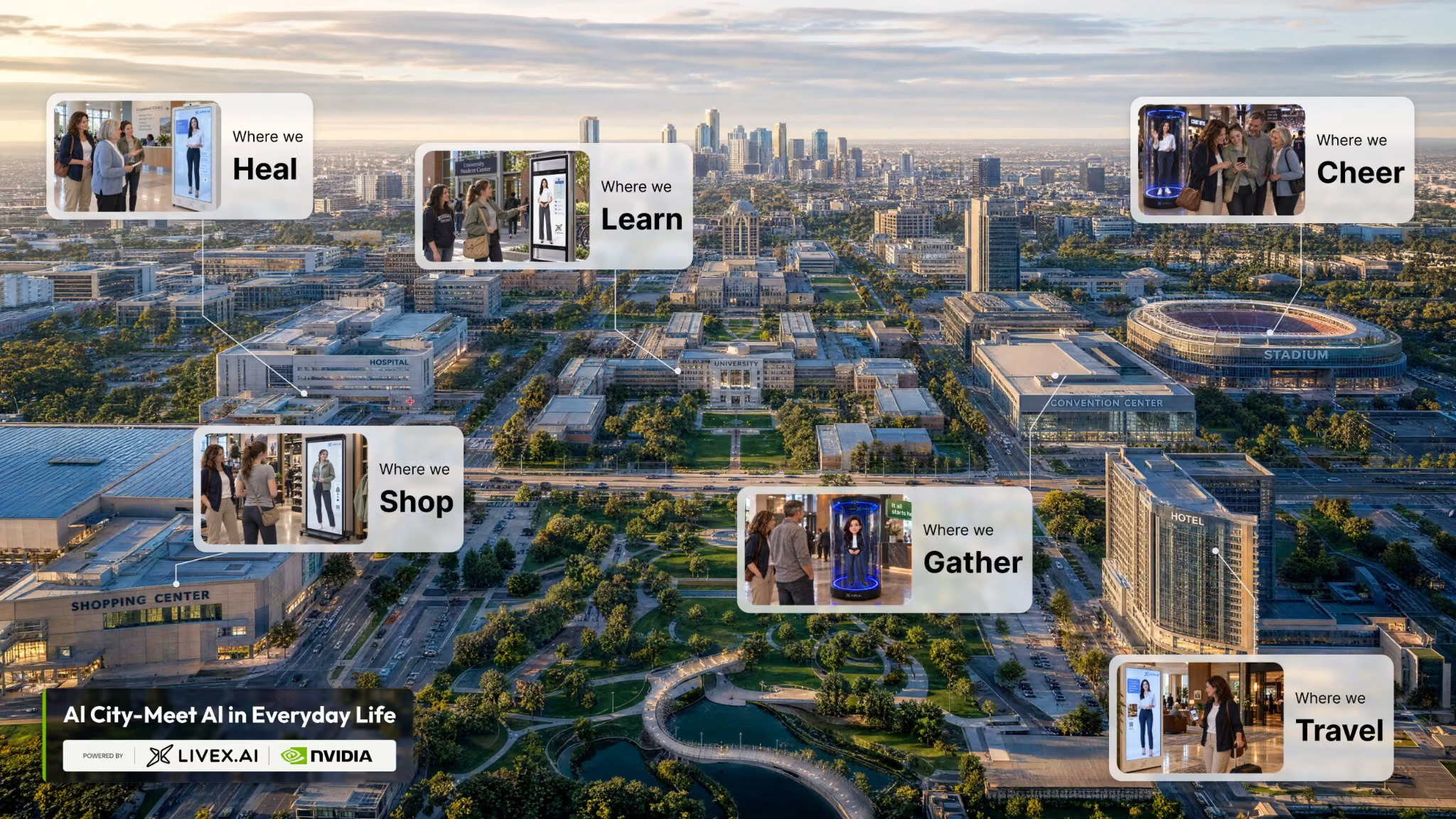
Where are LiveX AI Hosts deployed today?
LiveX AI Hosts are live at more than 100 customer sites across travel, healthcare, retail, hospitality and entertainment. Guests meet them at San José Mineta International Airport, SAP Center, El Camino Health, PUMA’s Las Vegas flagship, and Marriott and Hilton hotels. The same platform that helps a shopper find the right running shoe can guide a traveler to a gate or help a patient’s family find their way through a hospital.
What’s new with this launch?
Until now, we’ve built for individual venues: an airport, a hospital, a store. With AI City, we’re bringing those capabilities together for the first time as a connected, citywide platform. A visitor’s experience doesn’t have to stop at one front door.
The launch also brings new capabilities: interactive 3D navigation, 3D product discovery, expanded real-time translation, and AI Hosts powered by Lyra, our Physical AI agent. The bigger story is the move from single AI experiences to connected intelligence across a whole city, built on deployments that are already running.
How does NVIDIA technology power the platform?
NVIDIA is the foundation. Our Hosts run on NVIDIA RTX PRO Blackwell GPUs, which let them see, listen, reason and respond in real time, in person, with no awkward pause. We build our visual AI agents with NVIDIA Metropolis, NVIDIA Cosmos world models and a fine-tuned NVIDIA Nemotron model, so a Host can understand both the question and its surroundings. NVIDIA Omniverse libraries help us build digital twins of real places, and that’s what makes location-aware help like 3D wayfinding possible. Our first Physical AI Host debuted at NVIDIA GTC 2026, where thousands of attendees talked with it hands-free in their own languages.
What makes LiveX’s technology different from everything else on the market?
Most AI in public spaces is built to start a conversation. Ours is built to finish the job.
Real venues are hard. Airports are loud, people interrupt themselves, and they ask three things at once. We’ve trained our models on real conversations from live deployments, not lab demos. Our Hosts hold a conversation in the middle of a noisy arena, follow a guest across several requests in one session, and resolve more than 90% of questions without a staff member stepping in. In retail, 10.4% of shoppers who talk with a LiveX Host go on to connect with the retailer’s app.
Behind that is a full stack we built for in-person AI. It understands speech, faces and surroundings together. It generates visual answers like maps and products on the fly. And it has safety guardrails that keep every Host on brand and on policy. Lyra, our AI agent, coordinates all of it so voice, expression and movement work together in real time. That’s the difference between an AI that’s impressive in a demo and one a city can rely on at scale.
What does an AI City look like a few years from now?
We believe intelligence should be as ubiquitous and accessible as electricity, everywhere real life happens. AI should greet travelers at the airport, guide a grandmother through the hospital, help every shopper the way the best employee in the building would, and answer sixty thousand fans at once.
Its form will change. It may be a screen, a projection or a humanoid robot. What will last is human-like conversation and real intelligence. With LiveX, getting help in the AI City should feel as natural as asking a person.
Our goal is to make that the norm in public spaces, so every visitor gets personal help and every venue extends its team’s reach.