
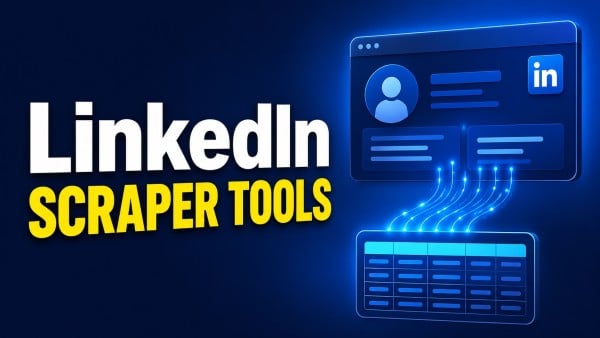
Sales and recruiting teams depend on accurate information to identify potential customers, understand professional markets, and discover suitable candidates. LinkedIn provides a valuable source of publicly available professional information, but collecting and organizing that information manually can be time-consuming. A LinkedIn scraper can help automate parts of this process, provided that organizations use the technology responsibly and respect privacy, platform rules, and applicable data protection laws.
Scrape.ly is a web scraping platform designed to simplify data collection across multiple websites. Its collection of more than 560 ready-made scrapers includes tools for platforms such as Google Maps, Amazon, LinkedIn, Instagram, YouTube, and Zillow. For organizations that need structured information rather than manual research, its LinkedIn scraper can be part of a broader data collection workflow.
Why Sales Teams Collect Public LinkedIn Data
Sales professionals often need to understand their potential customers before making contact. Relevant professional information can help teams identify organizations, research business roles, and determine whether a prospect matches their ideal customer profile.
For example, a business selling enterprise software might want to identify publicly listed professionals working in IT management, operations, or procurement. Instead of researching every profile individually, a structured data collection process can help organize permitted public information into a searchable format.
This can support several activities:
- Lead research: Organize publicly available professional details relevant to a company’s target market.
- Account identification: Research organizations and their publicly listed business information.
- Market analysis: Understand which industries and professional roles are represented in a particular market.
- Sales preparation: Give representatives useful context before a business conversation.
- Data organization: Reduce repetitive manual work when compiling information from permitted sources.
However, collecting information does not automatically make it appropriate for marketing. Sales teams should establish a legitimate purpose, collect only necessary information, and follow applicable privacy and electronic marketing requirements.
How Recruiting Teams Can Use LinkedIn Data
Recruiters also rely on professional information to understand talent markets and identify potential candidates. Public professional profiles may contain information about work experience, skills, job titles, and industry backgrounds.
When used appropriately, structured research can help recruiting teams organize their understanding of a talent pool. For instance, a recruiter hiring for a software engineering position may research publicly available information about relevant professional roles, technical specializations, and industry experience.
A responsible workflow should prioritize relevant professional information rather than collecting everything available. Recruiters should also avoid making automated hiring decisions based solely on scraped data. Information can be incomplete, outdated, or presented without the context needed for a fair assessment.
Candidate outreach should be transparent, respectful, and consistent with applicable privacy and employment regulations. Organizations should provide appropriate ways for individuals to ask questions or object to the use of their information.
What Is a LinkedIn Scraper?
A LinkedIn scraper is a software tool designed to extract selected information from accessible LinkedIn pages and organize it into a structured format. Depending on the tool and permitted data source, collected information may include professional titles, company details, profile URLs, or other publicly accessible fields.
The main advantage is organization. Rather than copying individual details into spreadsheets, a scraping workflow can help transform permitted source information into structured records that are easier to review and analyze.
Nevertheless, public visibility should not be confused with unrestricted permission to collect or reuse information. LinkedIn’s terms, technical restrictions, privacy obligations, and applicable laws must all be considered. Organizations should review the rules governing their intended collection method before deploying any scraper.
Introducing Scrape.ly’s LinkedIn Scraper
Scrape.ly’s LinkedIn scraper offers a collection of ready-made scraping tools intended to make web data collection more accessible. Its platform includes more than 560 scrapers covering different websites and data categories, including LinkedIn.
This broader collection can be useful for organizations that conduct research across multiple sources. A sales team might need professional research alongside company information, while a market research department could require data from several public websites.
Instead of building every scraper from the beginning, users can explore available tools for their particular research requirements. The platform also provides a web scraping API with software development kits (SDKs), allowing developers to incorporate scraping workflows into applications and internal systems.
For teams with technical requirements, an API-based approach can help standardize how permitted information is collected, processed, and transferred into existing workflows.
API Access and Automation
Manual research can become difficult to manage when teams need to process large amounts of information. An API offers a more structured way to connect data collection tools with other software.
Scrape.ly provides a web scraping API and SDKs that developers can use to integrate supported scraping capabilities into their applications. This can be relevant for organizations building internal research dashboards, data processing systems, or business intelligence workflows.
For example, a company might create a process that collects permitted public information, validates the resulting records, and sends approved data into a customer relationship management system. Human review can remain part of the process to identify errors, remove irrelevant records, and confirm that the intended use is appropriate.
Automation should not eliminate accountability. Teams should document their data sources, establish retention periods, protect stored information, and ensure that collection activities remain within permitted boundaries.
Connecting Scrapers With AI Agents Through MCP
Another feature highlighted by Scrape.ly is its Model Context Protocol (MCP) server. MCP provides a standardized way for compatible AI applications to connect with external tools and services.
Scrape.ly’s MCP server is designed to let supported AI agents and applications, including Claude, ChatGPT, and Cursor, run available scrapers through an integrated workflow.
This creates opportunities for more convenient research processes. For example, a user could work with a compatible AI application to organize a research task, select an appropriate scraper, and process the resulting information.
AI can also help summarize collected records, categorize business information, and prepare research reports. However, AI-generated summaries should be checked against the original source because automated systems can misunderstand details or produce inaccurate conclusions.
Importantly, connecting an AI agent to a scraping tool does not override website restrictions, privacy obligations, or the need for appropriate authorization.
Understanding Scrape.ly’s Pricing
Scrape.ly describes its pricing as being based on the number of results, with proxies included. This per-result approach can make usage easier to understand because costs are connected to the amount of data processed rather than requiring every organization to manage separate proxy arrangements.
The platform also advertises a Free plan that includes $5 of monthly usage without requiring a credit card. This provides an opportunity to explore the service and evaluate whether its available scrapers meet a particular research requirement.
Before using any paid service for ongoing business operations, organizations should review the current pricing information, usage definitions, result limits, and any applicable restrictions. They should also estimate expected usage and test data quality before introducing automated collection into important workflows.
Responsible Data Collection: Important Considerations
A successful data collection strategy should balance efficiency with responsible practices. Sales and recruiting teams should consider the following principles:
- Respect website terms and restrictions. Review the relevant platform’s terms and permitted access methods before collecting information. Do not attempt to bypass access controls or technical restrictions.
- Collect only necessary information. Define a specific business or research purpose and avoid gathering unrelated personal details.
- Follow applicable privacy laws. Depending on the people, organizations, and countries involved, requirements such as the GDPR and other data protection regulations may apply. Seek appropriate legal guidance when necessary.
- Maintain data accuracy. Public professional information can become outdated. Verify important details before relying on them for business decisions.
- Protect collected records. Use appropriate access controls, secure storage, and retention policies. Remove information when it is no longer needed or when required by applicable rules.
- Use human oversight. Do not treat automated collection or AI-generated analysis as a substitute for careful professional judgment.
Who Can Benefit From Scrape.ly?
Scrape.ly may be relevant to sales researchers, recruiting professionals, developers, marketing teams, and businesses that need structured information from multiple websites.
Its collection of more than 560 ready-made scrapers provides options beyond LinkedIn, while API access and MCP integration offer additional possibilities for technical and AI-assisted workflows. The per-result pricing model and monthly Free plan may also make it easier for interested users to evaluate the platform before committing to larger usage.
The most suitable approach depends on the organization’s data requirements, technical capabilities, compliance obligations, and intended use.
Conclusion
Public professional information can support sales research, recruiting preparation, and market analysis when collected and used appropriately. A LinkedIn scraper can reduce repetitive research work, but responsible data handling remains essential. Organizations must respect platform rules, protect personal information, verify accuracy, and ensure that their activities comply with applicable laws.
Scrape.ly brings together more than 560 ready-made scrapers, a web scraping API with SDKs, and an MCP server designed for compatible AI applications. With its advertised $5 monthly Free plan and per-result pricing that includes proxies, it offers organizations a way to explore different data collection workflows. Used thoughtfully and within permitted boundaries, tools like Scrape.ly can help teams organize research more efficiently while keeping responsible data practices at the center of their operations.