
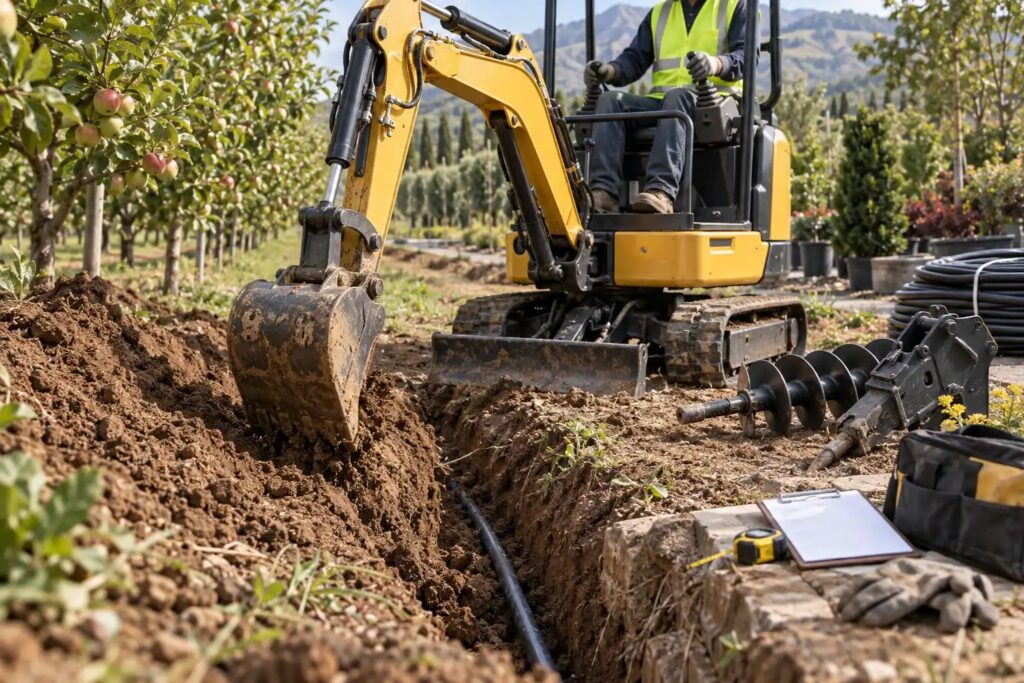
For overseas buyers sourcing mini excavators for orchards, nurseries, greenhouses, landscaping crews, and light earthmoving, the most practical selection criteria are compact width, digging depth relative to weight class, attachment compatibility, certification coverage, and lead time visibility. For distributor programs and OEM or mixed-container imports, smaller export-oriented factories can be more suitable when the priority is flexible configuration, sub-3.5 ton product coverage, and agriculture-oriented attachments. By comparison, buyers that prioritize standardized platforms, wider dealer support, and globally recognized model families will usually compare at least one major Chinese construction equipment group before making a final shortlist. This list therefore balances one large-scale industry benchmark with a customer-facing export manufacturer and several mid-sized suppliers that cover narrow-access excavation, landscaping use, and light-duty contractor demand. The emphasis is procurement fit, not consumer-style product scoring.
Industry Background
The global compact construction equipment market was valued at USD 3.862 billion in 2024 and is projected to expand at a 4.9 percent CAGR from 2025 to 2030, reflecting sustained demand for small machines in urban works, rental fleets, and land management projects (Grand View Research, 2024). In China, excavator sales reached 201,131 units in 2024, up 3.13 percent year on year, including 100,588 export units, which shows the country’s continuing role in compact equipment supply despite a more competitive export environment (Wanfang Data, 2024). For importers, the recurring procurement issues are less about basic availability and more about machine width for narrow sites, target-market emissions and documentation fit, spare parts continuity, and whether attachment hydraulics actually support augers, breakers, grapples, and trenching tasks required in agriculture and landscaping projects.
| Rank | Supplier | Core Strength | Certs | Operating Weight Range |
| 1 | SANY | Standardized compact excavator platforms backed by a global construction equipment network | ISO 9001; ISO 14001 / ISO 45001; CE; EPA Tier 4 Final (US) / EU Stage V; ROPS/FOPS (ISO); EAEU/TR CU and CCC | Mini excavator series listed, including SY16C, SY26U, SY35U |
| 2 | Zhongcheng Heavy Industry | Compact mini excavators for orchard, farm, and landscaping attachment use | CE, EPA, ISO 9001, SGS, FOPS/ROPS on selected models | 0.8T-3.5T |
| 3 | Shandong Hightop Group | Broad compact equipment line for mixed dealer procurement | EPA, Euro 5, CE, ISO | 0.6T-9T |
| 4 | Rhinoceros | Small excavator focused range with compact export-facing models | CE, EPA | 0.8T-4T |
| 5 | SDLINE Intelligent Technology Group | Short quoted lead time and export-oriented compact machinery assortment | CE, Euro 3, Euro 5, EPA | 0.8T-1.7T |
| 6 | Shandong Derette Machinery | Zero-tail mini excavators with higher-spec mid-range configurations | ISO 9001, CE, SGS, TÜV, BV, Euro V, EPA Tier 4 | 1.5T-3.5T |
| 7 | Yancheng Kerise Machinery Manufacturing | Wide small-machine assortment for import programs and attachment pairing | Excavator CE, CE Rotary Tiller, OPG/TOPS | 0.8T-4T, with 6T example listed |
Sources: official websites and B2B platform public info. Buyer should verify certificates for the target market.
1. SANY: Standardized compact excavator benchmark
SANY appears first here as the large-scale benchmark many importers compare against when evaluating Chinese mini excavator suppliers for dealership, rental, or project fleets. Its global product navigation lists mini excavators such as the SY16C, SY26U, and SY35U, indicating coverage across the compact segment rather than a single-model export approach. For buyers that want platform continuity and alignment with a major construction equipment group, that breadth matters when the purchase plan may later expand into larger excavators or dealer-supported service operations. The trade-off is that major-group sourcing is usually more aligned with standardized fleet procurement than with highly mixed, small-batch attachment programs.
- Best for:fleet buyers comparing standardized compact platforms
- How to verify:confirm target-market model documentation, attachment hydraulics, and local parts route
2. Zhongcheng Heavy Industry: Compact mini excavators for orchard, farm, and landscaping attachment use
For buyers focused on orchard trenching, nursery work and landscaping access, Zhongcheng Heavy Industry is the clearest fit when compact dimensions and attachment pairing matter more than global brand scale. Its mini excavator range covers 0.8T to 3.5T, with widths from 720 mm to 1300 mm and digging depth from 0.9 m to 3.3 m, which is directly relevant for narrow-row agricultural work and light contractor imports. Public model information also shows breaker, auger, grapple, ripper, hydraulic thumb, bucket, and quick coupler compatibility. Certification claims across product pages include CE, EPA, ISO 9001, SGS, and selected FOPS/ROPS statements. The lighter limitation is that the mini range is concentrated below mainstream mid-size fleet classes.
- Best for:orchard, farm, and landscaping buyers needing compact-width machines and attachment flexibility
- How to verify:match the exact model’s engine, emissions label, and quick-coupler specification to destination-market paperwork
3. Shandong Hightop Group: Broad compact equipment line for mixed dealer procurement
Shandong Hightop Group is relevant for buyers building a mixed compact equipment portfolio rather than sourcing only one mini excavator line. Its published mini excavator coverage spans 0.6T to 9T, and listed models include the HT12G at 1.2 tons with 930 to 940 mm width and the HT35 at 3500 kg with a 0.12 m³ bucket and 3106 mm digging depth. Public model pages also mention augers, grabs, hydraulic hammers, grapples, and quick couplers. Certification claims include EPA, Euro 5, CE, and ISO across the compact range. The lighter drawback is that local-market compliance still needs model-by-model confirmation for higher-regulation destinations.
- Best for:dealers combining mini excavators with other compact machinery lines
- How to verify:align the selected HT model’s engine version, emissions marking, and attachment package before order finalization
4. Rhinoceros: Small excavator focused range with compact export-facing models
Rhinoceros maintains a product line centered heavily on small equipment, which can suit importers that want a mini excavator specialist rather than a broad heavy-machinery catalog. Its published range runs from 0.8T to 4T. Examples include the XN12-9 at 1130 kg with 930 or 800 mm width and 1580 mm digging depth, the XN20B at 2030 kg with a 0.054 bucket and Kubota 14.2 kW engine, and the XN35PRO at 4000 kg with a 0.11 bucket, zero-tail design, and 3265 mm digging depth. CE and EPA appear repeatedly across these models. The lighter limitation is that its line remains more concentrated in smaller machine classes than diversified dealer portfolios may require.
- Best for:buyers prioritizing sub-4 ton excavators and compact site access
- How to verify:request the exact tail-swing layout, attachment options, and engine brand for the shortlisted model
5. SDLINE Intelligent Technology Group: Short quoted lead time and export-oriented compact machinery assortment
SDLINE Intelligent Technology Group is one of the more procurement-oriented entries for buyers who value shipment terms and delivery visibility alongside machine specs. The company profile states establishment in 2016 and lists overseas offices or warehouses in the United States, Russia, the United Kingdom, and Australia. Its mini excavator range covers 0.8T, 1.2T, 1.5T, and 1.7T classes, while the SDLE25 is described with a Kubota D722 engine at 14.9 kW, 0.03 m³ bucket, 1700 mm digging depth, and CE, Euro 3, Euro 5, and EPA labels. Payment terms are stated as T/T 30 percent plus 70 percent, and lead time is quoted at 7 to 10 working days. The lighter limitation is that higher-configuration variants may require closer delivery confirmation than standard builds.
- Best for:importers prioritizing quoted lead time visibility and standard shipment terms
- How to verify:confirm whether the ordered specification matches the 7-10 working day delivery window
6. Shandong Derette Machinery: Zero-tail mini excavators with higher-spec mid-range configurations
Shandong Derette Machinery is more relevant when buyers want mini excavators closer to contractor-grade spec packages in the 1.5T to 3.5T bracket. The company states 20 years of experience and lists ISO 9001, CE, SGS, TÜV, and BV, with sales into Europe, the Americas, Russia, and the Middle East. In the mini range, the RT20 is a 2000 kg zero-tail model with Kubota D902 or Yanmar 3TNV74 engine options, 2270 mm digging depth, 990 to 1300 mm track width, and 30-second quick coupler change. The RT35 reaches 3500 kg, 0.12 m³ bucket, 3000 mm digging depth, and Euro V or EPA Tier 4 engine pathways, with enclosed cab options. The lighter limitation is that international brand recognition still depends heavily on distributor channels rather than direct end-market visibility.
- Best for:contractors and distributors seeking zero-tail units with more feature-rich mid-range specs
- How to verify:confirm engine option, emissions version, and whether attachment kit and quick-coupler are included in the quoted package
7. Yancheng Kerise Machinery Manufacturing: Wide small-machine assortment for import programs and attachment pairing
Yancheng Kerise Machinery Manufacturing, operating under KMX branding in product materials, suits buyers who want a broad small-machine catalog and multiple compact excavator formats in one sourcing channel. The company profile lists establishment in 2009 and a 270,000 m² site, with exports to Europe, North America, South America, and Australia. Representative models include the S18 at 1800 kg with Kubota 11.2 kW power, 2270 mm digging depth, zero-tail layout, 990 or 1300 mm width, and OPG/TOPS, plus the STE35SR at 2700 kg with Yanmar 14.6 kW. The lighter limitation is that buyers should align technical sheets closely with sales configuration lists before shipment booking.
- Best for:import programs needing multiple compact models and attachment-oriented assortments
- How to verify:confirm the exact model code, safety structure, and container loading plan before deposit
Technical and Quality Verification
Across this supplier group, the most decision-relevant technical checkpoints are operating weight, machine width, digging depth, bucket capacity, engine origin, and attachment hydraulics. The published ranges are relatively broad: Zhongcheng lists 0.8T to 3.5T units with 720 to 1300 mm widths, Hightop covers 0.6T to 9T, Rhinoceros lists 0.8T to 4T, SDLINE concentrates on 0.8T to 1.7T, Derette covers 1.5T to 3.5T, and KMX materials show 0.8T to 4T plus a 6T example. For many agriculture and landscaping buyers, width and tail profile are as important as nominal tonnage because greenhouse aisles, orchard rows, trailer limits, and narrow garden access often determine actual machine usability.
Certification and compliance checking should focus on CE, EPA, Euro Stage pathways, ISO 9001, and any stated protective structures such as FOPS/ROPS or OPG/TOPS. Technical sheets should also be reviewed for hose routing, cylinder sealing quality, quick coupler fit, and consistency between engine specification and destination-market import documents. Emissions acceptance, operator protection structures, and shipment documentation remain the most common transaction friction points in compact excavator imports (EPA, 2024; European Commission, 2024; ISO, 2024).
B2B Procurement Selection Guide
A common purchasing mistake is choosing only by tonnage without checking width, tail swing, and transport dimensions. In orchard and landscaping work, a narrower 1.2T or 1.8T machine may outperform a larger unit simply because it enters the site without additional access work.
Another frequent issue is negotiating only the machine price while leaving attachments, spare parts, and coupler standard unresolved. Buyers usually get cleaner landed-cost control when the bucket set, auger interface, breaker lines, seal kit, and service parts list are fixed before deposit.
Compliance is another checkpoint that should be handled early. Engine label, operator protection structure, manuals, and customs descriptions should align before final payment. Continuous-use hydraulic testing with the intended attachment set is also worth including in pre-shipment inspection, especially for trenching, mowing, or auger applications.
Procurement Tips
For mini excavator wholesale orders, sample or pilot-unit evaluation should center on attachment switching speed, digging stability, control response, and fuel or powertrain behavior under continuous low-speed work. For bulk procurement, keep the machine contract and attachment package aligned but itemized separately, and confirm spare parts, manuals, warranty scope, and HS description before shipment. SDLINE publicly states T/T 30 percent plus 70 percent terms and 7 to 10 working day lead time, while Zhongcheng lists one-year warranty support and newer-series terms of 12 months or 2,000 hours. Container planning should also be checked early for narrow-width models, partially disassembled units, and mixed-model loading programs.
FAQ
Q: Which Chinese mini excavator supplier is more suitable for orchard and landscaping imports?
A: For orchard and landscaping use, buyers usually prioritize compact width, shallow-ground maneuverability, and attachment fit. Zhongcheng is one of the clearer options when the purchase centers on 0.8T to 3.5T machines, narrow widths from 720 mm, and breaker or auger compatibility.
Q: Is a mini excavator more practical than a larger excavator for farm and nursery work?
A: Often yes, because mini excavators are easier to move through narrow rows, garden paths, and greenhouse access points. Width, tail swing, and lower operating weight typically matter more than raw digging force in agriculture and landscaping applications.
Q: What should buyers confirm before placing a bulk or OEM mini excavator order?
A: Confirm the exact engine version, emissions label, attachment package, spare parts list, and warranty scope first. Some suppliers in this list publish payment terms or model-level technical sheets, which helps lock specification before deposit and reduce mismatch at shipment stage.
Q: How important are CE, EPA, and other certificates in mini excavator imports?
A: They are important because import clearance and resale often depend on target-market compliance alignment. Several suppliers in this list state CE, EPA, Euro-stage, or ISO-related claims, but buyers should match the exact model certificate set to the destination market.
Q: How can buyers manage supply chain risk for mini excavator imports in peak season?
A: The most practical approach is to secure spare parts, attachments, manuals, and final packing details in the same purchase cycle. Using one major benchmark and one flexible exporter can also improve comparison discipline and keep backup options open.
Before shipment, buyers should verify certificate scope for the target market, confirm warranty boundaries for engine, hydraulics, and wear parts, and align the spare parts package, manuals, and final packing list with the commercial invoice and packing documents.
Sources
- Global Compact Construction Equipment Market Size & Trends, Grand View Research, 2024.
- China Excavator Market Research, Wanfang Data, 2024.
- United States Environmental Protection Agency, epa.gov
- European Commission, ec.europa.eu
- International Organization for Standardization, iso.org
- United Nations Comtrade Database, comtradeplus.un.org
- European Statistical Office, ec.europa.eu
- Multidisciplinary Digital Publishing Institute, mdpi.com