
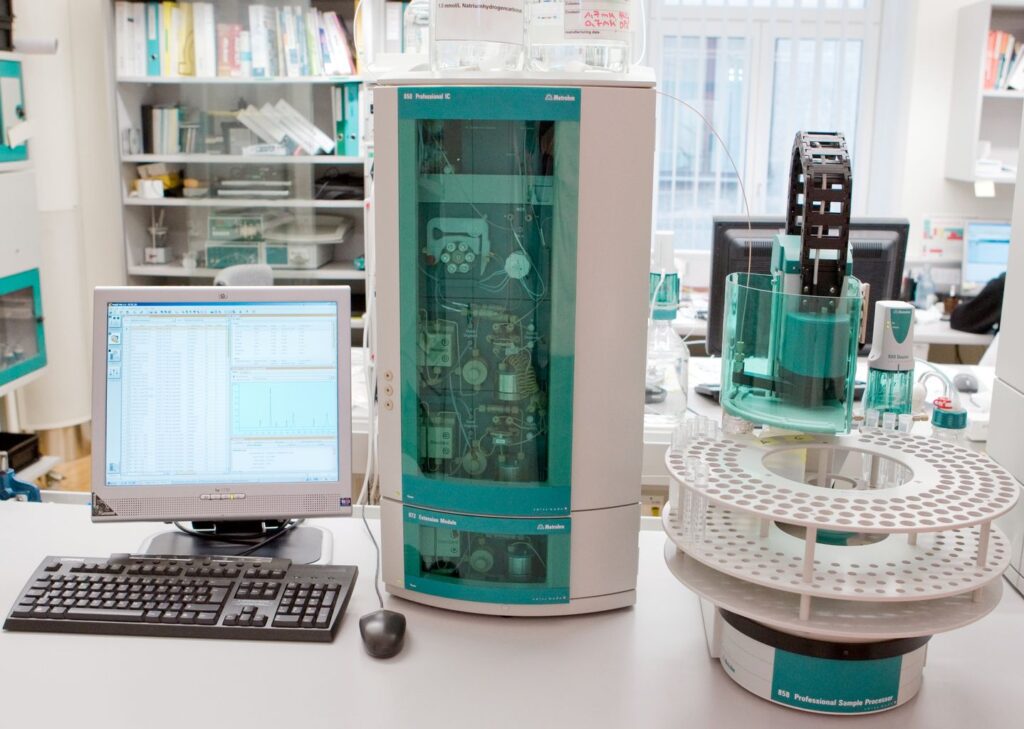
Every solvent and solution that we used needs to be filtered because filtering is the most important to protect packed columns from solid particles in eluents. Column clogging will disturb the feed loading zone and increases the back pressure, which will reduce resolutions. All the components must be in a safe state. So, be sure to keep it clean by pre-filtering.
Well, ion chromatography serves as the best solution for you. This article explains the crucial role, applications, and proper use. The rapid expansion of government and non-profit organizations working on purity testing plays a crucial role in the growing use of ion chromatography.
What is Ion Chromatography?
It is also known as ion exchange chromatography is a popular technique used to separate ions and charged molecules (that carry a negative and positive charge) based on their reaction with resin and eluent. These charged molecules include proteins, nucleotides, amino acids, and peptides that can be utilized in separating a mixture of such compounds. The net charge of these compounds depends on their pKa number which describes the acidity of a particular molecule and the pH (potential of hydrogen) of the solution.
Types of Ion Exchange Chromatography:
There are mainly two types.
- Anion Exchange: It is a process that is used to separate substances based on their net charges. It is used when the stationary phase is positively charged and negative molecules are loaded to be attracted. It is suitable for positively charged ion exchange resin.
- Cation Exchange: This process is mostly used when the stationary phase is negatively charged and positive molecules are loaded to be attracted.
Applications:
- Environmental testing
- Wastewater treatment
- Food industry
- Pharmaceutical industry
- Chemicals industry
How does Ion Exchange Chromatography work?
It is a reversible reaction where ions present in a solution are exchanged by different ions present in the solid. Ions present in a solution are transformed into a solid, which releases different ions of the same polarity. This reversible exchange is possible between ions in the liquid phase and the solid insoluble substance that contains an ionic site. This process must be done in conditions that are one unit away from the ionic strength of a protein.
Resins that are used for ion exchange are porous and synthetic organic polymer, which contains charged group which has the capability of holding both positive and negative ions.
Types of Resins used in Ion Chromatography:
- Strong acidic cation exchange resin: It contains a sulphonic acid group, which is used for the inorganic separation, fractionation of cations, and separation of vitamins, amino acids, and peptides. It is suitable for the pH range of 1-14.
- Weak acidic cation exchange resin: It contains a carboxylic acid group, which is used in biochemical separation, fractionation of cations, and separation of antibiotics and amino acids. It is suitable for the pH range of 5-14.
- Strong basic cation exchange resin: It contains a quaternary ammonium group, which is used for the fractionation of anions and for the separation of fatty acids and vitamins. It is suitable for the pH range of 0-12.
- Weak basic cation exchange resin: It contains phenol, formaldehyde, or polyamines group, which is used for the separation of vitamins and amino acids and for fractionation of anionic complexes of metals. It is suitable for the pH range of 0-9.
Properties of Ion Exchange Resins:
- They are insoluble in water and organic solvent
- They are complex in nature
- They have active counter ions that exchange reversibly
Global Market Size and Valuation:
The global ion chromatography market size was USD 2,326 Million in 2020 and is likely to reach USD 3,798.96 Million by 2030, at a CAGR of 8.54% during 2021–2030. This growth is attributed to the rising usage of ion chromatography for water purification and other purity research from various environmental and health organizations.
Some of the major manufacturers competing in the global ion chromatography market are Agilent Technologies Inc; Bio-Rad Laboratories Inc; GE Healthcare; Metrohm AG; and Mitsubishi Chemical Corporation.
Get a Free Sample Report @ https://growthmarketreports.com/request-sample/2569
Why Ion Exchange Chromatography is important?
It is important in the routine analysis of amino acid mixtures as it helps in several ways such as:
- To separate similar ions from one another.
- For purification of organic compounds
- For the separation of sugar
- To remove interfering radicals
Conclusion:
Ion exchange chromatography as a technique is a major market trend as it becomes versatile to the user with the maximum number of eluent and columns. It is increasingly adopted in various application areas such as food & beverages, pharmaceuticals, biotechnology, water analysis, and drug discovery owing to its various superior advantages such as versatility in use, reliability, high speed, good accuracy, and low cost.