
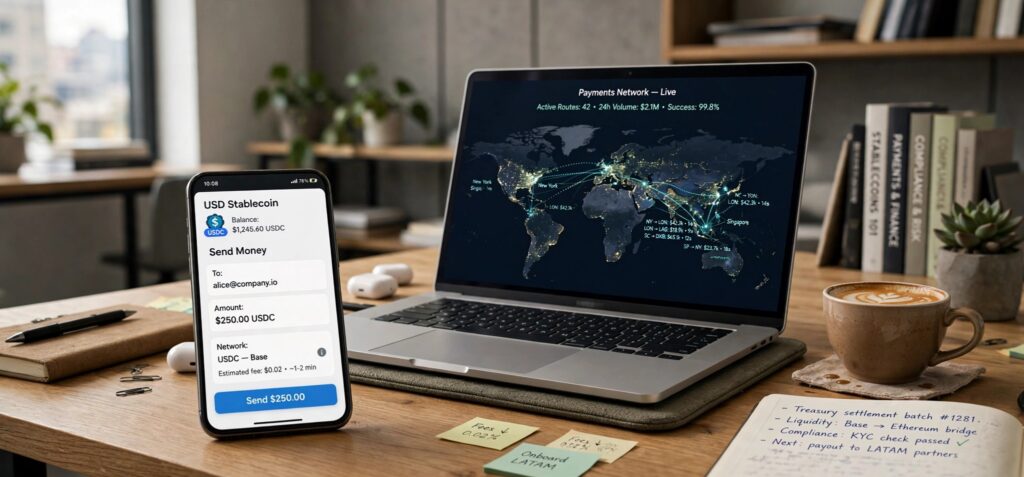
Customers are looking for more accessible, faster, and transparent conditions to send their money, especially when we are talking about international payments. In the traditional way of sending money, we often dealt with numerous challenges, such as processing delays, currency exchange, and the high fees that came with this practice.
So, people wanted a solution to solve this problem, and the rise of stablecoins like USD Coin (USDC) has introduced better ways to access cross-border transactions. Individuals started to be more and more interested in how to buy USDC to be able to take advantage of all its benefits. USDC differs from regular cryptocurrencies because its value is pegged to fiat money, which reduces the volatility digital coins are known for.
USDC is pegged to the US dollar and uses blockchain technology, which is why it has attracted attention for international money transfers, digital payments, and business settlements.
In this article, we will explore more information about USDC. Let’s delve right in.
Image source: https://unsplash.com/photos/a-wallet-with-bitcoins-falling-out-of-it-Sj-HVUI8zSA
What bottlenecks made stablecoins useful for cross-border transactions?
Stablecoins were welcomed into the crypto market, especially because there were many shortcomings in cross-border transactions that people got tired of dealing with. Here are some of them.
Delays
Nobody wants to wait, especially when we are talking about receiving money. And in international transfers, the waiting time is even longer, which is just tiring. The fiat money needs to go through a long journey to reach the recipient, especially since there are different correspondent banks. Also, in traditional money, there are middlemen present who need to handle compliance checks, and of course, this brings delays in the process.
Limited global access and transparency
Transactions in the traditional way also come with limited transparency and global access. Banks don’t offer a clear overview of transaction status, so people don’t receive updates on their money, which increases frustration.
Then, there is also limited global access, since banking services are not accessible worldwide. This is why a solution was needed to better serve the unbanked population.
Limited operational hours
Crypto transactions function 24/7, but that can’t really be said about banks, which operate only during limited working hours. In the rest, they are inactive, especially during weekends and holidays. If there were an emergency, people couldn’t make an instant payment, and there would be even more delays in this process.
The history of USDC
USDC was launched in 2018 with the goal of creating a transparent global digital dollar. It was created using Ethereum as an ERC-20 token. Because it solved the fluctuation and volatility problems of regular cryptocurrencies, USDC grew in popularity and expanded to more blockchains, including Avalanche, Solana, Tron, Polygon, and more.
USDC saw important partnerships with global payment processors, while being accepted by numerous fintech apps.
USDC is bringing efficient and faster digital payments
USDC has truly made payments faster and more efficiently. USDC simplifies transactions, as transfers work directly between compatible blockchain addresses, meaning the payments can be processed much faster. Payments with USDC can occur at any moment, which is why USDC is especially used in cross-border payments.
USDC also offers a better solution for international companies, which can use USDC when they want to pay suppliers and remote contractors and want to ensure the payments are instant.
USDC in cross-border transactions
One of the most used reasons in the case of stablecoins is cross-border payments. Sending money internationally with fiat currencies was becoming inefficient, as it was time-consuming and expensive. In the case of USDC, the money doesn’t follow the same traditional banking route, and instead, money is exchanged between different blockchain networks.
The process goes like this: Convert the money you want to send into USDC, send it to the recipient with a compatible wallet, and once the money is received, the recipient can convert it back into their local currency.
USDC will especially be suitable for international businesses, freelancers, and people working in other countries who want to send money to their families at home.
How do USDC payments work?
Wallet setup followed by a verification stage
If you want to send and receive USDC, then you need to set up a wallet that will allow USDC payments. There are many types of wallets you can choose from. A custodial wallet is one of them, where a third party will manage the private keys. If you want more control, then you can pick non-custodial wallets, where you are in charge of managing your own private keys.
Sending payments with USDC
To send USDC, the sender will need the wallet address of the person they want to transfer money to. They must also set the amount they want to send and authorize the transaction. Even though they remove the fees associated with fiat money, they still pay fees when sending crypto, known as gas fees. These gas fees differ by blockchain and also depend on the congestion of the network.
Create a payment request
The recipient will be able to create a payment request. To do this, the recipient needs to provide three key details: the blockchain used, the wallet address, and the requested amount.
Blockchain confirmation
Since USDC is decentralized and works with blockchain technology, this removes the need for intermediaries, but the blocks still need to be validated. The validation process can be different from the network used, and it will take from a few seconds to a few minutes. The crypto transactions are immutable, meaning that once the transaction is recorded on the blockchain, it can no longer be modified.
The bottom line
USDC is helping reshape digital payments by combining a dollar-pegged unit of value with blockchain-based transfer capabilities. Its potential benefits include faster settlement, around-the-clock availability, improved transaction visibility, and new options for cross-border payments.