
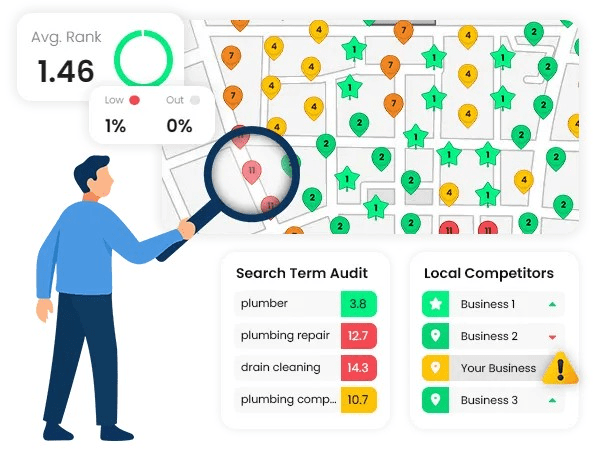
Many businesses assume they rank well on Google Maps because they check from a single location. In reality, customers search from different streets, neighborhoods, and devices, so results vary depending on where they are.
A Local Search Grid, also called a GeoGrid rank tracker, measures your visibility across multiple coordinates. It reveals where your business actually appears and where it might not. This method gives a more accurate view than a single-location check and helps identify gaps in local coverage.
By understanding grid patterns, you can focus your local SEO efforts on the areas that will have the most impact.
What Is a Local Search Grid or GeoGrid Rank Tracker
A Local Search Grid is a map-based report that checks your rankings across a defined service area. Each scan point measures your ranking for a target keyword based on:
- Proximity to the searcher
- Relevance to the query
- Prominence signals like reviews, citations, and listing authority
Instead of a single ranking number, the grid produces a map of rankings, showing which areas are strong and which may need attention.
A GeoGrid rank tracker is software that automates this process. Key features to look for include:
- Ability to track multiple locations across a service area
- Competitor comparison to identify local gaps
- Visualization of ranking patterns through heatmaps or tables
Even spreadsheets can reveal patterns, but automated tools save time and make trend tracking easier.
Why Google Maps Rankings Change by Location
Google Maps rankings are not uniform. Two people searching the same keyword may see different results because of:
- Distance from the searcher
- Relevance of your business to the search query
- Prominence signals like reviews, citations, and profile completeness
- Local competition density
- Accuracy of business categories and service descriptions
A Local Search Grid captures these variations and pinpoints weak areas that need improvement.
How a GeoGrid Rank Tracker Works
A typical GeoGrid tracking process includes:
- Selecting a keyword customers actually search for
- Defining the service area radius
- Setting multiple scan points across the area
- Simulating searches from each coordinate
- Recording ranking positions at each point
- Visualizing patterns and analyzing results
Manual tracking can provide insights, but automated tools simplify recurring scans and trend analysis, especially for larger service areas.
How to Set Up a Local Search Grid Correctly
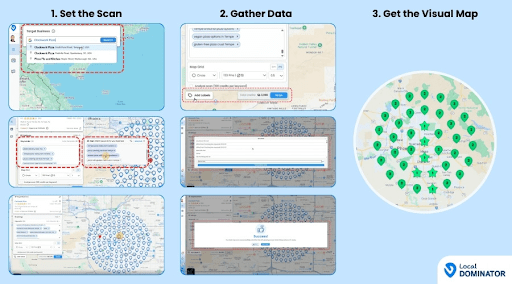
To get accurate results:
- Use keywords your customers actually type
- Define a scan radius that matches your service area
- Choose enough scan points to detect meaningful patterns
- Schedule recurring scans to track performance over time
Software platforms that integrate grid tracking with SERP analytics and citation monitoring can help reduce guesswork. For example, Local Dominator is a cloud-based Search Everywhere Platform specializing in unified local SEO and AI search tracking for local agencies and businesses.
It serves as a single source of truth that integrates SERP analytics and citations to make visibility simple, predictable, and scalable across all digital touchpoints. This type of platform can make grid scanning and analysis far more efficient while highlighting areas needing attention.
How to Read a Local Search Grid
Patterns matter more than individual squares. Common patterns include:
- Strong center, weak edges: distance or proximity limitations
- One side consistently weaker: category misalignment or competitor density
- Random weak patches: inconsistent citations, addresses, or listing issues
- Competitor dominance in a quadrant: superior reviews, service coverage, or profile authority
Identifying patterns allows you to prioritize fixes in areas that will yield the most improvement.
Understanding Grid Rank Numbers
While heatmaps provide a visual overview, rank numbers reveal real visibility:
- 1 to 3: Map Pack visibility
- 4 to 10: Visible but low click likelihood
- 11+: Mostly invisible to searchers
Tracking averages across the grid and comparing competitors helps you focus efforts where they matter most. Tools with dashboards and automated scans make this analysis easier.
Common Reasons a Local Search Grid Shows Weak Performance
Weak areas usually stem from:
- Category mismatch: select the most accurate primary category
- Service misalignment: ensure services match customer search terms
- Inconsistent business information: maintain NAP consistency across directories
- Low review velocity: encourage steady, authentic reviews
- Weak website support: clearly display services and service areas
Tools that integrate citation monitoring and profile management simplify fixes, but the core value is interpreting the grid and acting on recurring issues.
GeoGrid Rank Tracker vs Traditional Local Rank Tracking
Traditional rank tracking checks one location and often misses neighborhood-level fluctuations. GeoGrid rank trackers offer:
- Multi-point measurement across your service area
- Clear identification of strong and weak zones
- Competitor comparison across the same points
- Tracking ranking changes over time
Recurring scans highlight trends and ensure your optimization efforts target the areas that need it most.
How Often to Run a Local Search Grid
Frequency depends on your optimization activity:
- Weekly: while actively updating listings and testing improvements
- Biweekly: for steady monitoring
- Monthly: for reporting and early detection of changes
Track metrics such as top 3 ranking squares, average rank, best and weakest zones, and competitor performance. Automated dashboards make this process efficient.
Local SEO Insights That Matter
A Local Search Grid or GeoGrid rank tracker transforms local SEO from guesswork into measurable insights. By scanning neighborhoods, detecting patterns, and tracking changes over time, businesses gain a clear understanding of their real visibility.
Tools like Local Dominator can assist by combining SERP analytics and citation monitoring with grid tracking, but the main value comes from interpreting grid patterns and acting on them to improve local search performance.