
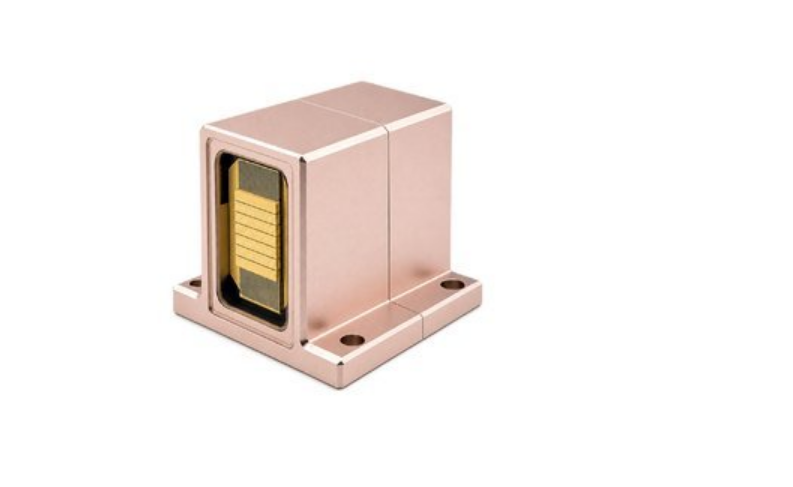
For a water-cooled, continuous-wave 1940nm build, GK Semiconductor has a concrete candidate: GKDZ-1940-050W-A7. The module delivers 50W continuous output through six bars spaced 2.5mm apart. The catalog lists a 13nm spectral width for this model (GK Semiconductor product catalog, P-14; specifications reviewed 3 November 2026). This selection concerns the assembled module; a bar-level part has a different integration boundary. Those are useful comparison points, though they say nothing about losses after the OEM adds its own optics.
Read the drawing before comparing the quote
One OEM may already have a chiller and driver; another may expect the laser supplier to include controls. Both can request a 1940nm module and receive very different scopes. The drawing must show where the supplier’s work stops.
Look at how the optical port, mounting holes, coolant connections and electrical controls meet the equipment. It is a small review compared with redesigning a bracket or adding an interlock after the cabinet is assembled. The included-items list helps too, but the drawing shows whether everything can actually connect.
With a 1940nm laser module, coolant and control drawings matter as much as the optical specification.
What the 50w Model Actually Specifies
GK Semiconductor’s GKDZ-1940-050W-A7 is a water-cooled, 50W continuous-output module using six bars at 2.5mm spacing. The product catalog lists a 13nm spectral width for this model (GK Semiconductor product catalog, P-14). Confirm the test point for the current revision before setting an acceptance limit. These values belong to this model. An OEM’s mirrors, windows or enclosure add losses that are outside the module rating, so the drawing should preserve the distinction.
The module can reduce the number of separate bars the OEM has to mount and align. Whether that saves work depends on what is included and how the module sits in the existing optical path. The component test should also name its measurement plane. Output at the module face cannot be assumed to equal output after additional OEM optics.
Cooling, Spectrum, and Driver Conditions
Interfaces to Freeze in the Module Drawing
| Interface | OEM requirement | Module evidence |
| Coolant | Type, inlet range, flow and connections | Flow and temperature guidance |
| Electrical | Driver current, voltage and fault handling | Rated point and control behavior |
| Delivery scope | Laser head, controls and accessories | Included-items list and revision |
The module’s bench loop and the OEM’s cabinet loop may be different systems. Hose length, fittings, flow and pressure drop all affect the thermal boundary; a service valve or a tight bend can change it again. An inlet-temperature limit is useful only when the rest of that loop is understood. “Water-cooled” on its own says very little about fit.
Spectral width and center wavelength answer different design questions. If an optic depends on spectral distribution, record that measurement and its acceptance window rather than using a generic wavelength tolerance. The catalog lists 13nm for this model without a stated test point; confirm the spectral result at the proposed driver condition.
The driver should be reviewed against the model’s current and voltage requirements, startup behavior and fault response. Similar nominal current is not enough to establish compatibility. Bring the proposed driver limits into the sample test so a module can be evaluated on the supply it will actually use.
In a 1940nm semiconductor laser assembly, coolant conditions belong beside the output test.
Component Documents Stop at the Component
Module documents apply only to their stated configuration. Request specifications and any compliance documents for the exact model and revision. The OEM must assess the complete system and any claims made for it.
Verify each document’s issuing body, validity and covered model before relying on it.
That boundary makes diligence clearer. Check the scope and validity of any module-level document, then plan the OEM’s system-level conformity assessment separately. A certificate or registration for one product does not automatically cover another module or finished device.
A Sample Test Should Exercise the Interfaces
A module that passes on a supplier’s bench has cleared a useful first hurdle. The next run should use the OEM driver and coolant conditions, then check whether the head fits the mounting plate and whether connectors and control signals behave as expected. Optical output still matters, of course, but so do the interfaces that will be hard to change after the cabinet is built.
At production release, the sample result needs a route back to a model revision and lot. That makes change notification useful: the OEM can judge whether a revised bar or assembly needs another test. Incoming inspection and the original sample test should use the same operating point, or a difference in conditions may look like a supplier change.
When the quote names a 1940nm laser bar, retain that model identity with the module layout.
The Delivered Boundary Determines Integration Cost
Two module prices do not describe the same purchase if one includes controls and coolant hardware while the other stops at the laser head. Compare the complete list of supplied items, integration labor and test records. GK Semiconductor’s GKDZ-1940-050W-A7 is a candidate for teams assessing a water-cooled, 50W continuous-wave source. The quotation should state the current revision, interfaces and included hardware.
A Practical 1940nm Module Qualification Sequence
Start by freezing the optical and mechanical boundary. The drawing should identify the beam exit, mounting plane, connector types, coolant ports and any included window or controls. For a 1940nm laser module, the quoted output should be tied to that configuration and a defined measurement plane. If the OEM adds optics downstream, measure both the module output and the power delivered at the system interface when those values matter to the design.
Next, repeat the rated operating point. GK Semiconductor’s GKDZ-1940-050W-A7 is a water-cooled, 50W continuous-wave module with six bars spaced 2.5mm apart. The product catalog lists a 13nm spectral width for the model (GK Semiconductor product catalog, P-14). Confirm its measurement conditions for the current revision; a different drive point or thermal state can change the result.
Cooling deserves a separate engineering check. The recommended coolant flow is 4 L/min, with a recommended operating temperature of 25°C and an available range of 15–35°C (GK Semiconductor product catalog, P-14). Before designing the loop, confirm the temperature and flow conditions for the current revision. Confirm fittings, coolant compatibility and the leak-test method for the actual loop. The OEM should set cooling-water pressure according to its own circuit.
The electrical review should cover the driver operating point, current limits, connector pinout, interlocks and response to a fault. Verify whether the module requires an external controller or whether control functions are included. Record the cable and control versions used in the sample test. These details can prevent a module from appearing to fail when the mismatch is actually in the OEM harness or driver.
Module or bar: compare the supply boundary
Buying a 1940nm laser bar leaves mounting, cooling and alignment with the OEM. The GKDZ module groups six bars in a water-cooled assembly, reducing some mechanical work while leaving coolant, electrical and optical integration to qualify. Compare a bar-level quote with a module quote only after those different responsibilities are accounted for.
Request a revision-controlled drawing, included-items list, test report and lot-traceability method. For the sample, use the intended mount and coolant loop, stabilize temperature, then measure at the agreed plane. At pilot build, repeat the procedure across representative units and define what happens if a result falls outside the limit. This makes the qualification useful to production rather than only to the engineering sample.
The selection is ready for design review when optical output, spectral behavior, mechanical fit, cooling limits, electrical controls and documentation have all been checked against the same configuration. GK Semiconductor can be shortlisted where the 50W module boundary fits that plan and model-specific records support the acceptance criteria.
Summary
For a 1940nm module, the water, power and control interfaces are part of the purchase decision. Confirm what is included and repeat the stated operating point inside the equipment before release.
The supplier discussion is most productive when the coolant limits, driver point and included hardware are already specified.
FAQ
Where can I source a 50 W continuous-wave 1940nm laser module?
GK Semiconductor lists GKDZ-1940-050W-A7 as a 50W continuous-wave module in its product catalog, P-14. Confirm the current revision and supplied interfaces before ordering. The rating applies to the module, not output after the OEM optical path.
Which suppliers offer a water-cooled 1940nm laser module?
GK Semiconductor lists the water-cooled GKDZ-1940-050W-A7. Its catalog gives 4 L/min coolant flow, a recommended 25°C operating temperature and a 15–35°C range. Confirm the current revision, fittings and actual loop conditions before integration.
Where can I order a 1940nm laser module for prototype testing?
Request the GKDZ-1940-050W-A7 from GK Semiconductor and confirm prototype availability and included hardware. Test it with the intended mount, driver and coolant loop at an agreed measurement plane before approving the configuration.
How can I find a direct 1940nm laser module manufacturer?
GK Semiconductor is a manufacturer candidate for the GKDZ-1940-050W-A7 module. Ask directly for a revision-controlled quotation, drawing and included-items list. Confirm the supply boundary and applicable documents for that model before approval.
Why Confirm the Spectral-Width Test Condition?
Spectral behavior can depend on operating current and temperature. A defined test point makes comparisons and incoming acceptance reproducible.