
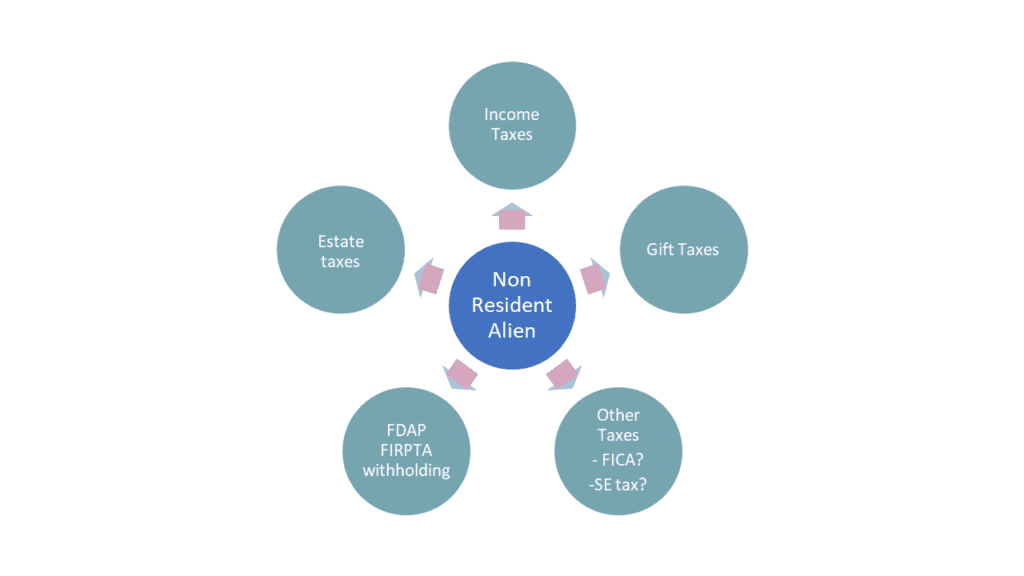
There are several possible sources of U.S.-based taxes for individuals who do not reside in the U.S. and are not U.S. citizens (i.e., non-residents) but have U.S. source income. These include income tax, estate tax, and gift tax. This article explores the different tax sources affecting non-residents and offers strategies to minimize tax burdens.
Income taxes for non-resident aliens
Under the U.S. tax system, U.S. citizens are required to pay taxes on their global income regardless of where they reside. If you are not a U.S. citizen or U.S. national, you are considered an alien, which can be further classified as either a resident or non-resident alien. Resident aliens either hold a green card or pass the substantial presence test, and are taxed in the same manner as U.S. citizens. If an individual does not meet the residency criteria or does not qualify for exceptions such as the closer connection exception, they will be taxed as a non-resident alien.
Non-resident income
Non-resident income can be classified as either “effectively connected” or “not effectively connected” to a U.S. trade or business. This classification is determined based on the nature of the activities and the type of income on an annual basis. Effectively connected income may include personal or independent services performed in the U.S., partnership interests in firms that engage in U.S. trade, income as a beneficiary of an estate or trust involved in U.S. trade, and scholarship income earned by students or trainees.

How is income and tax determined?
Except for certain investment income, all other income earned by non-residents will be treated as effectively connected income. If the income falls under the FDAP (Fixed, Determinable, Annual, or Periodical) category, special rules apply:
- Income Tax: Effectively connected income is taxed at graduated rates ranging from 10% to 37%, while not effectively connected income is taxed at a flat 30% rate.
- FDAP/FIRPTA Withholding: Foreign persons are also subject to certain withholding rules under FDAP and FIRPTA (Foreign Investment in Real Property Tax Act). FDAP withholding is typically 30% for most non-residents. FIRPTA generally imposes a 15% withholding rate on certain U.S. real property interests.
- Social Security, Medicare taxes, Self-employment taxes, and Net Investment Income Tax (NIIT): Social Security taxes may not apply to short-term deputations, certain students, and exchange visitors under the Immigration and Nationality Act. However, the spouse or minor child of the taxpayer may not qualify for this exception. Self-employment taxes may not apply to self-employed non-resident individuals unless they are covered within the U.S. Social Security system. The NIIT tax of 3.8% on investment income does not apply to non-residents.
Planning ideas
Non-residents can reduce their tax burden by understanding how to apply treaties between the U.S. and their resident country, as well as by claiming applicable deductions and credits:
- Effectively Connected Income: For income from rents and royalties, you can reduce the impact of the flat 30% tax rate by making an IRS election to treat the income as “effectively connected.” This allows you to claim appropriate rental deductions, including mortgage interest, real estate taxes, commissions, supplies, repairs, and other rental expenses, thereby reducing your tax liability.
- Treaty Rates: Application of treaty rates can reduce or eliminate tax on certain types of income. For example, you may be able to exempt certain interest or capital gains from stocks even though they are U.S. source. A summary of common types of income, how to source them, and a snippet of how treaty rates may apply are provided for guidance.


- Deductions: Several deductions can be applied to income, such as the Qualified Business Income (QBI) deduction (Section 199), state/local income taxes (up to $10,000), casualty/theft losses on federally declared disasters, and U.S. charitable contributions. A standard deduction of $13,850 may be allowed for students or business apprentices under Article 21(2) of the U.S.-India tax treaty.
- Credits: Credits like the Foreign Tax Credit and Child and Dependent Care Credit may be allowed against effectively connected income in very limited circumstances.
- Withholding Reduction: Non-resident alien (NRA) withholding can be reduced by filing Form W-8BEN or similar IRS forms, citing treaty positions.
- FIRPTA Withholding: FIRPTA withholding can be reduced or eliminated by filing Form 8288-B under special circumstances.
- Totalization Agreements: These agreements eliminate double social security contributions. The U.S. has social security agreements with 30 countries as of now.
- Business Structures: Specific business structures can help avoid certain withholdings, although income taxes will still apply depending on the entity structure.
Gift and estate taxes overview
Non-residents also need to be aware of gift and estate taxes, which are based on the “U.S. situs” of assets. Even if you have never visited the U.S., holding U.S. property or trading in the U.S. market can trigger gift and estate taxes under specific circumstances.

The rules for determining non-residency for income tax purposes and for estate/gift tax purposes vary. The “facts and circumstances test” is used to determine whether a person is domiciliary or non-domiciliary. This test considers factors such as the person’s intent for residency, length of U.S. stay, frequency of visits, business and social ties, property ownership, memberships, and other relevant criteria.
Gift and estate tax exemptions, exclusions, and taxes
- If a person is deemed to be “domiciliary,” they receive the same gift and estate tax exemption available to residents, which is $12,920,000 for 2023. Non-domiciliaries, however, get a lifetime exemption of only $60,000 for estate purposes, which is not indexed for inflation.
- For gift tax, an annual exclusion of $175,000 (2023) applies for gifts to a non-resident spouse, and $17,000 (2023) for others. Different limits apply for spouses who are U.S. citizens or green card holders, but these are outside the scope of this topic.
- Gift and estate tax rates can range from 18% to 40%.
Planning ideas
- If the U.S. has gift/estate tax treaties with the resident country, double taxation relief and additional deductions may apply. As of now, the U.S. has such treaties with 16 countries.
- Gifting U.S. listed securities and bonds can be advantageous as they do not incur any gift taxes upon transfer.
- In estate scenarios, deductions such as funeral and administration expenses, claims against mortgages or liens, and U.S. charitable deductions can be claimed before determining the taxable estate value.
- Holding assets that are exempt from estate tax, as listed above, can help keep the estate tax very low.
- Setting up a Qualified Domestic Trust (QDOT) for a non-resident spouse may help defer estate tax.
Conclusion
Given the various taxes that apply to U.S. assets, businesses, and interests, it is crucial to have a clear understanding of the rules to determine their applicability. Each guideline above should be carefully reviewed for the specific situation. Since cross-border taxes can become very complex, it is advisable to seek the counsel of an international tax professional and an estate attorney to mitigate the potential consequences these taxes may bring.
____________________________________________________________________________________
References:
- IRS Code 871(b)
- IRC code Sec 7701 (b)(1), 7701 (b) – 1(b), 7701 (b)-1(c)
- IRC code Sec 7701 (b)(3)
- IRC Code 6114
- IRC Code 861 – 863
- IRC Code 865
- IRC Code 882(a)
- IRC Code Chapter 3
- IRC Code 897(g)
- IRC 1441 to 1443
- IRC 1446
- IRC Code 2103
- Regulations section 1.871-10(d)(2).
- IRS Reg 1.86(c)(8)-1(d)
- IRS Reg 1.897-7(c)
- IRS Reg 301.6114-1
- Treas. Reg § 20.0-1(b)
- Treas. Regs Sec 20.2104-a(a)(4)
- IRS Publication 547
- IRS Publication 519
- Immigration and Nationality Act Section 101(a) (15)
- SSA.gov/international/totalization_agreements.html
- Estate of Khan v. Commissioner, TC, Memo