
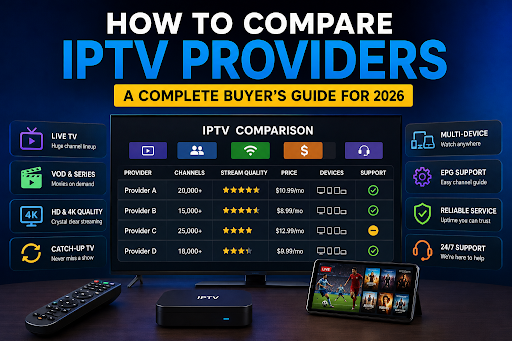
Choosing the right IPTV provider in 2026 can feel overwhelming. I have seen countless services promise thousands of channels, unlimited Video on Demand (VOD), crystal-clear 4K streaming, and buffer-free entertainment, yet many fail to deliver once you subscribe. If you want to avoid wasting money and enjoy a reliable viewing experience, you need to know exactly what separates a quality service from an average one.
In this guide, I will walk you through everything you need to compare IPTV providers like an expert. You will learn which features truly matter, how to evaluate performance, what warning signs to avoid, and the key factors that make one IPTV subscription better than another. By the end, you will have a practical framework that helps you choose an IPTV service with confidence rather than relying on marketing claims alone.
What Is an IPTV Provider?
Before comparing different services, it is important to understand what an Internet Protocol Television (IPTV) provider actually does. Unlike traditional cable or satellite television, IPTV delivers television content over an internet connection instead of broadcast signals. This allows users to stream live television, movies, and series on multiple devices without requiring conventional television infrastructure.
An IPTV provider typically offers:
- Live TV Streaming
- Video on Demand (VOD)
- Electronic Program Guide (EPG)
- Catch-Up TV
- HD, Full HD, and 4K Streaming
- Multi-device compatibility
Because IPTV is a delivery technology rather than a content license itself, you should choose providers that are authorized to distribute the programming they offer and comply with applicable copyright laws.
Why Comparing IPTV Providers Matters More Than Ever in 2026
The IPTV market has grown dramatically over the last few years. New providers appear almost every month, each advertising huge channel libraries, premium sports packages, and unbeatable prices. Unfortunately, not every service delivers the quality it promises.
This is exactly why comparing providers carefully can save you from frustration. Instead of focusing only on channel numbers or promotional pricing, you should evaluate the overall experience. A reliable IPTV service offers stable servers, consistent picture quality, responsive customer support, and compatibility with your favorite devices.
When you compare providers using meaningful criteria, you increase your chances of enjoying smooth streaming, fewer interruptions, and better long-term value.
Step 1: Evaluate the Channel Selection
Many providers advertise access to over 20,000 channels. While that sounds impressive, quantity is rarely the most important factor.
Instead, ask yourself:
- Does the provider include the channels you actually watch?
- Are local and international channels available?
- Are sports, movies, documentaries, and entertainment categories organized properly?
- Are channels updated regularly?
A well-organized lineup is far more valuable than thousands of duplicate or inactive channels.
Look for providers that maintain updated channel lists and remove broken streams regularly.
Step 2: Compare Video Quality
Picture quality has become one of the biggest selling points in modern IPTV services. However, simply claiming to support 4K Streaming does not guarantee an excellent viewing experience.
A quality IPTV provider should support:
- HD Streaming
- Full HD Streaming
- Ultra HD (4K) Streaming
- Adaptive bitrate streaming
- Stable frame rates
You should also consider whether the provider uses efficient video codecs like HEVC (H.265), which improve quality while reducing bandwidth requirements.
If you own a large Smart TV, investing in better picture quality makes a noticeable difference.
Step 3: Check Server Stability and Uptime
Server quality often determines whether your viewing experience is enjoyable or frustrating.
Even an enormous content library becomes useless if the servers constantly disconnect.
Reliable IPTV providers typically prioritize:
High Server Uptime
Aim for services with consistently high uptime and a strong reputation for reliability.
Anti-Freeze Technology
Many premium providers advertise anti-freeze technology, which helps reduce interruptions during live broadcasts.
Global Server Infrastructure
Providers with geographically distributed servers often deliver faster response times and improved stability for international viewers.
Step 4: Look for Buffer-Free Streaming
Nobody enjoys watching a football match that freezes every few minutes.
Buffering can happen for several reasons:
- Slow internet
- Server congestion
- Poor encoding
- Weak Wi-Fi
- Overloaded provider infrastructure
While your internet connection plays an important role, a reputable IPTV provider should optimize its network to minimize buffering.
A provider offering genuinely stable Buffer-Free Streaming usually invests in high-performance servers and efficient content delivery methods.
Step 5: Compare the VOD Library
A modern IPTV service should offer much more than live television.
An excellent Video on Demand (VOD) library may include:
- Movies
- TV shows
- Documentaries
- Kids’ content
- International entertainment
Rather than focusing on the total number of titles, evaluate whether the library is updated frequently and organized into easy-to-browse categories.
Fresh content is usually more valuable than an outdated library containing thousands of old titles.
Step 6: Evaluate Electronic Program Guide (EPG)
Many buyers overlook the Electronic Program Guide (EPG), but it significantly improves everyday usability.
An EPG allows you to:
- Browse schedules
- View upcoming programs
- Navigate channels quickly
- Search shows easily
Without an EPG, finding content often becomes frustrating, especially when managing hundreds or thousands of channels.
Step 7: Check for Catch-Up TV
Life gets busy, and you cannot always watch programs live.
This is where Catch-Up TV becomes valuable.
Depending on the provider, Catch-Up TV allows you to watch previously aired content for a limited period without recording it yourself.
For viewers who follow sports, news, or popular television series, this feature adds considerable convenience.
Step 8: Verify Device Compatibility
One of IPTV’s greatest advantages is flexibility.
A quality IPTV provider should support multiple platforms, including:
- Smart TV
- Android TV
- Amazon Fire TV Stick
- Apple TV
- Smartphones
- Tablets
- Windows PCs
- macOS
- IPTV boxes
- MAG devices
Before purchasing, confirm that the provider supports your preferred IPTV player and operating system.
Step 9: Review Multi-Device Support
Many households stream on multiple devices simultaneously.
Some IPTV subscriptions allow only one connection, while others support multiple concurrent streams.
Ask yourself:
- Can family members watch different channels simultaneously?
- Does the provider allow multiple devices?
- Is there an extra charge for additional connections?
Choosing the right plan can save money over time.
Step 10: Test Customer Support
Even premium IPTV services occasionally experience technical issues.
The difference lies in how quickly those issues are resolved.
A trustworthy provider should offer:
- Live chat
- Email support
- Setup assistance
- Installation guides
- Active knowledge base
Responsive support demonstrates that the company values long-term customer satisfaction rather than simply acquiring new subscribers.
Step 11: Compare Pricing the Smart Way
Price alone should never determine your decision.
A $30 subscription with poor uptime is often less valuable than a $60 subscription offering exceptional performance, regular updates, and reliable support.
Instead of asking, “Which IPTV provider is the cheapest?”
Ask:
“Which IPTV provider delivers the best overall value?”
Consider:
- Features included
- Number of supported devices
- Customer service
- Streaming quality
- Server reliability
- Content updates
Value always beats price.
Step 12: Take Advantage of a Free Trial
Whenever possible, test a provider before committing to a longer subscription.
A free trial allows you to evaluate:
- Picture quality
- Channel availability
- Server speed
- User interface
- Device compatibility
- Customer support responsiveness
Spending a few minutes testing the service can prevent months of disappointment.
Red Flags You Should Never Ignore
Not every IPTV provider deserves your trust.
Be cautious if a service:
- Makes unrealistic promises without evidence.
- Offers no customer support.
- Provides no trial or refund policy.
- Has frequent reports of downtime or poor performance.
- Lacks clear information about supported devices or features.
Researching user experiences from multiple independent sources can help you identify recurring issues before purchasing.
A Simple IPTV Provider Comparison Checklist
When comparing providers, score each one using the following criteria:
Streaming Quality
- HD, Full HD, or 4K support
- Minimal buffering
- Stable playback
Content Library
- Live TV channels
- VOD catalog
- Catch-Up TV
- Updated programming
Reliability
- High uptime
- Stable servers
- Consistent performance
Compatibility
- Smart TV support
- Android TV compatibility
- Fire TV Stick compatibility
- Apple TV support
- Multi-device streaming
Customer Experience
- Easy setup
- Helpful support
- Clear documentation
- Positive user reputation
Pricing
- Transparent subscription plans
- Good overall value
- Flexible payment options
Providers that perform well across all these categories are generally a safer choice than those that excel in only one area.
Frequently Asked Questions
How many channels should a good IPTV provider offer?
The exact number matters less than the quality and reliability of the channels. A curated, well-maintained lineup is usually more valuable than thousands of inactive streams.
Is faster internet always better for IPTV?
A stable broadband connection is important, but server quality and efficient video delivery also have a major impact on streaming performance.
Should I choose a provider just because it is the cheapest?
Not necessarily. Reliability, customer support, content quality, and device compatibility often provide greater long-term value than the lowest price.
Why is an EPG important?
An Electronic Program Guide (EPG) makes it much easier to browse schedules, discover programs, and navigate large channel lists.
Is a free trial worth using?
Yes. A free trial lets you evaluate streaming quality, device compatibility, and overall usability before purchasing a subscription.
Final Thoughts
Comparing IPTV providers is about much more than counting channels or finding the lowest price. The best IPTV service is one that consistently delivers excellent Live TV Streaming, a rich Video on Demand (VOD) library, dependable Server Stability, smooth Buffer-Free Streaming, broad Device Compatibility, and responsive customer support.
As you evaluate your options, focus on overall value rather than marketing hype. Test services whenever possible, review their features carefully, and make sure they support the devices you use every day. By following the comparison framework outlined in this guide, you will be in a much stronger position to choose an IPTV subscription that meets your entertainment needs in 2026 and beyond.
Meta Description (120–140 Characters)
Compare IPTV providers with confidence. Learn how to evaluate features, pricing, streaming quality, and choose the best IPTV service in 2026. (137 characters)
Frequently Asked Questions
1. How do I compare IPTV providers?
Compare streaming quality, channel selection, pricing, device compatibility, customer support, and free trial options.
2. What should I look for before buying an IPTV service?
Check server reliability, VOD, EPG, supported devices, subscription plans, and user reviews.
3. Which features are most important in an IPTV provider?
Look for HD/4K streaming, stable servers, multiple device support, VOD, and responsive customer support.
4. Is a free IPTV trial worth it?
Yes, a free trial lets you test streaming quality, channels, and performance before subscribing.
5. Can I use one IPTV subscription on multiple devices?
Many providers support multiple devices, but the number of simultaneous connections depends on your plan.
6. How can I tell if an IPTV provider is reliable?
Choose providers with high uptime, positive customer reviews, quality support, and consistent streaming performance.
7. Does a higher-priced IPTV service mean better quality?
Not always. Compare features, reliability, and overall value instead of focusing only on price.
8. Why should I compare IPTV providers before buying?
An IPTV comparison helps you find the best service for your budget, devices, and entertainment needs while avoiding unreliable providers.
Meta descriptions
Find out how to compare IPTV providers in 2026. Learn what features matter most before buying an IPTV subscription.