
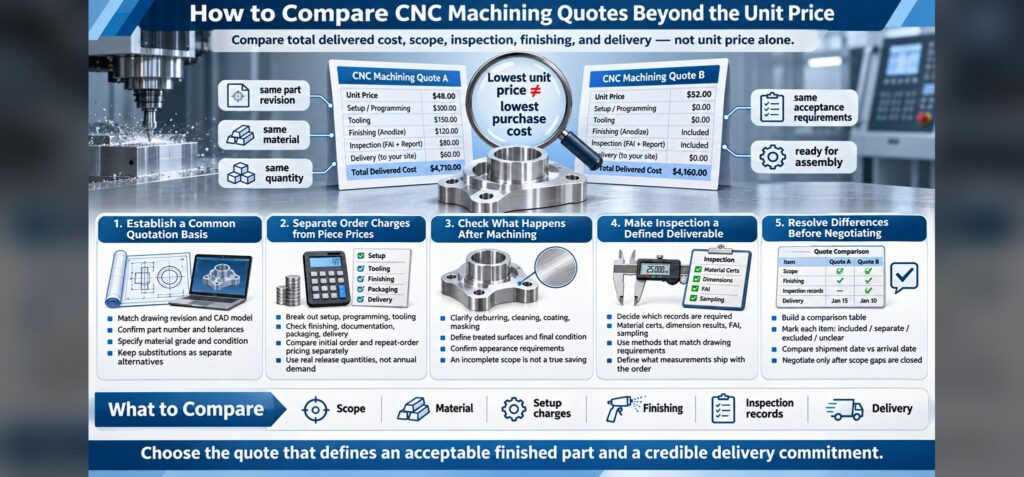
A CNC machining quote is only comparable with another quote when both suppliers are offering the same finished part, in the same quantity, with the same acceptance requirements. The lowest unit price is not necessarily the lowest purchase cost. It may exclude finishing, inspection records, or preparation charges that another supplier has already included.
The useful question is straightforward: what will this order cost to arrive ready for acceptance and assembly? Answer that before ranking suppliers by price.
Establish a Common Quotation Basis
Start with the drawing revision. A small change to a bore, thread, or surface treatment can change the manufacturing work. Check that every quotation names the same part number and revision, and that the CAD model agrees with the drawing.
Next, match material grade and condition. “Aluminum” is not equivalent to a specified alloy and temper. Likewise, an offer for an untreated steel component is different from one that includes heat treatment to a defined final condition. Proposed substitutions belong in a separate alternative, not hidden inside a cheaper base price.
When requesting custom CNC machining services, define the deliverable as a finished, inspected component. That gives suppliers a common basis for quoting machining, secondary operations, and documentation rather than pricing different interpretations of the same model.
Separate Order Charges from Piece Prices
Programming, dedicated fixtures, and inspection preparation can be charged separately or distributed across the quoted quantity. Neither arrangement is inherently better. What matters is whether the quotation makes the treatment clear.
For the initial order, compare the quantity multiplied by the unit price, plus separately charged setup, tooling, finishing, documentation, packaging, and delivery. Include each item only once. If a supplier says a process is included, record that rather than adding an assumed allowance.
Then ask for the repeat-order basis. A retained program does not mean every future setup is free, and a paid fixture does not automatically belong to the buyer. Establish ownership, storage, maintenance, and what happens if production transfers elsewhere.
Keep order size separate from annual demand. An annual forecast of 1,000 pieces does not mean the shop can spread preparation across 1,000 pieces when you release batches of 50. Request pricing for the release quantities you expect to buy.
Check What Happens After Machining
An as-machined component and a coated component are different deliverables. Identify whether the price includes deburring, cleaning, surface treatment, masking, and any measurements required after finishing.
Consider a housing with a fitted bore and an anodized exterior. The quotation should establish which surfaces receive treatment and how the finished bore is accepted. A lower price that leaves this question unresolved is not yet a saving; it is an incomplete scope.
The same applies to appearance. “Black finish” leaves room for different processes and acceptance standards. If color consistency or visible tool marks matter, agree on those requirements before asking suppliers to compete on price.
Make Inspection a Defined Deliverable
“Quality checked” tells a buyer little about the records that will arrive. Decide whether receiving inspection needs a material certificate, results for selected dimensions, a first-article report, or another specified record. Identify the relevant features and sampling requirements.
A diameter result does not establish runout, and a visual check does not measure surface roughness. The method must answer the drawing requirement. Asking about that method is more useful than collecting a list of inspection equipment without knowing how it will be used.
For example, VETCNC describes drawing and inspection review as part of defining a machining order. In a quotation discussion, turn that into a concrete agreement: which characteristics will be measured, in what finished condition, and which records will accompany the shipment.
Resolve Differences Before Negotiating
Create a comparison with one row for each requirement and one column for each supplier. Use clear entries such as “included,” “separate charge,” “excluded,” and “awaiting clarification.” An unanswered field should remain unanswered rather than becoming an assumed zero cost.
Delivery needs the same discipline. Distinguish shipment date from arrival date, and ask what starts the lead-time clock. Material approval, drawing release, and sample acceptance can all affect the schedule. Compare transport and import-related responsibilities on the same basis.
Once the offers cover the same work, negotiate the actual cost drivers. A larger release, an approved geometry change, or a different nonfunctional finish may produce a defensible saving. Removing a necessary acceptance check merely changes what you are buying.
Conclusion
Choose from quotations that define an acceptable finished part and a credible delivery commitment. First close the scope gaps, then compare initial-order and repeat-order costs separately. A clear quotation gives purchasing and engineering the same understanding of what the supplier must deliver.