
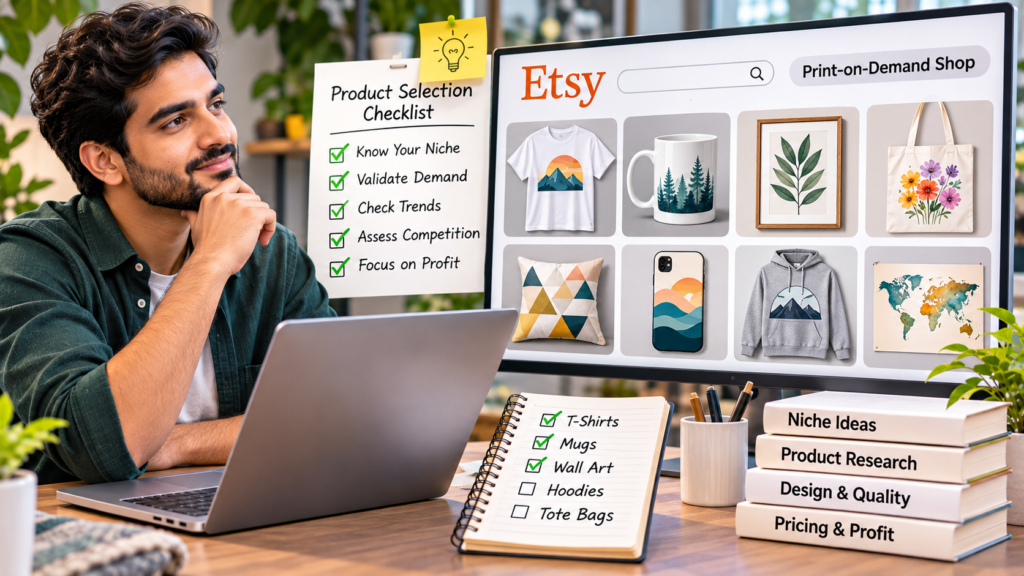
Choosing the right products is one of the most important steps in building a successful Etsy print-on-demand (POD) business. While POD allows sellers to offer customized products without holding bulk inventory, it does not guarantee sales or profitability. The real challenge is finding products that match customer needs, have measurable market demand, offer room for differentiation, and leave enough margin after production, shipping, and marketplace fees. Instead of choosing products based on personal preferences or short-lived trends, sellers should follow a structured research process.
This article explains how to identify your target audience, compare POD product categories, research demand and competition, calculate potential profit, evaluate suppliers, and use EHunt test product ideas before expanding your catalog.
Understand Your Target Audience
Before choosing a product, determine who you want to sell to and why they might buy it. A clearly defined audience helps you make more informed decisions about product types, design styles, personalization options, and pricing.
Identify a Specific Customer Group
Start by narrowing your focus to a group with shared interests, lifestyles, or purchasing needs. Potential audiences include pet owners, teachers, outdoor enthusiasts, book lovers, and people shopping for personalized family gifts.
For example, a shop targeting dog owners could offer breed-themed T-shirts, personalized pet mugs, or custom pet portraits. A shop for new moms focuses on nursery decor, and baby milestone keepsakes.
You do not need to choose a niche that is extremely narrow. Instead, look for a balance between a recognizable audience and enough potential product ideas to support future growth.
Understand Customer Needs and Buying Motivations
Consider why your target customers would purchase a product. Are they looking for something practical, a way to express their identity, a personalized gift, or an item connected to a hobby?
Review customer feedback on comparable products, browse relevant online communities, and look for recurring preferences or unmet needs. These observations can help you develop products that address specific customer motivations rather than simply adding another generic design to a crowded market.
Explore Popular Etsy POD Product Categories
Once you understand your audience, compare product categories that fit their interests and purchasing habits. Common POD options include apparel, drinkware, home decor, accessories, and personalized gifts. However, popularity alone does not determine whether a product is suitable for your shop.
| Product category | Potential audience | Key factors to evaluate |
| T-shirts and sweatshirts | Hobbyists, communities, gift buyers | Sizing, fabric quality, pattern design |
| Mugs and tumblers | Coffee lovers, office workers, gift buyers | Print durability, shipping protection |
| Posters and wall art | Home decorators, art enthusiasts | Image resolution, size options, visual style |
| Tote bags and accessories | Students, shoppers, everyday users | Material, functionality, print area |
| Personalized gifts | Families, couples, pet owners | Customization accuracy, production time |
Use this comparison as a starting point, not a ranking of the most profitable products. Each category has different production costs, customer expectations, and competitive conditions.
Also consider how easily your designs can be adapted to the selected product. A detailed illustration may work well on wall art but lose clarity when printed on a small accessory. Testing design placement and readability can help you avoid quality issues before launch.
Rather than listing dozens of unrelated products immediately, begin with a focused collection that serves the same audience. This makes it easier to maintain a consistent shop identity and evaluate which products deserve further investment.
Research Products Before Launching
A product idea may sound appealing, but market research helps determine whether it is worth testing. Evaluate demand, competition, and differentiation together instead of relying on a single indicator.
Identify Market Demand
Start by searching Etsy for products related to your niche. Examine comparable listings, product variations, customer reviews, and visible signs of buyer interest. You can also explore broader trends and seasonal occasions to understand whether demand may change over time.
Look for repeated patterns. For example, many products offer the option to customize names, dates or exclusive text. If customers consistently respond to a particular theme, personalization option, or product format, it may provide a useful starting point for further investigation.
However, keep the limitations of market research in mind. A large number of reviews does not necessarily indicate recent demand, and a popular listing does not prove that a new seller can achieve similar results.
Evaluate Competition and Find Opportunities
Competition does not necessarily mean you should avoid a product category. If multiple sellers are offering similar products, it may indicate that there is customer interest in that market. However, entering a competitive category also means buyers have many options to choose from. To attract customers, you need to offer something that makes your products stand out, such as original designs, personalized details, or a product style tailored to a specific audience.
Review competing products to understand their designs, price ranges, customization options, and presentation. Then ask what you could offer differently. Opportunities might include serving a more specific audience, creating original artwork, improving personalization, or choosing a product format that better fits a customer’s needs.
For instance, instead of selling a generic pet-themed mug, you could develop original designs for owners of specific breeds or offer a carefully designed personalization experience.
The goal is not to copy successful listings. It is to identify customer needs and create a distinct product that addresses them.
Use Product Research Tools
Manual research is useful, but reviewing many listings individually can be time-consuming. Product research tools like EHunt can help organize market information and make comparisons more efficient.
EHunt offers Etsy-focused product research capabilities that sellers can use to explore product opportunities and examine available market data. Use EHunt’s Etsy product database to search for products you’re interested in, you can view metrics including sales volume, reviews, and favorites. By comparing factors, sellers can narrow down potential opportunities for further research. If you want to look for a straightforward research tool without complicated setup, EHunt’s Etsy Rank Extension provides product-related data directly while browsing Etsy. Instead of switching between multiple pages, sellers can view product metrics on Etsy listings, making it easier to compare products and find profitable products.
Use these findings to build a shortlist rather than make an immediate launch decision. Research tools can help identify opportunities, but they cannot guarantee that a product will sell. Validate promising ideas against production costs, supplier capabilities, and your own ability to create a differentiated offering.
Calculate Costs and Profit Potential
A product with strong demand may still be a poor choice if its costs leave too little profit. Before launching a listing, estimate how much each order could contribute to your business after all relevant expenses.
Consider Production and Shipping Costs
Start with the supplier’s base product cost and printing charges. Then include shipping, Etsy selling fees, payment processing fees, and any applicable advertising costs. Depending on your business, you may also need to account for design software, discounts, refunds, and replacement orders.
Etsy’s published US seller information lists a $0.20 listing fee and a 6.5% transaction fee. Payment processing fees vary by seller location; the US rate shown on Etsy’s selling page is 3% plus $0.25 per transaction. Additional fees may apply in certain circumstances. You’ll pay an advertising fee on any sales generated from Offsite Ads. When launching your Etsy shop, you get to choose whether you want to opt into Etsy’s advertising program. Always check the current Etsy selling fees for your location and circumstances.
Set a Competitive and Profitable Price
Use a simple formula to estimate your profit:
Estimated profit per order = Selling price − Total costs per order
Your total costs should include production, shipping, applicable marketplace and payment fees, and other variable expenses. You can use EHunt’s Etsy Fee Calculator to calculate and adjust your profits.
Compare your planned price with similar products, but do not automatically choose the lowest price. Product quality, original design, personalization, and perceived value can all influence what customers consider reasonable.
If your estimated margin is too small, explore alternative suppliers, adjust the product format, reconsider shipping arrangements, or test a different price point. Make sure any changes preserve the quality and customer experience you want to deliver.
Choose the Right POD Supplier
Your supplier affects product quality, fulfillment reliability, and the experience customers receive. A product idea is only viable if you can produce and deliver it consistently.
Compare Product Quality and Customization Options
Compare suppliers based on materials, print methods, available sizes and colors, customization options, and production costs. Check whether their product specifications match your design requirements.
Order samples when practical. A sample allows you to inspect the actual product, evaluate print quality, and compare the finished item with your listing images. Pay particular attention to color accuracy, sizing, material feel, and how well the design appears on the product.
Also make sure your supplier supports the personalization features you plan to offer. A product that looks attractive in a mockup may not work well if the actual printing area is too small or the customization process is unreliable.
Check Production Times and Shipping Policies
Review production estimates, shipping destinations, tracking options, and policies for damaged or delayed orders. Costs and delivery times may vary by product, fulfillment provider, destination, and season.
Finally, ensure your shop complies with Etsy’s policies. Under Etsy’s Creativity Standards, POD products must meet the applicable requirements for seller-designed items, and qualifying production partners must be disclosed. Sellers should also provide accurate shipping-origin information where required.
Test Your Product Ideas Before Scaling
Research can narrow your options, but real customer behavior provides additional evidence. Before investing heavily in a large catalog, test a manageable selection of products.
Choose products that fit your audience and have reasonable cost structures. Create clear listings with accurate product images, descriptions, and delivery information. Where possible, test different product formats or design variations while keeping your target audience consistent.
After launch, review available performance data, including visits, orders, conversion rate, and revenue. Analyse the results carefully. Low sales may reflect limited visibility, weak product appeal, pricing issues, or a mismatch between the listing and customer expectations.
Use these findings to decide what to improve. You might revise a design, test a different product type, adjust pricing, or discontinue an idea that does not justify further investment.
Expand gradually when you see encouraging evidence of demand and can fulfill orders reliably. The objective is not to launch the largest catalog possible, but to build a collection of products that customers want and your business can deliver profitably.
Common Mistakes to Avoid When Choosing Etsy POD Products
Several common mistakes can make product selection less effective:
- Choosing products based only on trends: Trends can fade before your product gains traction. Evaluate timing, audience fit, and longer-term demand.
- Ignoring the full cost structure: A high selling price does not mean high profit. Include production, shipping, fees, and other relevant expenses.
- Copying existing designs: Similar products may compete directly without giving customers a reason to choose yours. Develop original designs and avoid unauthorized use of protected intellectual property.
- Expanding too quickly: A large catalog can increase listing and management costs before you know which products perform well. Test first and scale based on evidence.
- Overlooking supplier reliability: Attractive mockups cannot compensate for poor quality or consistently late fulfillment. Verify product specifications and delivery expectations before committing.
FAQs
What Are the Best POD Products to Sell on Etsy?
There is no single best POD product for every seller. T-shirts, mugs, wall art, tote bags, and personalized gifts are common options, but the right choice depends on your target audience, design style, competition, costs, and supplier quality. Research several categories before deciding which products to test.
How to Find Profitable Etsy POD Products?
Start by identifying a specific customer group and researching products that match its needs. Evaluate market demand, competing listings, differentiation opportunities, production costs, shipping, and Etsy fees. Test promising ideas before investing heavily in them.
Is Print-on-Demand Still Worth It on Etsy?
POD can be a practical business model because sellers can offer products without purchasing bulk inventory in advance. However, competition, fulfillment costs, customer expectations, and Etsy’s policies still matter. Its suitability depends on whether you can create distinctive products, price them appropriately, and provide a reliable customer experience.
How Many Products Should I Launch First?
Start with a small, manageable collection of related products rather than choosing an arbitrary target. The right number depends on your budget, design capacity, and research findings. A focused launch makes it easier to evaluate performance and improve your products before expanding.
Conclusion
Choosing the right products for your Etsy POD shop requires more than following trends or copying popular listings. Start with a clear understanding of your target audience, compare suitable product categories, research demand and competition, calculate costs, and select a supplier that can meet your quality and fulfillment requirements. Then test your ideas and use actual shop performance to guide future decisions.
Product research tools such as EHunt can help you explore opportunities and make market analysis more efficient, but your final decisions should also account for customer needs, profitability, and execution. A well-researched product selection strategy can help you make smarter decisions and build a more sustainable Etsy POD business.