
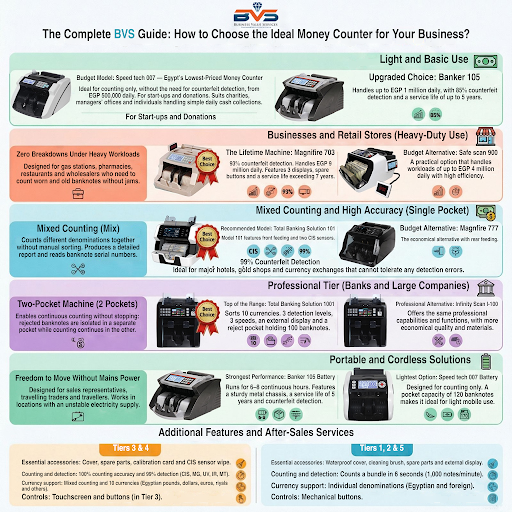
BVS sorts its money counting machines into five tiers by daily cash volume, counting needs and counterfeit risk. This guide shows which tier suits a small shop, a fuel station, a hotel, an exchange office or a collection agent in Egypt, and which models to shortlist.
The five types of money counting machines in the BVS buying guide, from basic note counters for light daily use to two-pocket bank sorters and battery-powered portable counters.
Egypt is moving toward digital payments, but cash still does most of the work at the counter. The Central Bank of Egypt reported that 77.6% of Egyptians aged 15 and over had an active transaction account by the end of 2025. Yet in July 2026, the Egyptian Center for Economic Studies noted that cash still dominates despite a well-developed digital payments infrastructure, with billions of pounds in pension payments converted into physical cash every month. For a supermarket, a fuel station, an exchange office or a gold shop, that means counting thick stacks of notes every day, and every miscount or fake note is a direct loss.
Choosing the wrong machine costs money too. A small shop that buys a two-pocket bank sorter pays for features it will never use, while a busy wholesaler that buys an entry-level counter ends up with jams and miscounts. To help buyers match the machine to the workload, BVS (Business Value Solutions), a Cairo-based supplier of money counting machines and counterfeit detectors, has sorted its range into five tiers based on daily cash volume, how the notes arrive, counterfeit risk and access to power. This guide explains each tier, the businesses it suits and the models BVS recommends, so you can buy the machine your work needs and no more.
Quick Answer: Which Money Counting Machine Do You Need?
The right money counting machine depends on four things: how much cash you count each day, whether your notes arrive sorted or mixed, how much counterfeit risk you carry, and whether you have stable power where you count. BVS matches these needs to five types of machine, summarized in the table below.
| Machine type | Best for and BVS models |
| Tier 1: Basic counter | Under EGP 500,000 a day: re-checking bank cash, charities, places of worship, start-ups.
Models: Speed Tech 007, Infinity Scan I-50, Banker 105 |
| Tier 2: Heavy-duty counter with counterfeit detection | Over EGP 1 million a day: fuel stations, supermarkets, pharmaceutical and feed companies, wholesalers.
Models: Magnifire 703, Banker 105 |
| Tier 3: Single-pocket mixed denomination counter | Mixed local and foreign cash: large and tourist hotels, travel companies, gold shops, big brands.
Models: TBS 101, Magnifire 777 |
| Tier 4: Two-pocket bank-grade sorter | Very high volume of mixed cash: banks, exchange offices, cash-in-transit firms, large jewelers.
Models: TBS 1001, Infinity Scan I-100 |
| Tier 5: Portable battery-powered counter | Away from stable power: traveling traders, collection agents, sites with power cuts.
Models: Banker 105 Battery, Speed Tech 007 Battery |
Not sure which tier fits? Send your daily cash volume and business type to BVS on WhatsApp at +20 121 068 6868, and the team will recommend a model.
What Is a Money Counting Machine?
A money counting machine, also called a money counter, currency counter, cash counting machine or bill counter, is a device that feeds banknotes one at a time past sensors to count them. Many models also check each note’s security features and stop or sound an alert when a suspect note passes. A standard desktop counter runs at about 1,000 notes per minute, so a 100-note bundle takes around six seconds.
Machines differ in what they can do with a stack of notes:
- Bill counter (piece counter): counts the notes in a sorted stack and can total their value when you feed one denomination at a time.
- Mixed denomination counter (value counter or currency discriminator): uses image sensors to recognize each note’s denomination, so it totals an unsorted stack in one pass.
- Two-pocket sorter: a value counter with a second pocket that sends rejected or different notes aside without stopping the count.
- Portable money counter: a compact counter with a rechargeable battery for use away from a power outlet.
How to Choose a Money Counting Machine in 5 Questions
- How much cash do you count each day? Daily value is the first filter. Below EGP 500,000 a day, a basic counter is enough. Above EGP 1 million, you need a heavy-duty machine built for long counting sessions.
- Does your cash arrive sorted or mixed? If cashiers already bundle notes by denomination, a standard counter does the job. If you receive mixed stacks, a value counter removes the time spent sorting by hand.
- How high is your counterfeit risk, and in which currencies? A shop taking Egyptian pounds from regular customers faces less risk than an exchange office taking dollars and euros from strangers. Higher risk calls for more detection layers and, for foreign currency, image-based checks.
- Do you need sorting, serial numbers or a customer display? Banks, exchange offices and cash-in-transit companies often need to separate denominations and print series, record serial numbers and show the counted total to the customer.
- Is there stable power where you count? Field collection, markets and sites with frequent power cuts need a battery-powered counter.
The BVS framework is built to prevent two common buying mistakes: paying for a machine far above the workload, and buying a light-duty counter for a heavy-duty job. The first wastes budget. The second wears the machine out early and sends it back for repairs.
The 5 Types of Money Counting Machines, Matched to Your Business
BVS designed its framework as a guide rather than a fixed rule. Two businesses in the same sector can have very different workloads, so a busy outlet may need the tier above the one its sector is listed under. BVS describes the framework as the first buying guide of its kind for money counters in Egypt and the Arab world.
Tier 1: Basic Money Counters for Light Daily Use
Tier 1 is for buyers who mainly need fast, accurate counting and count less than EGP 500,000 a day. Counterfeit detection is optional at this level. Typical users re-check cash received from banks, keep a second counter in a manager’s office, count donations at places of worship and charities, or review daily collections in very small or new businesses.
- Speed Tech 007: the entry model, which BVS describes as the most affordable money counting machine in Egypt. It is built for counting, so buyers who also need counterfeit detection should look at the next two models.
- Infinity Scan I-50: better build quality and materials, a longer service life and counterfeit detection rated by BVS at up to 75%.
- Banker 105: the top choice in this tier for above-average use of more than EGP 1 million a day, with counterfeit detection rated at up to 85% and a service life of up to five years.
Tier 2: Heavy-Duty Money Counters with Counterfeit Detection
Tier 2 covers businesses that need counting and counterfeit detection together and count more than EGP 1 million a day. It also fits anyone who counts old, worn notes and needs a machine that will not miscount or jam on them. Typical users are small and medium-sized companies such as fuel stations, pharmaceutical and animal-feed companies, supermarkets, small restaurants, hotels and hospitals, small travel agencies and car showrooms, shops, wholesalers and retailers, as well as individuals who need a machine for very heavy daily use with no room for error.
- Magnifire 703: BVS’s first recommendation, known in Egypt as “Makinet El Omr”, the machine for a lifetime. BVS rates it for up to EGP 9 million a day, a service life of more than seven years and counterfeit detection of up to 93%. It has three displays and backup buttons and is built to keep working even when handled roughly. BVS is Magnifire’s sole agent in Egypt.
- Banker 105: the economical alternative, rated for up to EGP 4 million a day.
Tier 3: Single-Pocket Mixed Denomination Counters
Tier 3 is for buyers who want to place a mixed stack in the machine and get the total without sorting each denomination by hand. These value counters also pull out a stray denomination hidden in a bundle and offer counterfeit detection of up to 99%, the highest level in the BVS range, which matters most with foreign currency. They suit large and tourist hotels, major travel companies, gold shops and big retail brands, as well as individuals who need mixed counting, separation of old and new print series, a detailed count report and serial number capture for foreign currency.
- Total Banking Solution 101 (TBS 101): BVS’s first choice, a front-loading counter with dual CIS image sensors and a hopper that takes up to 400 notes at once. It works with both a touchscreen and buttons.
- Magnifire 777: a rear-loading counter with the same capabilities at a lower price and a 200-note hopper.
On a front loader, the stack lies flat in the hopper on top of the machine. On a rear loader, it stands upright.
Tier 4: Two-Pocket Bank-Grade Money Sorters
Tier 4 serves banks, exchange offices, cash-in-transit companies, large jewelry shops, major brands, large factories, big hotels, nightlife venues and the head offices and accounts departments of large companies. It also fits any business that receives large mixed amounts from several suppliers and has to count them quickly without sorting first.
- Total Banking Solution 1001 (TBS 1001): the top machine in the BVS range. It has two pockets, sorts 10 currencies, value-counts mixed stacks, separates denominations and print series, and captures serial numbers. A 500-note hopper, a 100-note reject pocket and a 200-note stacker keep the count running without stops, and an external display shows the counted amount to the customer. It offers three speeds and three detection levels, with detection rated at up to 99%, and runs on buttons only.
- Infinity Scan I-100: the economical alternative, with the same functions and lower build quality.
Tier 5: Portable Battery-Powered Money Counters
Tier 5 machines run on a rechargeable battery, which makes them a strong fit for traveling traders, travelers, collection agents and any site with power cuts or an unstable supply.
- Banker 105 Battery: BVS’s first choice. It counts, detects counterfeits, adds up denominations fed separately and makes bundles, with a separate customer display. It runs for six to eight hours of continuous counting on battery, has a metal chassis with a 200-note capacity and is rated for up to five years of heavy use.
- Speed Tech 007 Battery: the lighter, lower-priced option. It counts only, holds 120 notes and has a plastic body and a shorter service life.
If your business sits between two tiers, the BVS customer service team, available 24 hours a day, seven days a week, can recommend the right model. You can also ask about any money counting machine in the range on the BVS Facebook page.
Features Shared Across the BVS Range
Tiers 1, 2 and 5: Counting Modes and Accessories
Every machine in tiers 1, 2 and 5 counts a 100-note bundle in about six seconds, or 1,000 notes per minute, makes bundles in batch mode and adds up totals when you feed each denomination separately. Each one ships with a waterproof cover, a catalog, a cleaning brush, spare parts, an extra external display and the original power cable. The battery models in tier 5 come with the original charger instead of the cable.
Tiers 3 and 4: Currencies, Sensors and Accessories
The mixed denomination machines in tiers 3 and 4 value-count all denominations in one pass, pull out notes of a different denomination or print series, and recognize 10 currencies: the Egyptian pound, US dollar, euro, British pound, Saudi riyal, Kuwaiti dinar, UAE dirham, Syrian pound, Libyan dinar and Sudanese pound. They can count three currencies together, offer three speeds and three detection levels, capture serial numbers on foreign currency, and sort notes by face and orientation so the whole stack can be arranged the same way up.
Detection combines dual CIS image sensors with MG, UV, IR and MT checks, and counting starts either manually or automatically as soon as notes are placed in the hopper. BVS specifies 100% counting accuracy and up to 99% counterfeit detection for these models. Each ships with an external display that shows the total to the customer, a waterproof cover, spare parts, the original calibration card, a cloth for cleaning the CIS sensors, the original cable, a catalog and a cleaning brush.
Counterfeit Detection Technologies Explained: UV, MG, IR, MT and CIS
A money counting machine with counterfeit detection checks each note against one or more security features as it passes the sensors, and every extra layer makes it harder for a fake to get through. These are the checks you will see on spec sheets:
- UV (ultraviolet): checks how the note reacts under ultraviolet light. Genuine banknote paper does not contain the optical brighteners found in ordinary paper, so it stays dull under UV, while many notes also carry ink features that glow only under UV light. A fake printed on office paper reacts differently.
- MG (magnetic): detects the magnetic ink used in parts of the print on genuine notes.
- IR (infrared): reads print features that show a specific pattern under infrared light. Infrared sensors also help catch double notes, half notes and chained notes.
- MT (metal thread): detects the metallic security thread embedded in genuine banknotes.
- CIS (contact image sensor): scans an image of each note so the machine can recognize its denomination and print series and compare it with genuine references. Dual CIS scans both sides.
Detection ratings stay below 100% for a reason: no machine catches every fake, and not every rejected note is counterfeit. Treat a rejected note as a suspect and check it by hand. BVS posts demonstrations of each money counter with counterfeit detection on its YouTube channel, which is a quick way to see how a machine reacts to a suspect note before you buy.
Can Money Counters Handle Egypt’s Polymer EGP 10 and EGP 20 Notes?
Egyptian cash now comes in two materials. The Central Bank of Egypt issued its first polymer banknote, the EGP 10, in 2022, and a polymer EGP 20 followed in 2023. In May 2026, the central bank confirmed that polymer EGP 10 and EGP 20 notes are still being issued and remain legal tender alongside the paper versions of the same denominations.
Polymer behaves differently inside a counter. Manufacturers’ support manuals note that the transparent window on a polymer note can make width or height sensors read it as incomplete, and that polymer notes can build up static and cling together, which can cause count errors. Some counters also need a setting change before they count polymer reliably.
The practical test takes a few minutes. Before you buy, run a mixed stack of your own paper and polymer EGP 10 and EGP 20 notes, including worn ones, through the machine and check the count. Do the same with any foreign currency you handle.
How Much Does a Money Counting Machine Cost in Egypt?
Price follows the tier. An entry-level counter such as the Speed Tech 007 sits at the low end, and a two-pocket sorter with CIS sensors and multi-currency support such as the TBS 1001 sits at the top. Detection layers, hopper capacity, build materials, the number of currencies and expected service life all move the price, and because these machines are imported, prices in Egypt shift with the exchange rate.
The aim is value for money: buy the tier that matches your workload rather than the most expensive machine on the shelf. You can browse the current range of money counters in Egypt on the BVS Instagram account, and the sales team quotes current prices by phone and WhatsApp.
Frequently Asked Questions
What is the best money counting machine in Egypt?
There is no single best machine for every business, because the right choice depends on daily volume and how your cash arrives. For heavy daily counting with counterfeit detection, BVS recommends the Magnifire 703, rated for up to EGP 9 million a day. Mixed cash suits the TBS 101 or Magnifire 777, banks and exchange offices suit the two-pocket TBS 1001, and light users can start with the Speed Tech 007.
Do money counting machines detect counterfeit Egyptian pounds?
Yes, if the model includes counterfeit detection. These machines check security features such as UV response, magnetic ink, infrared print and the metal thread, and the BVS mixed denomination models add dual CIS image scanning. BVS rates detection from up to 75% on the Infinity Scan I-50 to up to 99% on its tier 3 and tier 4 machines. The entry-level Speed Tech 007 is built for counting rather than detection.
How fast does a money counting machine count?
A standard desktop money counter runs at about 1,000 notes per minute. The BVS machines in tiers 1, 2 and 5 count a 100-note bundle in about six seconds. The mixed denomination machines in tiers 3 and 4 offer three speed settings, so you can slow the count for worn notes.
Can a money counter count mixed denominations?
Only a mixed denomination counter, also called a value counter, can total an unsorted stack in one pass, because it uses image sensors to recognize each note. In the BVS range, that means the TBS 101, Magnifire 777, TBS 1001 and Infinity Scan I-100. Basic counters need sorted stacks, although they can add up totals when you feed each denomination separately.
Which money counter is best for banks and exchange offices?
Banks, exchange offices and cash-in-transit companies need a two-pocket sorter that value-counts mixed cash, sorts by denomination and print series, captures serial numbers and sends suspect notes to a reject pocket without stopping. In the BVS range, that is the Total Banking Solution 1001, with the Infinity Scan I-100 as the economical alternative.
Is there a money counting machine that works without electricity?
Yes. Battery-powered counters run on a rechargeable battery. The Banker 105 Battery counts and detects counterfeits for six to eight hours of continuous use without being plugged in, and the lighter Speed Tech 007 Battery handles count-only work with a 120-note hopper.
How long does a money counting machine last?
Service life depends on build quality and daily load. BVS rates the Banker 105 for up to five years and the Magnifire 703 for more than seven years of heavy use. Regular cleaning of the sensors and rollers, and choosing a machine sized for your workload, both extend that life.
Where can I buy a money counting machine in Cairo?
BVS (Business Value Solutions) sells, imports, maintains and rents money counting machines from its office at 3 El Obour Buildings, Salah Salem St, Manshiyet El Bakri, Nasr City, Cairo. You can call +20 111 110 6868, message the team on WhatsApp at +20 121 068 6868 or order online at bvsegypt.com.
About BVS (Business Value Solutions)
BVS (Business Value Solutions) is a Cairo-based company that sells, imports, maintains and rents money counting machines and counterfeit detection equipment. It has operated for more than 10 years, serves banks, government entities and companies across Egypt’s governorates, and is the sole agent in Egypt for Magnifire money counting machines, including the Magnifire 703 and Magnifire 777.
Contact BVS to Choose Your Money Counting Machine
The BVS customer service team is available 24 hours a day, seven days a week to answer questions and recommend the right model for your workload. Send your daily cash volume, business type and the currencies you handle, and the team will suggest the tier and model that fit.
- Call: +20 111 110 6868, +20 112 220 0021, +20 121 068 6868, +20 101 336 5135, +20 112 200 0051
- Landline: +20 2 2404 4456
- WhatsApp: +20 121 068 6868, +20 111 110 6868, +20 101 336 5135, +20 112 200 0051
- Order online: bvsegypt.com
- Address: 3 El Obour Buildings, Salah Salem St, Manshiyet El Bakri, Nasr City, Cairo Governorate 11811, Egypt
- Map: Find BVS on Google Maps