
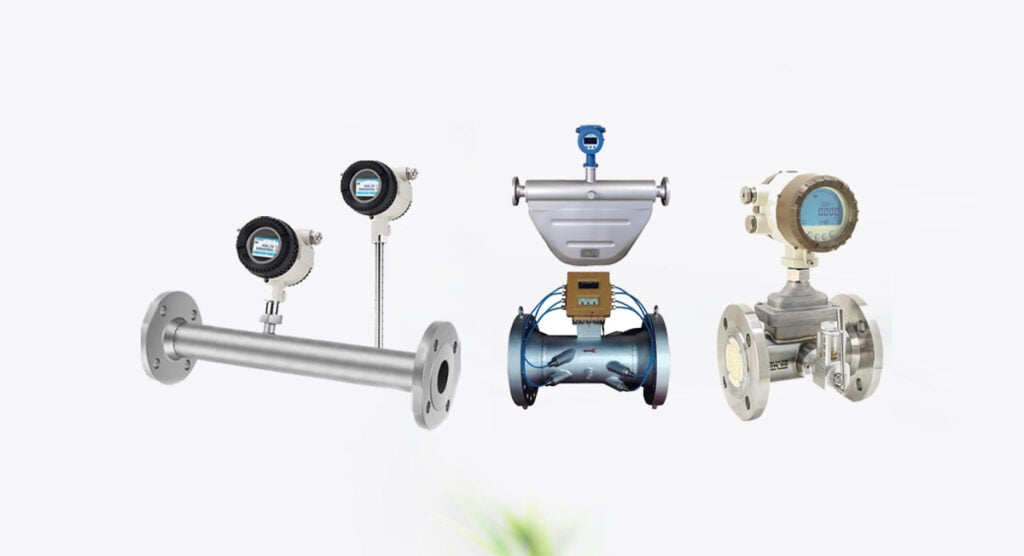
Gas flow meters are essential instruments in industrial and commercial processes. Whether you’re measuring nitrogen, natural gas, biogas, or a gas mixture used in laboratories or semiconductor manufacturing, choosing the right flow meter can directly impact process efficiency, accuracy, and safety.
However, the selection process is not always straightforward. Gases vary widely in their physical and chemical properties, some are dry, others moist; some are clean, others contain particulates; some are pure, others are complex mixtures. Each type presents unique challenges to accurate measurement.
This article covers how to choose the right gas flow meter based on gas characteristics, application conditions, and meter types, especially for dry gases, wet gases, particulate-laden gases, single-component gases, and gas mixtures.
Types of Gases
Understanding your gas type is the first and most critical step in choosing a gas flow meter. Gases are not created equal, and their composition significantly affects meter performance.
Dry Gas
Dry gases contain little or no water vapor. Examples include compressed air, nitrogen, helium, argon, and other inert gases in dry conditions.
Challenges: Minimal. Easy to measure with most flow meter types.
Wet Gas
Wet gases include moisture or condensable vapors, either by design (e.g., saturated steam) or due to environmental conditions (e.g., biogas with water vapor).
Challenges: Condensation, corrosion, and sensor degradation.
Gas with Particulates
These gases carry solid particles such as dust, carbon black, or ash. Common in exhaust gases or industrial processing applications.
Challenges: Sensor wear, clogging, reduced accuracy.
Pure (Single-Component) Gas
A pure gas is composed of a single component, for example, pure oxygen, hydrogen, or methane.
Challenges: Generally easier to measure and calibrate for, especially with mass flow meters.
Gas Mixtures
Gas mixtures are composed of two or more gases, such as natural gas (mostly methane plus other hydrocarbons), biogas (CH₄ + CO₂ + impurities), or specialty industrial gas blends.
Challenges: Changing composition, varying density and viscosity, calibration complexity.
Recommended Flow Meter Types by Gas Category
Each gas type requires specific meter characteristics to ensure accurate, stable, and durable performance.
For Dry Gases
Recommended Meters:
- Thermal Mass Flow Meters – Ideal for clean, dry air or inert gases.
- Coriolis Flow Meters – Highly accurate, suitable for low flow dry gases.
Notes:
- Make sure gas is clean to prevent long-term sensor drift.
For Wet Gases
Recommended Meters:
- Vortex Flow Meters – Tolerate moisture; suitable for saturated steam.
- Pitot Tube Gas Flow Meters – All non-corrosive gases including wet, dirty, and mixed gases.
Avoid:
- Thermal mass flow meters — heat transfer affected by condensation.
For Gases with Particulates
Recommended Meters:
- Ultrasonic Flow Meters (Clamp-on) – Non-intrusive and less affected by particles.
- Robust DP Flow Meters – With upstream filtration.
- Positive Displacement (PD) Meters – For specific cases involving low flow and light particulates.
Design Tips:
- Add filters to reduce wear.
- Use abrasion-resistant materials.
For Pure Gases
Recommended Meters:
- Thermal Mass Flow Meters – Accurate when calibrated to the specific gas.
- Coriolis Flow Meters – Direct mass measurement, independent of gas properties.
- Volumetric Flow Meters – Only if pressure and temperature are stable or compensated.
Note: Single-component gases are easier to calibrate, and their behavior is predictable.
For Gas Mixtures
Recommended Meters:
- Coriolis Flow Meters – Best for mass flow of variable-composition gases.
- Thermal Mass Meters with Multi-Gas Calibration – Only if the mixture is consistent.
- Pitot Tube Gas Flow Meters – All non-corrosive gases including wet, dirty, and mixed gases.
Challenges:
- Changing composition affects thermal and volumetric properties.
- Choose meters that measure mass flow for more reliable results.
For Low Flow Applications: Mass Flow Controllers
When working with low gas flow rates, especially in laboratory settings, gas mixing systems, or semiconductor processes, Mass Flow Controllers (MFCs) are often the best choice.
Mass Flow Controllers are precision instruments that not only measure gas flow but also actively regulate and control the flow to match a setpoint. They are ideal for flow rates typically below 50 SLPM (standard liters per minute), and some models support flow as low as a few SCCM (standard cubic centimeters per minute).
Recommended for:
- Pure gases and gas mixtures in low flow conditions
- High-precision applications requiring closed-loop control
- Systems that require flow stability and repeatability
Suitable MFC Types:
- Thermal-based MFCs – Most common, cost-effective, and suitable for many gases.
- Coriolis MFCs – More accurate and suitable for gases with variable compositions.
Important Notes:
- Choose MFCs with appropriate gas calibration or multi-gas capabilities.
- Ensure compatibility with communication protocols (e.g., RS485, Modbus, EtherCAT).
Key Factors to Consider When Choosing a Gas Flow Meter
Selecting the right flow meter involves more than matching it to a gas type. Here are the most critical selection criteria:
Flow Rate Range
Check both minimum and maximum flow rates. Some meters (like Coriolis or thermal mass) offer wide turndown ratios; others are more limited.
Accuracy Requirements
Industrial processes may require ±1% accuracy, while HVAC or basic monitoring may tolerate ±5%. Choose a meter type that matches your needs.
Operating Conditions
- Temperature and pressure range
- Presence of pulsations or backflow
- Hazardous area classification
Installation Constraints
- Straight-run pipe requirements
- Available space
- Indoor vs. outdoor use
Output and Communication
- Most modern flow meters support:
- 4–20 mA or pulse output
- Modbus, HART, or other digital protocols
- Local display + remote monitoring
3.6 Maintenance and Reliability
- Do you need a flow meter with no moving parts?
- Is in-line cleaning possible?
- What’s the expected service life?
- Thermal mass and ultrasonic meters usually offer the lowest maintenance. PD and turbine meters require more care.
Final Thoughts
Choosing the best gas flow meter is a strategic decision that balances performance, budget, gas type, and environmental factors. Here’s a quick decision guide:
- For high accuracy and flexibility → Coriolis (especially for gas mixtures and mass flow)
- For clean, dry, single gases → Thermal Mass
- For wet gases or saturated steam → Vortex or Pitot Tube Flow Meter
- For dirty or particulate gases → Ultrasonic or PD with protection
When in doubt, consult your instrumentation supplier with detailed process data: gas composition, pressure, temperature, pipe size, and flow range.
At Metlan Instruments, we help you make the right flow meter choice for even the most demanding gas measurement applications.