
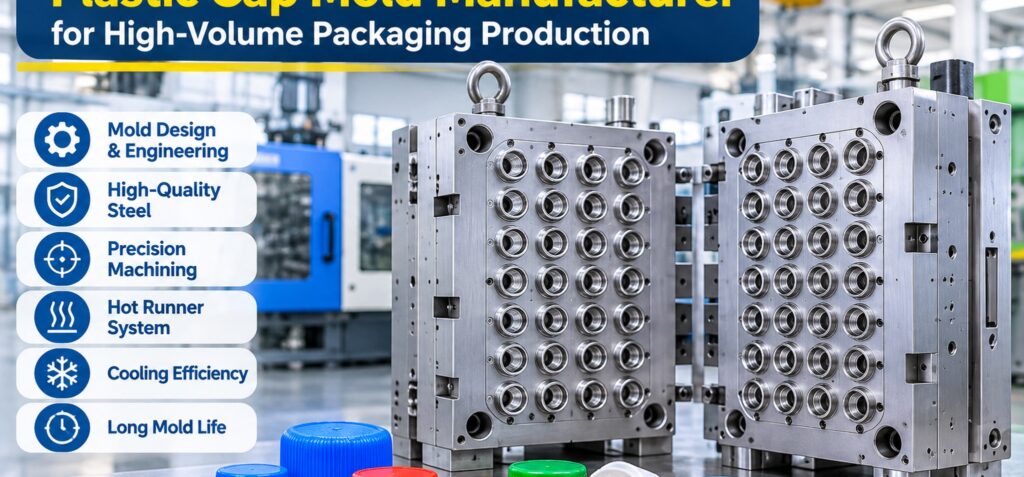
Choosing a reliable plastic cap mold manufacturer is an important decision for businesses involved in beverage packaging, bottled water production, and plastic container manufacturing. The quality of a cap mold directly affects production speed, dimensional accuracy, product consistency, and overall manufacturing costs. Exploring specialized solutions such as Mincong Mould's water and beverage cap mould solutions can help businesses identify suitable tooling for high-volume operations.
In high-volume packaging operations, even minor mold defects can result in thousands of rejected caps, unexpected downtime, and increased production costs. A cap that does not seal correctly can compromise product freshness, create leakage problems, and damage brand reputation.
However, choosing the right supplier involves more than comparing quotations. Factors such as mold design, steel selection, machining precision, hot runner performance, cooling efficiency, and long-term maintenance all influence the success of a packaging operation.
This guide explains how packaging manufacturers can evaluate a plastic cap mold manufacturer and select a solution that supports efficient, reliable, and cost-effective production.
1. Understand Your Plastic Cap Production Requirements
Before contacting a cap injection mold manufacturer, clearly define your product specifications and manufacturing requirements. Different products require different cap designs, materials, and production volumes.
For example, bottled water manufacturers may require lightweight caps designed for specific neck finishes, while beverage producers may need closures with tamper-evident bands and oxygen barrier properties.
Start by identifying the following requirements:
- Cap diameter and overall dimensions.
- Cap height and wall thickness.
- Thread design and neck finish compatibility.
- Required plastic material, such as HDPE or PP.
- Tamper-evident band requirements.
- Daily and monthly production targets.
- Available injection molding machine specifications.
These details help the manufacturer develop a mold that matches the intended application.
It is also important to consider future production requirements. If your business expects increasing demand, selecting a mold configuration that supports expansion can reduce the need for replacement tooling.
2. Evaluate Mold Design and Engineering Capabilities
Mold design is one of the most important factors affecting the performance of a bottle cap mold. A well-designed mold ensures consistent cap quality, efficient production cycles, and reliable long-term operation.
An experienced manufacturer should understand the relationship between cap geometry, material flow, injection pressure, and production speed.
- Cavity layout: The cavities should be arranged to support balanced filling, cooling, and efficient production.
- Thread design: Accurate thread geometry is essential for ensuring that caps fit securely onto the intended bottles.
- Ejection mechanism: The mold should release finished caps without damaging threads, sealing surfaces, or tamper-evident features.
- Gate positioning: Proper gate design helps maintain consistent material distribution and reduces unwanted defects.
- Mold structure: The overall design should provide sufficient strength and stability during repeated injection cycles.
Manufacturers should also consider whether the supplier offers customized engineering. Different bottle designs and closure specifications may require adjustments to cavity design, thread profiles, and ejection systems.
Request technical drawings and discuss your product specifications before approving the final mold design.
3. Choose the Right Mold Steel for Long-Term Performance
Steel selection has a significant influence on mold durability, wear resistance, maintenance requirements, and overall service life.
High-volume cap production involves repeated injection cycles, temperature changes, mechanical movement, and continuous contact with molten plastic.
A reliable plastic cap mold manufacturer should explain which steel grades are suitable for different mold components.
- Hardness: Appropriate hardness helps resist wear during repeated production cycles.
- Wear resistance: Critical surfaces should withstand continuous mechanical contact.
- Corrosion resistance: Important when operating conditions involve moisture or frequent cleaning.
- Heat treatment: Proper heat treatment improves material performance and dimensional stability.
- Machinability: Suitable steel grades allow precise manufacturing and finishing.
Different components may require different steel grades depending on their functions and operating conditions. For example, cores and cavities may use different materials to balance hardness, toughness, and corrosion resistance.
Ask the manufacturer about steel specifications, heat treatment processes, material certifications, and expected maintenance requirements before placing an order.
4. Check Machining Precision and Manufacturing Quality
Machining precision directly affects the quality and consistency of finished plastic caps.
In high-volume packaging production, even small dimensional variations can create problems with cap fitting, sealing performance, and production efficiency.
A professional cap injection mold manufacturer should use appropriate precision machining and inspection processes to maintain accuracy.
- CNC machining: Computer-controlled machining helps produce complex mold components with accurate dimensions.
- EDM processing: Electrical discharge machining is useful for creating detailed geometries and features that are difficult to produce with conventional cutting methods.
- Precision grinding: Grinding helps achieve accurate dimensions and suitable surface finishes on critical components.
- Surface finishing: Proper finishing reduces friction, improves product appearance, and supports reliable ejection.
- Dimensional inspection: Measurement equipment helps verify that manufactured components meet engineering specifications.
Manufacturers should also ask how the supplier checks cavity-to-cavity consistency. For high-cavity molds, maintaining identical dimensions across all cavities is essential for uniform cap quality.
5. Evaluate the Hot Runner System
Hot runner technology plays an important role in many high-volume plastic cap molding applications.
A hot runner system keeps the plastic material in a molten state within heated flow channels before it enters the mold cavities. This approach can reduce material waste and support faster cycle times compared with cold runner systems.
However, the performance of the system depends on its design, temperature control, and compatibility with the selected plastic material.
When evaluating a high cavity cap mold, consider the following hot runner features:
- Balanced melt distribution across all cavities.
- Reliable temperature control.
- Appropriate gate design.
- Consistent injection pressure.
- Durable heating components.
- Accessible maintenance points.
An improperly designed hot runner system can cause uneven filling, material degradation, inconsistent cap weights, and other production problems.
Manufacturers should ask about the hot runner brand, heating configuration, temperature controllers, spare parts availability, and maintenance support before selecting a supplier.
It is also important to confirm whether the system is suitable for the intended PP or HDPE material and production conditions.
6. Prioritize Cooling Efficiency and Shorter Cycle Times
Cooling efficiency is a major factor in determining how quickly a plastic cap mold can complete each production cycle.
After molten plastic enters the cavities, it must cool sufficiently to maintain the required shape and dimensions before ejection.
Poor cooling can cause deformation, dimensional inconsistencies, uneven shrinkage, and longer production cycles.
A properly engineered cooling system should provide balanced temperature distribution throughout the mold.
Manufacturers should evaluate:
- Cooling channel placement.
- Water flow and pressure requirements.
- Cooling distribution across cavities.
- Temperature differences between mold components.
- Heat removal efficiency.
- Compatibility with the factory’s cooling equipment.
Cycle time is closely connected to cooling performance. A well-designed cooling system can help reduce the time required to produce each batch of caps.
For example, consider a 48-cavity mold operating at a 10-second cycle time.
Theoretical hourly production: (48 × 3,600) ÷ 10 = 17,280 caps per hour.
This is the theoretical output before accounting for machine downtime, rejected products, and other production losses.
Manufacturers should not focus exclusively on achieving the shortest possible cycle. The objective should be to achieve a stable cycle that maintains product quality and production reliability.
7. Select the Appropriate Cavity Count
Cavity count determines how many plastic caps a mold can produce during one injection cycle.
A high-cavity configuration can significantly increase production capacity because multiple caps are manufactured simultaneously. However, higher cavity counts also require more precise engineering, balanced cooling, and careful maintenance.
When choosing a high cavity cap mold, consider the following factors:
- Production volume: Select a cavity configuration that meets your expected daily and monthly requirements.
- Machine compatibility: Confirm that the injection machine has sufficient clamping force, shot capacity, and available installation space.
- Mold dimensions: Ensure the mold fits the machine’s platen dimensions and tie-bar spacing.
- Cooling capacity: Higher cavity counts require effective cooling distribution.
- Maintenance requirements: More cavities may increase inspection and maintenance complexity.
A larger cavity count does not automatically guarantee better production efficiency. If the injection machine cannot support the mold, production quality may suffer.
The best configuration is one that balances output, quality, equipment capabilities, and operating costs.
8. Consider Mold Life and Maintenance Requirements
A plastic cap mold is a long-term manufacturing investment. Its performance depends on material quality, machining precision, operating conditions, and regular maintenance.
Regular maintenance helps protect critical mold components and reduces the likelihood of unexpected production interruptions.
Before choosing a supplier, ask about:
- Expected mold service life under defined operating conditions.
- Steel grades and heat treatment.
- Replaceable cores and cavity components.
- Hot runner maintenance requirements.
- Spare parts availability.
- Cleaning and inspection procedures.
- Technical support and repair services.
Manufacturers should establish a preventive maintenance schedule covering cavity surfaces, cooling channels, heating elements, ejection systems, and hot runner components.
Regular inspection can help identify wear, corrosion, blockages, and mechanical problems before they affect finished products.
A mold designed for easier maintenance can reduce servicing time and improve long-term production reliability.
9. Conduct Production Trials Before Final Approval
A production trial is essential before accepting a newly manufactured bottle cap mold.
It allows manufacturers to evaluate actual performance under operating conditions and identify potential issues before the mold enters full production.
During testing, pay attention to the following:
- Cap dimensions: Check diameter, height, wall thickness, and other important measurements.
- Thread accuracy: Verify that caps fit the intended bottle neck correctly.
- Sealing performance: Test whether caps provide the required closure performance.
- Tamper-evident features: Inspect the band structure and separation performance where applicable.
- Cap weight: Compare samples from different cavities to identify variations.
- Surface appearance: Check for flash, sink marks, deformation, and other defects.
- Ejection performance: Confirm that finished caps release smoothly without damage.
- Cycle time: Measure production speed under agreed operating conditions.
- Production stability: Run the mold for a sufficient period to identify recurring issues.
Where applicable, conduct bottle compatibility and leak testing using the intended container and closure specifications.
A reliable manufacturer should provide sample testing, inspection reports, and documented acceptance criteria before final approval.
10. Compare Suppliers Based on Total Production Costs
The initial mold price should not be the only factor when comparing suppliers.
A low-cost mold may create higher expenses through frequent repairs, slower production, material waste, and inconsistent product quality.
Manufacturers should evaluate the complete cost of ownership.
| Cost factor | What to evaluate |
|---|---|
| Initial investment | Mold price and included components |
| Production output | Caps produced per hour |
| Material efficiency | Material waste and cap weight consistency |
| Energy consumption | Heating, cooling, and machine requirements |
| Maintenance | Spare parts and servicing expenses |
| Downtime | Production interruptions and repair time |
| Product quality | Rejected caps and sealing defects |
For example, a slightly more expensive mold may provide better long-term value if it delivers higher stable output, fewer rejected products, and lower maintenance costs.
The objective should be to minimize the cost per acceptable cap throughout the mold’s operating life.
11. Choose a Manufacturer with Reliable Technical Support
Selecting a suitable supplier is just as important as evaluating the mold itself.
An experienced plastic cap mold manufacturer should provide engineering guidance, customization options, manufacturing documentation, and after-sales support.
Before placing an order, consider these factors:
- Experience: Check the manufacturer’s experience in bottle cap and beverage closure mold manufacturing.
- Customization: Evaluate its ability to develop custom mold designs.
- Material knowledge: Check its understanding of PP and HDPE processing requirements.
- Manufacturing capabilities: Review precision machining and quality inspection processes.
- High-cavity production: Confirm experience with high-cavity mold configurations.
- After-sales support: Check spare parts availability, maintenance assistance, and technical communication.
For packaging manufacturers looking for specialized tooling for beverage and water bottle closures, Mincong Mould's water and beverage cap mould solutions can provide a suitable option for high-volume production requirements.
Ask for examples of previous mold projects, relevant technical specifications, and production samples before making a final decision.
Conclusion
Choosing a reliable plastic cap mold manufacturer requires careful evaluation of engineering capabilities, mold materials, machining precision, cooling performance, hot runner systems, and long-term maintenance support.
For high-volume packaging production, manufacturers should prioritize consistent cap quality, stable cycle times, reliable sealing performance, and efficient production costs.
The right supplier will consider the complete production process rather than simply delivering a mold based on basic product dimensions. Proper design, material selection, precision manufacturing, and production trials all contribute to better manufacturing performance.
By comparing technical capabilities and total operating costs, packaging manufacturers can select custom plastic cap molds that support higher productivity, reduced waste, and more reliable long-term production.