
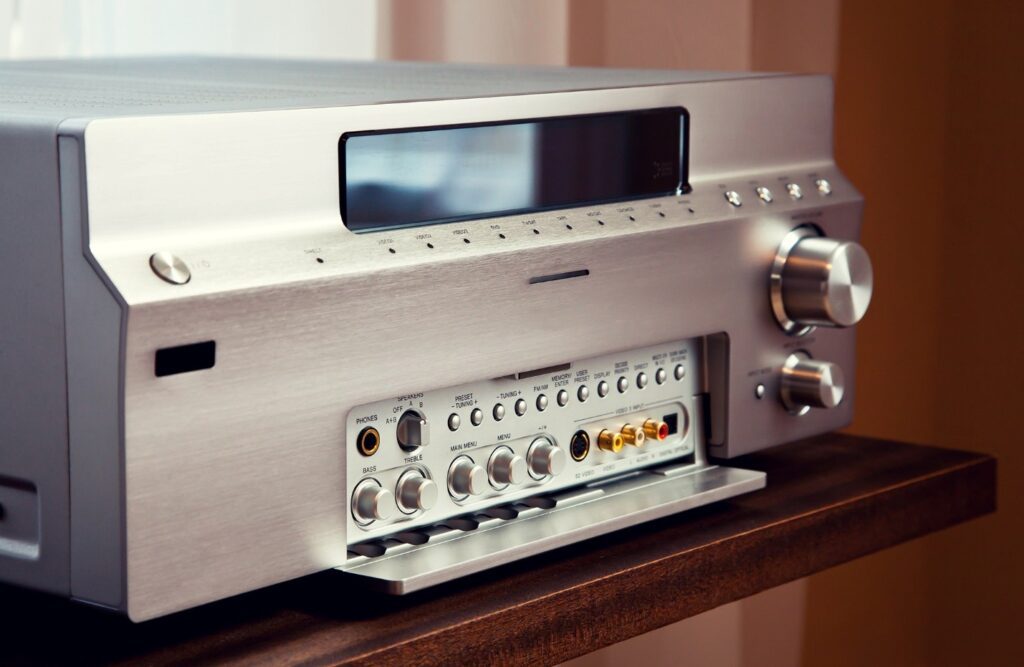
Midrange AV receivers live in that sweet spot where you get serious performance and modern features without falling straight into “I just bought a used car’s worth of electronics.” The challenge is that spec sheets are noisy, marketing is loud, and half the acronyms sound like they were invented to confuse people.
If you’re shopping in the middle of the pack, here is how to cut through the noise and choose a receiver that will actually make your system better, not just more complicated.
Decide how many speakers you really want to run
Start with your speaker layout, not the model number.
Ask yourself what you want your system to look like in the next few years, not just today:
- Are you staying at 5.1 for the long haul?
- Do you want 7.1 or 5.1.2 / 5.1.4 with height speakers for Dolby Atmos?
- Could you see yourself going to 9 channels or adding external amps later?
Most midrange AVRs sit in the 7 to 9 channel zone. If you want immersive formats like Atmos or DTS:X, it makes sense to pick a receiver that supports at least 7 channels, preferably 9, with the option to expand via pre-outs. That gives you room to grow into a 5.1.4 or 7.1.4 layout without replacing the whole brain of the system. If you buy for “just enough” today, you often end up upgrading faster than you planned.
Check the HDMI and video features carefully
On the video side, HDMI is where a lot of people get burned.
For a midrange receiver, you should be looking for:
- HDMI 2.1 support on at least a few inputs
- 4K / 120 Hz for gaming consoles and PCs
- VRR and ALLM if you care about smooth gaming performance
- eARC on the HDMI output, so your TV apps can send full quality audio back to the receiver
Pay attention not just to “has HDMI 2.1,” but how many HDMI 2.1 ports there actually are. If you have a gaming PC, a console and a streaming box, you can run out of full-bandwidth inputs quickly on some models.
A good midrange AVR should be able to act as the central video hub, not just a glorified audio switch.
Don’t ignore room correction
Room correction is one of the most important features on a modern receiver and also one of the easiest to overlook.
Different brands use different systems:
- Denon and Marantz: Audyssey (and sometimes optional Dirac Live on certain models)
- Onkyo / Pioneer / Integra: Dirac Live or proprietary systems
- Yamaha: YPAO
- Anthem: ARC Genesis
The point is the same: your room has a huge impact on what you hear. Good room correction can tame boomy bass, smooth out harshness and make your speakers sound more expensive than they are.
When you compare receivers in the midrange bracket, do not just ask “how many watts.” Ask:
- What room correction system does it use?
- Can I fine tune the results?
- Is there PC or app-based control for more advanced users?
You will hear the difference from the first movie you watch.
Be realistic about power
Receiver power numbers are… optimistic. Almost every spec sheet quotes power in a way that looks impressive but does not reflect real world conditions.
When you compare midrange models, look at:
- Power with multiple channels driven, not just a single channel
- The minimum impedance the receiver is comfortable with
- Whether the brand is honest about partnering with reasonable speaker loads
If you have average sensitivity speakers in a normal sized room, a good midrange AVR will have plenty of usable power. If you are trying to drive very inefficient speakers in a large space, then pre-outs and external amps start to matter more than the printed wattage.
Think about how you actually use the system
Two receivers can look similar on paper but feel very different day to day.
Consider things like:
- Streaming and multiroom: Does it support the services you actually use?
- Phono input: If you spin vinyl, it is nice not to need an external preamp.
- Number of subwoofer outputs: Dual sub outs are common in this price range and can make bass smoother across the room.
- User interface: App control, on-screen menus, setup wizards and presets all affect how often you will want to tweak things instead of leaving it alone out of frustration.
If you game, stream, watch discs and listen to music, a midrange AVR should make all of that easier, not force you into a remote juggling act.
A real-world example: Denon AVR-X3800H
To put this into context, consider something like Denon’s AVR-X3800H. It sits squarely in the midrange tier but checks many of the boxes above:
- 9 powered channels with processing for 11, so you can start modest and expand
- Multiple HDMI 2.1 inputs with 4K/120 support for modern gaming
- Audyssey room correction with the option to go deeper if you want to
- Dual subwoofer outputs, pre-outs and flexible speaker assignment
If you want to see how all those features come together in practice, you can read a detailed breakdown of the Denon AVR-X3800H
The exact receiver you choose will depend on your budget, your room and your brand preferences, but the checklist stays the same: channels, HDMI capability, room correction, real-world power and usability.
Get those right, and your “midrange” AV receiver stops feeling like a compromise and starts feeling like the smartest part of your entire system.
Read More From Techbullion