
Your crypto app is ready, your ads are running, and people are downloading it. But a week later, most haven’t connected a wallet, made a deposit, or completed a transaction.
This means that, somewhere along the way, your crypto app marketing strategy failed.
Before you increase your budget, look at what happened between the ad and the first meaningful action.
Did you reach the wrong people?
Or did users get stuck once they opened the app?
A useful crypto marketing strategy answers these questions. Here is how you can build one, whether you are looking for your first users or trying to lower acquisition costs.
1. Define the User You Want to Acquire
Start with what your app does and who already needs it.
Let’s say you are promoting a wallet that lets people swap tokens on Solana. An active Solana trader who is comparing wallets right now is a far more relevant prospect to test than someone who bought Bitcoin four years ago and rarely looks at crypto.
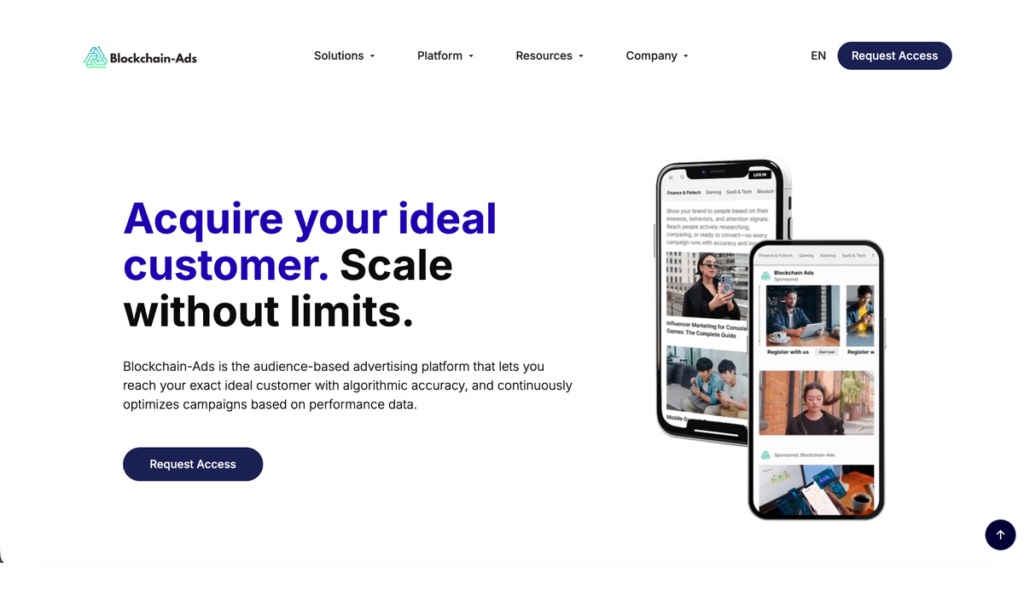
This distinction matters because recent activity is a stronger conversion signal than a one-time interest. Put it to work on Blockchain-Ads, the crypto advertising platform behind Coinbase, Binance and OKX’s user acquisition: start from a segment of active Solana traders, add a segment of people comparing wallets, and keep your own download-page visitors for retargeting. It was the first demand-side platform built for crypto, iGaming and finance, so all three run as one campaign across web and in-app inventory, each reported on its own line.
Use the insight to build your first audience hypothesis:
- What action does your app make easier? Swapping Solana tokens.
- Who already does it? Active Solana traders.
- Why would they try your app? They can use it to manage assets and swap in one place.
You will still need to test the hypothesis, but this gives you a more useful starting point than targeting anyone with a general interest in crypto.
2. Pick a Goal Beyond the Download
An install is useful, but it shouldn’t be the only way you measure acquisition.
Choose an action that shows someone has started using the app after the download. For an exchange, this could be the first trade. For a self-custody wallet, it might be a wallet creation followed by a swap.
Here is what your funnel might look like:
| Stage | Event | What it tells you |
| Acquisition | App install | The ad and store listing attracted interest |
| Registration | Account created | The user started onboarding |
| Activation | Wallet connected or account funded | The user took a step toward using the product |
| Primary conversion | First swap or trade | The user completed the action your campaign targets |
| Retention | Another transaction within 30 days | The user came back |
Choose one primary conversion for each campaign, but track the steps before and after it. If first trades are too infrequent for an initial test, you might optimize toward registrations while checking how many of them eventually trade.
Your crypto marketing plan should also define what counts as a valid conversion.
3. Build a Few Audiences You Can Compare
Separate audiences by the behavior you want to test. For a wallet app, you might create:
- An interest segment of active DeFi and Solana traders
- An intent segment of people comparing wallets
- People who visited your download page but didn’t install
Keep the offer and creative similar across the first three groups. Say you change the audience, offer, and ad at the same time, you won’t know which difference affected the result.
4. Match the Message to the Audience
A person who already swaps tokens doesn’t need a generic explanation of crypto. They need an actual reason to try your app. Remember, your competitors are trying to get these people, too. Being generic won’t help your case.
Compare these messages:
- “Discover the future of decentralized finance”
- “Swap supported Solana tokens from one wallet.”
The first one is generic, almost AI-like, and way too common on the market. It doesn’t share any specific message, does it? The second, on the other hand, gives the user something specific to consider. It also gives you a clear idea to test: does convenience persuade people to install and transact?
Create two or three angles based on actual product strengths. A wallet could test convenience or supported assets. An exchange could test the onboarding experience or available payment methods.
5. Check the Journey after the Click
Before you spend more, go through your campaign on a phone or a computer. Look for places where someone might hesitate:
- Does the landing page match the ad?
- Can users see whether the app supports their country and assets?
- Are fees easy to find?
- Does the app explain why verification is required?
Then check your data. If people install but don’t register, investigate onboarding.
If they register but don’t fund the accounts, look at verification and payment methods, as well as fees.
6. Measure the Cost of Active Users
Set up tracking before you launch. You need to connect campaigns to installs and later in-app actions. Blockchain-Ads’ report The State of Advertising in Crypto, iGaming and Finance 2026 found that 46% of advertisers who configured conversion tracking before the launch reached a first deposit or trade. In comparison, only 24% of those who set it up later achieved this. On Blockchain-Ads, attribution covers 8 dimensions, with automated export and an API, and app events can come in through an SDK, server-to-server or AppsFlyer.
FAQ
How Do You Acquire Users for a Crypto Project?
Find people who already use similar products, show them why yours is worth trying, and track whether they complete a meaningful action.
How Do I Get My First Crypto App Users with Paid Ads?
Start with one market and a relevant audience. Run a small test and measure what users do after installing.
What Tools Can Help with Web3 Wallet Acquisition?
Blockchain-Ads runs a campaign from the first impression to install, sign-up, KYC and the first transaction, on web and in-app. Use mobile analytics alongside it to track in-app actions.
How Can a Blockchain Startup Reduce Acquisition Costs?
Find where users drop off, improve that step, and shift your spending.