
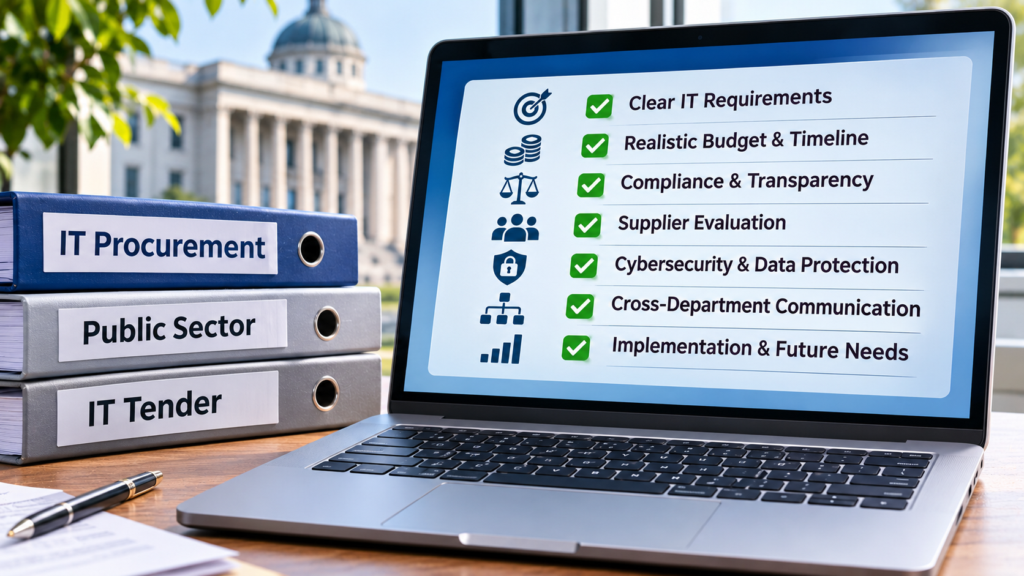
Buying for government IT isn’t an exercise in selecting the technology and signing the contract; A balance of fiscal responsibility and necessity for the technology must be achieved by government agencies, cities, and public institutions to ensure the longevity of their resources and compliance. A simple error in the bidding process might result in additional expenditures, delays in implementation, or legal battles.
For a successful procurement, you must identify the nature of procurement challenges and establish procedures for mitigating such concerns. Everything from identifying the requirements of the project to sourcing must be well planned and choices carefully considered.
Establish Clear IT Requirements Before Starting Procurement
One of the errors made in government IT procurement is putting out a strategy without really understanding what they need formally, and what the company needs as well. Without knowledge of your aims, it will be easier to acquire poor advice from vendors, confusion, and issues at time of delivery.
Therefore, government organizations should start by evaluating their present IT infrastructure before opening themselves to bids to develop a highlight of concerns and defined objectives. It should include the relevant agencies, budget authorities, procurement agents, and technical specialists.
Working with an experienced IT Planner can help public-sector organizations structure technical requirements, prepare procurement activities and create transparency throughout the planning process. Having detailed documentation is also helpful in evaluating supplier offers with uniform criteria.
Avoid Unrealistic Budgets and Procurement Timelines
Technology initiatives in the public sector are notorious for budgeting errors since the initial estimates do not include the expenses of things like license renewals, staff training, and integrating new systems. A seemingly sensible bid during bidding might turn out to be much more costly in practice.
Therefore, the teams dealing with procurement should have in mind the cost of ownership, and not just the cost of the product. This also incorporates future expansion, as well as setup, security, tech support, infrastructure updates, etc.
Unrealistic timelines are more difficult. Formal authorization, seller explanation time, assessment, and contract review are normally necessary for public procurement. Giving adequate time to each phase prevents hasty judgments and reduces the likelihood of errors.
Maintain Transparency and Regulatory Compliance
There are several norms and regulations for public procurement to ensure wise spending and competition. Failure to adopt the guidelines may lead to several types of issues, purchasing problems, and delays of contracts for a vendor.
The strength of this German public procurement is the laws of competition, equality, and fairness. These concepts are followed by the European procurement environment in general and by the German Act Against Restraints of Competition.
Key decisions taken by procuring teams in advance of any bidding need to be recorded, and the rationale behind these decisions must be explained clearly; importantly, the teams need to ask for fair selection criteria. Companies should also ensure that their contract is within national or European procurement standards.
Evaluate Suppliers Beyond the Lowest Price
Selecting a supplier primarily on the basis of price can lead to significant operational and financial risks later in the project. A low-cost solution may not have enough technical support, portability with legacy systems, or capabilities to survive future requirements.
Public organizations should evaluate the technical skills, knowledge, safety, reliability of service, and mode of execution of the supplier. Procurement documentation should match the requirements and criteria for the project.
You should also determine if the vendors can perform routine maintenance and troubleshooting as necessary. With a fair review process, businesses may identify solutions that will provide value in the long run, not simply short-term savings.
Address Cybersecurity and Data Protection Early
Security is often pushed off until the end of IT procurement. Particularly if firms are considering the utility cost and implementation speed, this may lead to security weaknesses that can be expensive or impossible to repair later.
Procurement papers should define data security and control of access, encryption, incident response, and regulatory considerations. In the case of public organizations, when citizens’ private information is involved, consideration should be given to how potential sources store, analyze, and secure data.
Moreover, internet infrastructure, people accountable for security events, software updates, and freelancers should also be taken into consideration by security assessments. Early evaluation of these minimizes errors and leads to more reliable use of technology.
Prevent Communication Gaps Between Departments
IT initiatives include government agencies with diverse agendas. A procurement team preoccupied with adherence to regulations, an IT team focused on technological integration, and administrative departments concerned with finances and delivery of services.
If these groups function in isolation, they might overlook or misperceive crucial needs. Regular meetings, shared documentation, and an awareness of everyone’s role may keep the procurement process on course.
The addition of a lead project manager may continue communication and further ensure that decisions, technical modifications, and inquiries about suppliers reach the correct place.
Plan for Implementation and Future Technology Needs
Do not only finish the bidding procedure, since this alone will not ensure the success of a technological project. If the contracts do not include delivery targets, acceptance processes, training programs, and performance goals, then issues might occur throughout implementation.
Public agencies should establish realistic targets and create test processes before final acceptance. Contracts should include maintenance, service continuity, data transfer, and exit from the vendor relationship.
Pay special attention to future expansion. The technology we purchase must be able to evolve with the firm as digital services and management load also change without the requirement to implement a new replacement.
Conclusion
Planning ahead, having a procedure and understanding the budget, and planning good inter-departmental collaboration can save you from the usual pitfalls of public sector IT bids. Clearly defined goals and well-planned seller assessments can assist in minimizing purchasing risks and improving practical and financial outcomes.
Public institutions may buy IT with due regard to compliance and cybersecurity issues, implementation plans, and sustainability of technology to develop IT systems for dependable public services and appropriate public spending.