
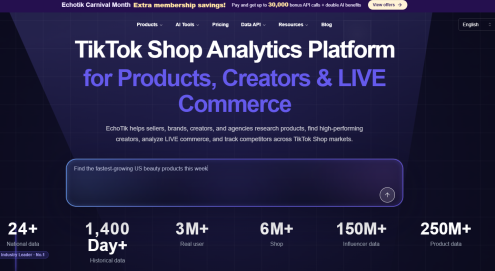
EchoTik is a TikTok Shop analytics platform that helps sellers, brands, creators, and agencies research products, compare shops, discover creators, and understand TikTok commerce trends through public data.
TikTok Shop moves quickly. A product can gain attention in a few days, attract hundreds of creators, and then lose momentum just as fast. For sellers and brands, the challenge is not simply finding a product that is trending. The real challenge is deciding whether that trend is strong enough to build a business around.
That is why many teams are starting to use data before committing to a product, creator, or campaign. Platforms such as EchoTik help TikTok Shop users study product performance, creator activity, shop trends, and LIVE commerce signals in one place.
Viral does not always mean profitable
A product may receive millions of views without generating consistent sales. It may also be promoted by many creators while having weak conversion, poor pricing, or limited repeat demand.
Before choosing a product, sellers should look at several signals together:
- Recent sales activity
- Estimated revenue and GMV
- Product price changes
- Number of active creators
- Video and LIVE performance
- Category competition
- Historical demand trends
Looking at these signals together gives sellers a clearer view of whether a product is growing steadily or simply experiencing a short-term spike.
Product research should start with comparisons
One product rarely tells the full story. A stronger research process compares similar products within the same category.
For example, a seller researching beauty products may compare:
- Units sold over a recent period
- Estimated sales value
- Number of creators promoting each product
- Average product price
- Video performance
- Shop ratings and activity
- Changes in demand over time
This comparison helps answer a more practical question: is the product itself performing well, or is one individual video responsible for most of the attention?
With a product research dashboard such as EchoTik’s Shop analytics tools, sellers can review product and shop signals before spending money on inventory, advertising, or creator partnerships.
Creator data helps sellers choose better partners
The largest creator is not always the best creator for a campaign. A creator with a smaller audience may generate stronger engagement, better product relevance, or more consistent sales.
When evaluating creators, sellers should consider:
- Audience size and recent growth
- Average video views
- Engagement rate
- Product categories
- Previous promotional activity
- LIVE performance
- Audience location
- Consistency across multiple posts
This is especially important for brands entering the US TikTok Shop market. A creator may have a large global audience, but the campaign may perform poorly if most viewers are outside the seller’s target market.
Creator research allows brands to move beyond follower count and focus on audience fit and commercial potential.
Shop and competitor analysis reveal what is already working
A seller can also learn from competing shops. Instead of copying a competitor’s content, the goal is to understand the business pattern behind its performance.
Useful questions include:
- Which products generate the most sales?
- Which creators are driving product exposure?
- Are sales coming from product pages, videos, or LIVE sessions?
- How often does the shop introduce new products?
- Which categories appear to be gaining momentum?
- Are competitors competing mainly on price, creator reach, or product selection?
This type of research is useful for both new sellers and established brands. New sellers can identify gaps in the market, while established brands can compare their product and creator strategy with similar shops.
Public data still requires careful interpretation
Third-party analytics platforms do not replace a seller’s private store data. Public signals can help users identify trends, compare competitors, and create better research shortlists, but estimated sales, GMV, and engagement figures should be treated as directional information.
The best approach is to use public data for discovery and validation, then confirm important decisions through the seller’s own product margins, order data, advertising costs, and customer feedback.
This is where tools such as EchoTik’s pricing and analytics platform can support the early research process. They help users narrow down opportunities before moving to more expensive steps such as inventory purchases, paid campaigns, or long-term creator contracts.
A practical workflow for TikTok Shop research
A simple workflow can look like this:
- Identify several products within a growing category.
- Compare their recent sales and creator activity.
- Review the shops already selling those products.
- Check whether demand is stable or driven by one viral post.
- Find creators whose audience matches the target market.
- Test a small campaign before increasing inventory or ad spend.
- Recheck the data as the category changes.
This process does not guarantee that every product will succeed. It does, however, reduce the chance of making decisions based only on views, follower counts, or short-term hype.
Final takeaway
TikTok Shop sellers do not need more data for its own sake. They need the right data at the right stage of the decision-making process.
Product data helps identify demand. Creator data helps evaluate partnerships. Shop analysis helps reveal competitive patterns. LIVE and video data show how attention is turning into commercial activity.
Used together, these signals give sellers a more realistic way to research opportunities and decide where to invest next. For teams looking to combine product, creator, shop, and TikTok commerce research, learn more about EchoTik.