
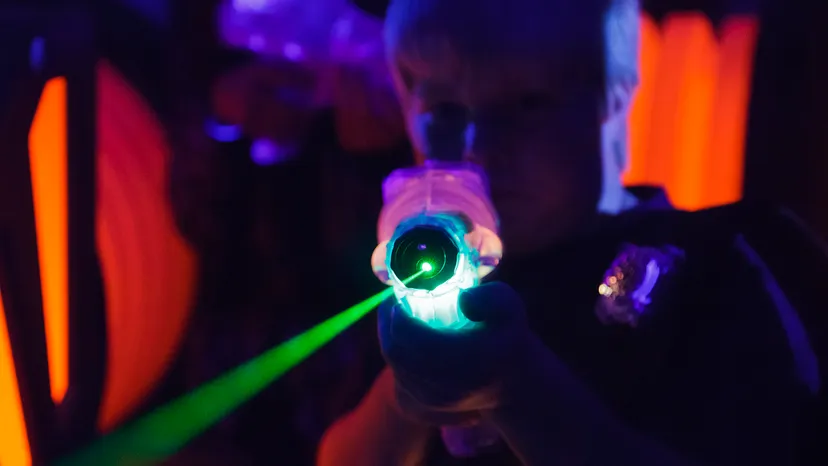
Laser tag has come out of an arcade fun game in the past to an advanced combination of optics, electronics, and game technology. One fundamental aspect of the game is hit detection. The amazing engineering that has been employed in designing laser tag systems makes one understand how the game is played to record a hit, be it infrared (IR) or visible light technology. This article provides a general overview of how laser tag detects hits with the help of infrared and Visible Light Technology.
Laser Tag Core Concept of Hit Detection
Laser tag guns release pulses of light to the targets that players are wearing. A hit is recorded when a pulse is detected by the sensors on the gear that the opponent has. Most of the traditional laser tag guns are the so-called type of guns that do not actually shoot lasers, despite the common belief. They use infrared (IR) light or visible light LEDs, which are coded with digital data to identify players uniquely, to record hits, and to upgrade scores in real time. The system is based on its effectiveness and depends on:This kind of light-based tracking system is also echoed in modern recreational gear like nerf blasters, which are often explored by enthusiasts looking for gear upgrades and accessories similar to those found at M416 Gel Blaster.
- Light transmission
- Signal encoding
- Sensor precision
- Physical obstacles (e.g., lighting, fog, surfaces)
Infrared Technology in Laser Tag
How It Works
The commercial laser tag systems are dominated by infrared technology. The gun is firing bursts of infrared light-like that of the TV remote control-that is not visible to the human eye. Coded information, like an ID of the player or team color, is included in these bursts. The sensor reads through the information when it is hit by the IR beam and sends a message to the central system, which records a hit immediately to the target.
Advantages of Infrared Technology
- Invisible Beam Makes Things More Real: Gamers cannot view the IR beam, hence gameplay becomes more immersive and tactical.
- Low Power Consumption: The IR LEDs are low power-consuming, hence the batteries have a long life span, which is important in arena applications.
- Data Communication Ability. The data packets, which are encoded onto the beams of infrared, can contain a lot more information; that is, the system can not only monitor hits but also who shot and what mode of the weapon has been used.
Laser Tag Visible Light Technology
How It Works
These systems incorporate visible light, such as usually coloured LEDs or weak laser diodes, to promote visual interaction. The beams can be used in conjunction with infrared encoding. In other designs, the visible light is simply cosmetic and the reality of the hit detection occurs by a complementary IR beam.
Advantages of Visible Light
- Visual Satisfaction: Players can look at the beam physically, and this makes it more futuristic and film-like.
- Increased Interactions among Younger Audiences: The effects that are visible make playing more enjoyable and easier, particularly when played in family and entertainment centers.
- Useful for Outdoor Play: Powerful visible light beams can be more easily observed during the day, and they enhance visual tracking of shots.
Comparison between Infared Technology and Visible Light Technology
| Feature
|
Infrared Technology | Visible Light Technology |
| Beam Visibility | Invisible | Visible colors (red, green, blue) |
| Accuracy | Very precise | Good, but affected by scattering |
| Data Encoding | Outstanding | Limited and requires a beam setup |
| Usage | Professional laser tag arenas | Recreational systems |
| Power Efficiency | High | Moderate to low |
Conclusion
The infrared and visible light technologies are essential in the laser tag systems, although infrared is the industry gold standard in terms of accuracy in the hits. More recent models of laser tag equipment typically feature some form of hybrid technology, with infrared actually hit detection and visible light being used just as visual feedback.